
Severe technology outages affecting major banks, businesses and government agencies could persist for months as investigators struggle to identify the source of the disruption, a cybersecurity expert has warned.
A wave of technical failures has disrupted industries across the country and fueled concerns about a coordinated cyberattack. The turmoil began with a nationwide ground stop ordered by the Federal Aviation Administration on November 13, which brought air travel to a standstill.
Since then, disruptions have spread across email services, banks, online retailers and other critical platforms.
Government officials have said there is no evidence of a cyberattack, attributing the outages to organizations updating outdated systems and addressing software vulnerabilities.
Still, many Americans remain uneasy as problems affecting email providers, banks, retailers and other services continue. The disruption may not be over, according to David Kennedy, a former National Security Agency (NSA) hacker.
‘It’s going to be bumpy for the next six months,’ Kennedy told the New York Post. ‘I’ve never seen so many service outages in a week’s span in my entire life.’
Kennedy questioned the government’s assurances that cyberattacks were not responsible, saying the outages displayed several characteristics associated with an attack.
‘The combination of timing, the volume, the companies, and the industry verticals that were in play is definitely very suspicious to me, are very much what an adversary would go after,’ Kennedy said.
The cybersecurity expert warned that US adversaries, including Iran and China, could be testing American systems ahead of a potentially larger attack.
Kennedy said China appeared the most likely potential culprit because its leadership plans over decades and could seek to disable US infrastructure if Beijing moved to invade Taiwan.

Former NSA hacker David Kennedy described the recent US technology disruptions as ‘very suspicious’ and warned they could continue ‘for the next six months’

Recent outages affecting the NSA, other government agencies and numerous private companies have left Americans increasingly concerned
Lisa Palmer, CEO of AI firm Neurocollective.Ai, told the Post that she was also worried malicious actors could be using artificial intelligence to attack services Americans depend on. She said many organizations are poorly prepared for such threats.
‘I particularly worry about certain government agencies that are underfunded – and that includes local and state government agencies,’ Palmer said.
Kennedy stressed the potential power of AI to identify and exploit cybersecurity weaknesses.
‘I’ve been a hacker for 25 years, and [AI] hacks better than I can,’ he said.
He added that AI is especially effective on the offensive, meaning companies that cut costs by replacing employees with automated systems could leave their networks more exposed.
IN CASE YOU MISSED IT: Ex-Husband Who Fatally Shot His Former Wife Gets Lenient Plea Deal
Justin Cappos, a professor at NYU’s Tandon School of Engineering, offered a different assessment. He told the Post that most of the recent outages were likely linked to software upgrades or the integration of AI.
Although his explanation differed from Kennedy’s, Cappos likewise warned about the risks of replacing human workers with artificial intelligence.
‘If you’re going to be doing things like integrating AI into systems and laying off people, then you do need to be very concerned about what impact this is going to have,’ Cappos said.

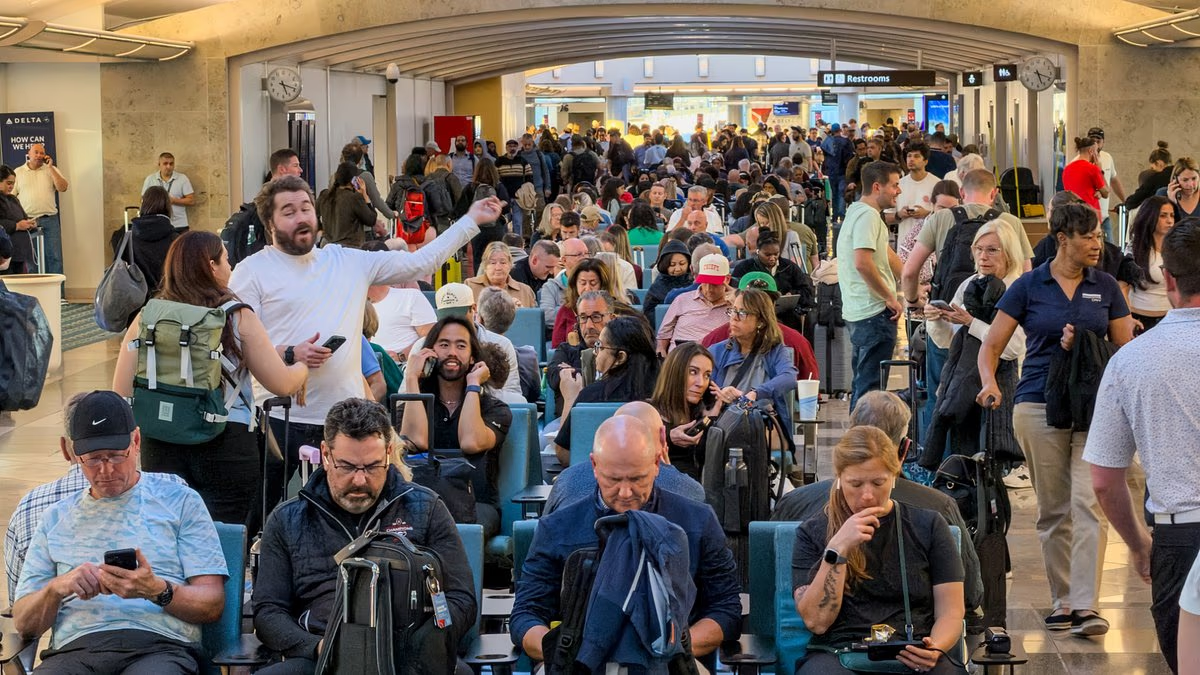
People wait at Orlando International Airport during a nationwide ground stop, one of the first in a series of major technology outages
JS Nelson, a University of Pittsburgh law professor who specializes in cybersecurity, told the Post that the actual cause of the outages remains uncertain.
Nelson said the disruptions could stem from several sources, including foreign actors, software updates or AI integration that caused systems to behave in unforeseen ways.
Whatever the cause, even if foreign adversaries are involved, Kennedy urged the public not to panic. ‘We’re going to be able to handle it. I don’t think it’s going to be catastrophic or the end of human civilization or the United States or things like that,’ he said.
The experts spoke days after the latest major outage, reported Tuesday, when Apple said customers were experiencing problems accessing iCloud, Apple Pay and other services.
The $5 trillion company attributed the disruption to an internal update.
That same day, the NSA’s highly classified communications system for sharing intelligence on terrorists also went offline.
The agency said there was no sign of a cyberattack and blamed the outage on ‘software updates for vulnerabilities in PHP,’ the older scripting language used by the system.
In the preceding days, JPMorgan Chase customers reported difficulty accessing their accounts and completing transactions. United Airlines, Workday and Microsoft also reported outages between November 12 and November 16.

The NSA’s classified communications system for sharing terrorist intelligence went down last week. The agency’s headquarters in Maryland is pictured
Company and government officials said none of those disruptions resulted from cyberattacks. However, the FBI and NSA separately warned last week about malicious hacking activity.
On Tuesday, the FBI issued a flash warning about an AI platform called ARTEX, which cybercriminals and state-aligned hackers have allegedly ‘weaponized’ to automate attacks against businesses and organizations worldwide.
An NSA official also warned that ‘malicious cyber actors’ had targeted Department of War employees with malware designed to attack personal computers when users inserted their common access cards into connected card readers.
The official described the operation as a ‘watering hole’ or ‘drive-by’ technique that could provide access to anything the cardholder would normally be authorized to use. ‘It is a significant concern,’ the official said.