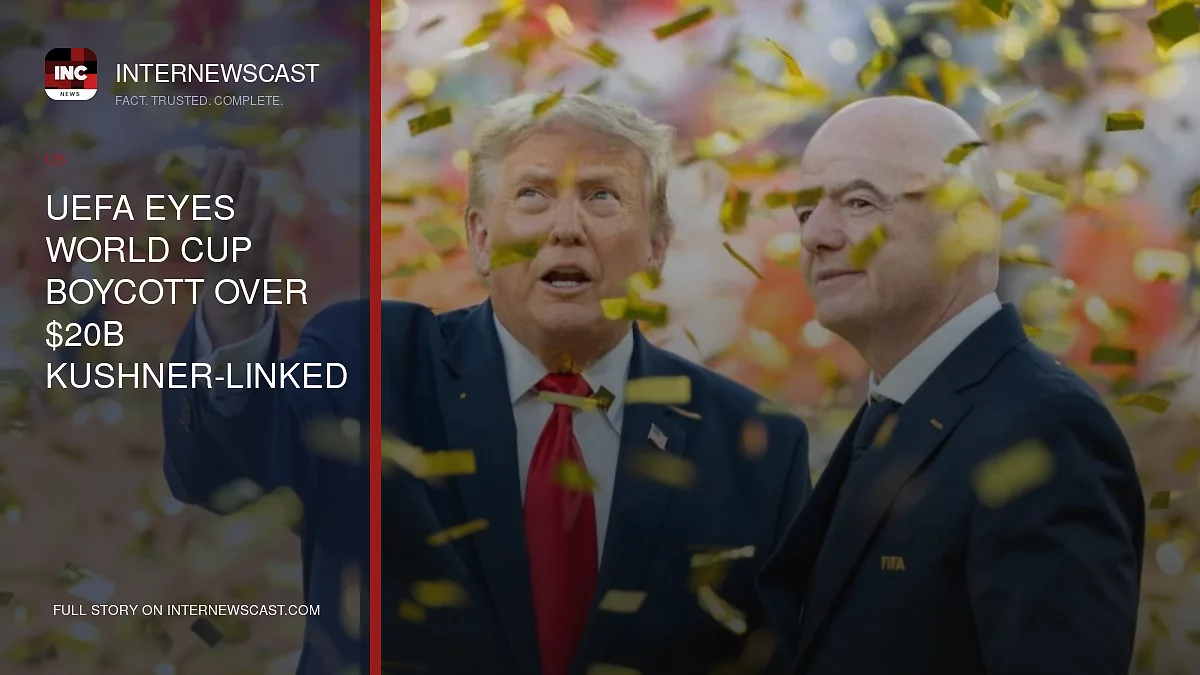

UEFA, the 55-nation governing body for European soccer, is preparing to boycott the World Cup and other FIFA-run tournaments in response to what insiders describe as a $20 billion Wall Street-style push to reshape the sport’s global commercial structure, sources familiar with the discussions told The Post.
The proposed boycott plan is expected to be formally approved Thursday during emergency talks staged from Switzerland, with proceedings scheduled to begin at 9 a.m. Eastern. Under the blueprint, European national teams would pull out of “all FIFA competitions” overseen by the Zurich-based nonprofit.
European soccer leaders, angered by FIFA President Gianni Infantino’s forceful efforts to further commercialize the international game, are said to be “very confident” they can rally “a landslide majority” of “more than 50 countries” to oppose his proposal, according to people briefed on the matter.
One source suggested the vote “could even be a clean sweep,” despite the Czech soccer association’s chief initially signaling support for the privatization concept.
Should UEFA move ahead Thursday, the decision would thrust FIFA into what could become the gravest institutional crisis in its 122-year history.
A European boycott would mean the 2030 World Cup taking place without heavyweight nations such as England, France, Spain and Germany — countries that, between them, have won every men’s World Cup but one since 2006.
Stripped of Europe’s elite players and its most lucrative broadcast markets, the World Cup would be severely weakened, potentially undercutting Infantino’s multibillion-dollar pitch to investors before it can gain traction.
The threatened boycott would cover the men’s and women’s World Cups, youth tournaments and the expanded Club World Cup, FIFA’s global competition featuring leading clubs from each continent.
However, European teams would continue playing in regional tournaments completely controlled by UEFA, such as the money-spinning Champions League and the European Championship.
Infantino’s controversial scheme aims to bundle the World Cup’s massive broadcasting, ticketing, and sponsorship rights into a new private subsidiary dubbed FIFA Forward Enterprise.
“He’s struggling to keep it together,” said one source close to UEFA of Infantino. “The one thing that’s unifying about him is that everyone hates him. But he’s so deluded is that he doesn’t think that’s true.”
The move marks a stunning escalation in the sport’s global civil war amid anger over a multibillion-dollar deal set to line the pockets of a private equity group close to President Trump’s in-laws, the Kushner family.
Infantino’s private equity plan, in which US banking giant JPMorgan is reportedly playing an advisory role, still needs approval from FIFA’s 211 member nations, including the United States.
READ MORE: Suri Cruise, 20, Takes the Stage for Shakespeare Acting Debut
If passed, Thrive Eternal — an American venture capital firm founded by Joshua Kushner, brother of Trump son-in-law Jared Kushner — is expected to lead the investor group and snap up a 20% stake for just over $4.2 billion.
The Post has sought comment from UEFA, FIFA, Thrive Capital and JPMorgan.
Infantino has struck up a close relationship with the current commander-in-chief, even awarding him the inaugural FIFA Peace Prize after he failed to win the Nobel Peace Prize.
The boycott threat follows weeks of intense scrutiny over the relationship between the two men.
Earlier this month, Trump admitted he directly called Infantino to demand FIFA review a red card issued to American striker Folarin Balogun during the World Cup, a move that successfully overturned the player’s mandatory suspension.
To sweeten the deal, Infantino is dangling a massive payday. The former lawyer is promising to hike development payouts for smaller federations from $8 million to a whopping $20 million through 2030, branding the cash grab as the “democratization” of soccer.
But the backlash has spilled from the sports pages into the halls of government across Europe, with politicians furious over the blatant corporatization of a cultural institution.
“Let me say this very directly. Football does not belong to investors,” left-wing British Prime Minister Andy Burnham thundered on social media Wednesday. “The World Cup is not a product. It is the greatest competition in world sport, and it was never anyone’s to sell.”
EU Sports Commissioner Glen Micallef took a thinly veiled shot at American corporate sports culture, telling reporters: “This isn’t baseball. The FIFA World Cup remains the greatest sporting tournament on the planet. The relentless commercialization of football has become corrosive.”
Because FIFA operates as a massive business in Europe, it must obey the European Union’s strict anti-monopoly laws. Recent EU court rulings made it clear that sports organizations cannot use their power to act like illegal monopolies and break free-market rules.
Even the typically reserved English Football Association threw its weight behind the boycott, slamming FIFA’s “lack of process and governance.” Hans-Joachim Watzke, vice-president of Germany’s soccer association and the former CEO of German giants Borussia Dortmund, echoed the continent’s fury, calling the private equity play an “outright attack on football.”
Infantino has already caused consternation among some European supporters by defending “dynamic pricing” that left fans shut out of stadiums due to skyrocketing ticket costs.
And this is not the first time European nations have poured scorn on his bid to bring private money into the game.
In 2018, Infantino floated a massive $25 billion deal with a consortium including Japan’s SoftBank to launch a revamped Club World Cup and a new global Nations League, but the proposal was swiftly abandoned due to intense pushback from UEFA.
The next men’s FIFA World Cup, scheduled for 2030, will be primarily hosted by Spain, Portugal, and Morocco. To mark the centenary of the tournament, the opening three matches will be played in South America, hosted by Uruguay, Argentina, and Paraguay. The most recent World Cup took place in 2026, jointly hosted by the United States, Mexico, and Canada