
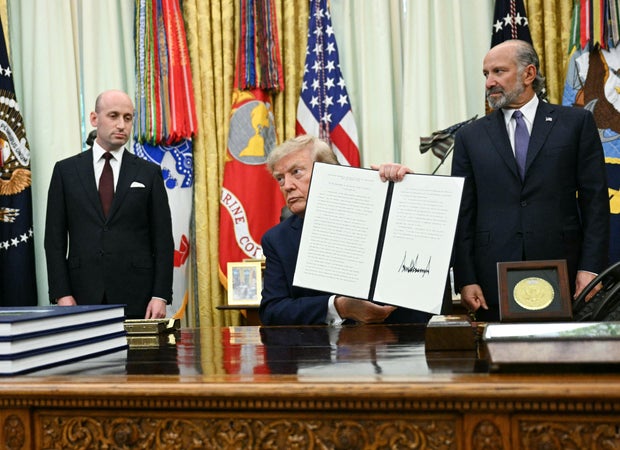
Washington — President Trump moved Thursday to revive his push against birthright citizenship, signing two new executive orders aimed at denying U.S. citizenship to certain children born on American soil. The action comes after the Supreme Court struck down his earlier executive order seeking to end automatic citizenship for some U.S.-born children.
Speaking from the Oval Office during the signing, Mr. Trump criticized the high court’s ruling. “We had a very unfortunate decision in the Supreme Court concerning birthright, it was close,” he said. “But a very, very unfortunate decision. So we’re making adjustments.”
According to White House deputy chief of staff Stephen Miller, one order is designed to crack down on commercial “birth tourism,” while the other broadens the categories of people whose children would not qualify for birthright citizenship. That includes, he said, children born to foreign nationals who lobby in the United States on behalf of foreign governments.
Miller said the issue of “birth tourism” has been debated in Washington and beyond for “not only years, but for decades.”
He described the practice as people entering the country under the guise of tourism — claiming they plan to visit Disneyland, a monument or a national park — while actually intending to give birth in the United States so their child receives automatic citizenship. Miller argued that, under what he called a “broken system,” that status can eventually open the door to public benefits, voting rights and other privileges tied to American citizenship.
Axios was first to report that Mr. Trump planned to sign the new executive orders.
Mr. Trump has repeatedly objected to birthright citizenship, making it a recurring theme in his broader immigration agenda. He and his supporters have argued that the constitutional provision was meant to address the legacy of slavery rather than grant citizenship broadly to children born in the U.S. to noncitizen parents.
“This was done right after the Civil War,” Mr. Trump said Thursday. “This was for the babies of slaves.”
The 14th Amendment, ratified in 1868, states “all persons born or naturalized in the United States, and subject to the jurisdiction thereof, are citizens of the United States and of the state wherein they reside.”
Jim WATSON /AFP via Getty Images
The Supreme Court ruled 6-3 that the president’s first executive order, which he issued on his first day in office in 2025, was unlawful and out of step with the 14th Amendment.
Asked if he thinks these new executive orders will pass constitutional muster, the president said, “I think it will.”
“Birth tourism” came up during Supreme Court oral arguments. In regard to that issue, Chief Justice John Roberts told the U.S. solicitor general, John Sauer, “You do agree that that has no impact on the legal analysis before us.” Sauer said that such tourism is evidence of the negative effects of the prevailing interpretation of the Citizenship Clause.
“We’re in a new world now … where 8 billion people are one plane ride away from having a child who is a U.S. citizen,” Sauer said.
“Well, it’s a new world. It’s the same Constitution,” Roberts replied.
Melissa Quinn
contributed to this report.


