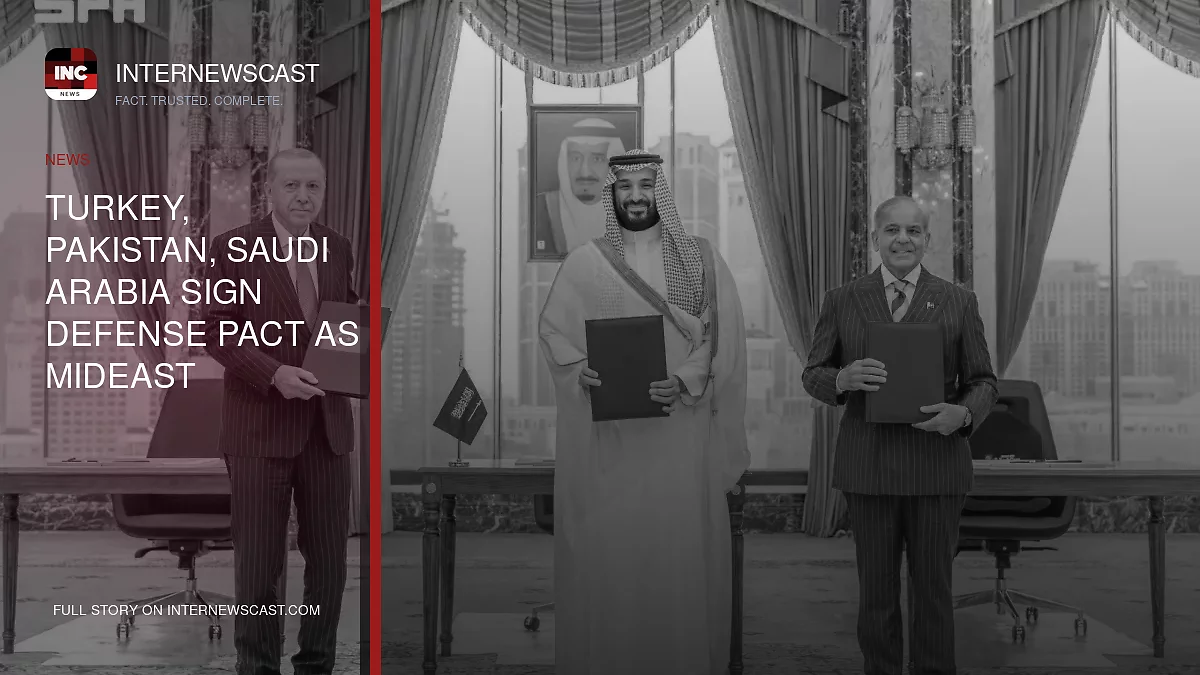

Pakistan, Turkey and Saudi Arabia have entered into a new mutual defense pact, even as Iran-backed Houthi fighters intensify strikes on targets connected to the Saudi kingdom.
Here are the key Middle East developments unfolding on Friday.
Pakistan, Turkey and Saudi Arabia sign a mutual defense agreement
Saudi Arabia, a major oil power, Pakistan, a nuclear-armed state, and Turkey, home to NATO’s second-largest military and an expanding defense sector, formalized the mutual defense agreement on Friday.
Under the terms of the accord, any armed assault on one of the three nations would be treated as an attack on all of them.
Pakistan’s foreign ministry said the agreement was signed in Saudi Arabia during talks involving Saudi Crown Prince Mohammed bin Salman, Turkish President Recep Tayyip Erdogan and Pakistani Prime Minister Shehbaz Sharif.
In a statement, the ministry said the pact is designed to reinforce “collective deterrence” against any act of aggression.
The move comes as Saudi Arabia seeks to broaden its security alliances, following repeated threats and attacks on its vital infrastructure and oil facilities amid wider regional tensions linked to Iran.
Houthi rebels blamed for attack on eastern Yemen
Meanwhile, Iran-aligned Houthi rebels launched fresh attacks Friday morning in Yemen’s eastern Marib province, marking another escalation with Saudi-backed forces, according to a military official from the Marib forces.
The official, who spoke on the condition of anonymity because he wasn’t authorized to speak to the media, said the missiles were fired from west of the Yemeni capital, Sanaa.
Local resident Khaled Masbih told The Associated Press that Houthi missiles struck multiple areas across the city, causing an unknown number of casualties. The Houthis did not claim the attack.
Separately, the rebel group struck the Najran region in southwestern Saudi Arabia near the Yemeni border on Thursday, the official spokesperson of the Saudi-led Coalition to Restore Legitimacy in Yemen, Maj. Gen. Turki al-Malki, confirmed in a statement on X overnight.
He said the attack wounded 11 civilians, including a woman and a child who suffered second-degree burns, and accused the rebels of carrying out “indiscriminate shelling against civilian objects.”
The rebel group did not claim responsibility for the attacks in Marib or Najran. A spokesperson for the Houthis, Nasruddin Amer, said on X on Friday that the group will continue to target gatherings of Saudi-backed forces.
The attacks mark a major escalation since a truce in 2022 largely halted fighting.
The civil war pits the Iran-backed Houthis against a Saudi-led coalition allied with Yemen’s internationally recognized government.
Israeli strike wounds Lebanese soldier
The Lebanese army said the soldier was lightly wounded on Friday while he was in a bulldozer opening roads in the southern village of Mansouri.
Mansouri was subjected to Israeli shelling earlier this week, according to Lebanon’s state news agency.
There was no immediate comment from the Israeli military.
The Israeli army launched strikes Wednesday in southern Lebanon in response to what it described as Hezbollah’s violation of the ceasefire and called on residents of Mansouri to flee — the first such warning Israel has issued in Lebanon for weeks.