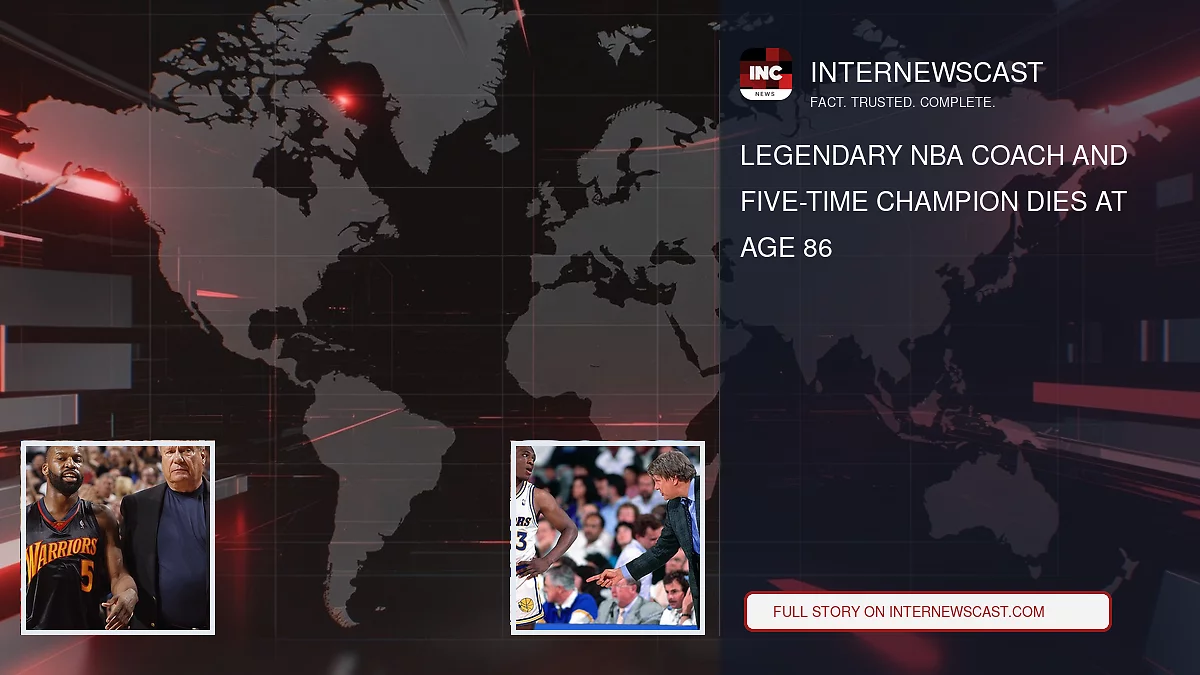

Don Nelson, the Hall of Fame basketball figure regarded as one of the most influential coaches in NBA history and a five-time champion as a player with the Boston Celtics, has died at 86.
The Dallas Morning News reported that Nelson suffered a stroke three weeks earlier and had recently been moved into hospice care.
His family said in a statement that he was with those closest to him when he died. “On Sunday morning our beloved husband, dad, grandfather and great-grandfather Don Nelson peacefully went to be with the Lord, surrounded by his loving family,” the statement said.
“Throughout his last week, friends and family encircled him with love, sharing the blessing of his friendship and revisiting treasured memories.”
Although Nelson built a championship résumé as a player, his name became most closely linked to coaching innovation and longevity. For 12 years, he stood as the winningest coach in NBA history before former San Antonio Spurs coach Gregg Popovich moved past him. Nelson remains one of just 11 coaches to reach 1,000 career victories, and he is widely remembered as perhaps the greatest NBA coach never to lead a team to the Finals.
Before his long career on the sidelines, Nelson spent 14 seasons in the NBA as a player and became an important part of the Boston Celtics’ title-winning teams of the late 1960s and 1970s.

Don Nelson, an NBA coaching legend, has died at the age of 86

Nelson held the title of winningest coach in NBA history for years before being surpassed in 2022

Nelson was inducted into the Basketball Hall of Fame in 2012 and is second all-time in wins
Born in Michigan, Nelson grew up in the Illinois portion of the Quad Cities region. Despite a lack of recruitment, Nelson went on to play for the University of Iowa.
Nelson was a star for the Hawkeyes, being named a third-team All-American in 1962 and an Honorable Mention in 1961.
After graduating college, he was selected in the third round with the 17th overall pick of the 1962 NBA Draft by the Chicago Zephyrs. He was then waived by the team before they moved to Baltimore – where they became the Baltimore Bullets (now the Washington Wizards).
The Los Angeles Lakers claimed Nelson off waivers. He played for the team for two seasons and made the playoffs each year – including reaching the 1965 NBA Finals, where the Lakers lost to the Celtics.
Nelson then signed with the Celtics that offseason after becoming a free agent. He would go on to spend eleven seasons at the Boston Garden, playing alongside Hall of Famers Bill Russell, Sam Jones, Satch Sanders, John Havlicek, Jo Jo White, Dave Cowens, Paul Westphal, Don Chaney and KC Jones among others across his career.
Across his time in Boston, Nelson carved himself a role as a sixth man and is considered one of the greatest sixth-men in NBA history.
Nelson would win five NBA titles in Boston in 1966 (his first season with the team), 1968, 1969, 1974 and 1976.
Two years after his playing career ended, the Celtics retired his No. 19 – which now hangs in the rafters at TD Garden.

After graduating from Iowa, Nelson (L) played for the Chicago Zephyrs and Los Angeles Lakers

He would sign with the Boston Celtics in 1966 and stayed there for a decade, winning 5 titles

Nelson carved a role for himself as a six-man and is considered one of the best in NBA history
Nelson’s career as a coach and executive began in 1976 as an assistant with the Milwaukee Bucks under Larry Costello. After Costello resigned just 18 games into the season, Nelson became the team’s head coach.
Throughout his tenure with the Bucks from 1977 to 1987, Milwaukee made the playoffs in all but two seasons. However, they never went further than the conference semifinals.
It was with Milwaukee that Nelson began to develop a system of play that would be branded as ‘Nellie Ball’ – a run-and-gun style that relied on smaller, but more athletic players to create mismatches and demanded a high volume of 3-point attempts.
Nelson resigned as head coach of the Bucks in 1987, in part due to a rift with team owner Herb Kohl. After fielding offers from multiple teams, he chose to join the Golden State Warriors – which had been bought by the former Bucks owner Jim Fitzgerald.
His Warriors teams were highlighted by an unconventional lineup using three guards – Mitch Richmond, Tim Hardaway Sr, and Sarunas Marciulionis while deploying Chris Mullin at forward.
Much like in Milwaukee, Nelson’s Warriors never made the NBA Finals – going to the conference semifinals twice. He resigned after 45 games in the 1994-95 season.
In the 1994 offseason, Nelson took the helm of Team USA for the FIBA World Championships in Toronto. The Americans beat the Russians in the final 137-91 to give Nelson his only major career title.
After leaving Golden State, Nelson went to the New York Knicks for an ill-fated stint that lasted just 59 games in the 1995-96 season. He was fired despite having a winning record and was replaced by assistant Jeff Van Gundy.

Nelson’s coaching career began with the Milwaukee Bucks, where he coached from 1976-87

From there, he coached the likes of Mitch Richmond with the Golden State Warriors
A year later, Nelson became the head coach and general manager of the struggling Dallas Mavericks. In 1998, his first full off-season at the helm, he pulled off draft-day trades with the Bucks and Phoenix Suns to acquire the draft rights to Dirk Nowitzki and Steve Nash, respectively.
Both Nowitzki and Nash – especially Nowitzki – would become franchise icons in Dallas and led to a turnaround in the team’s fortunes.
The most controversial moment of Nelson’s tenure with Dallas came after Nash was offered a max contract by the Suns, which Nelson wanted to match. However, owner Mark Cuban overruled him and Nash signed with Phoenix – going on to win back-to-back MVPs in 2006 and 2007.
Nelson resigned after the 2004-05 season, with the Mavericks reaching the NBA Finals the following year and losing to the Miami Heat.
A year later, Nelson would return to the Warriors for a four-year stint that would be his final job in the NBA. Golden State only made the playoffs in the 2006-07 season and Nelson retired in 2010.

Nelson also helped revive the Dallas Mavericks and acquired Dirk Nowitzki and Steve Nash

He ended his career by returning to the Warriors before retiring in 2010

L-R: Nelson, former Bucks player ‘Big Shot’ Bob Lanier, former Warriors player Chris Mullin and former Celtics teammate Satch Sanders at Nelson’s Hall of Fame induction in 2012
In 2012, Nelson was inducted into the Naismith Memorial Basketball Hall of Fame.
While he himself never experienced success in the form of an NBA championship, the legacy of his ‘Nellie Ball’ system was replicated in two of the most dominant NBA teams of the 2010s: the LeBron James-era Miami Heat and the Steph Curry ‘small ball’ Warriors.
Both Miami coach Erik Spoelstra and Golden State head coach Steve Kerr utilized smaller players and a high-volume of 3-pointers to win multiple NBA titles.
Nelson is survived by his wife, six children and 15 grandchildren.
One of his sons, Donnie Nelson, was an assistant coach with the Warriors, Suns and Mavericks.
Donnie took over as general manager of the Mavericks in 2005 after his father’s departure and remained in the role for 24 years – winning the 2011 NBA Finals.