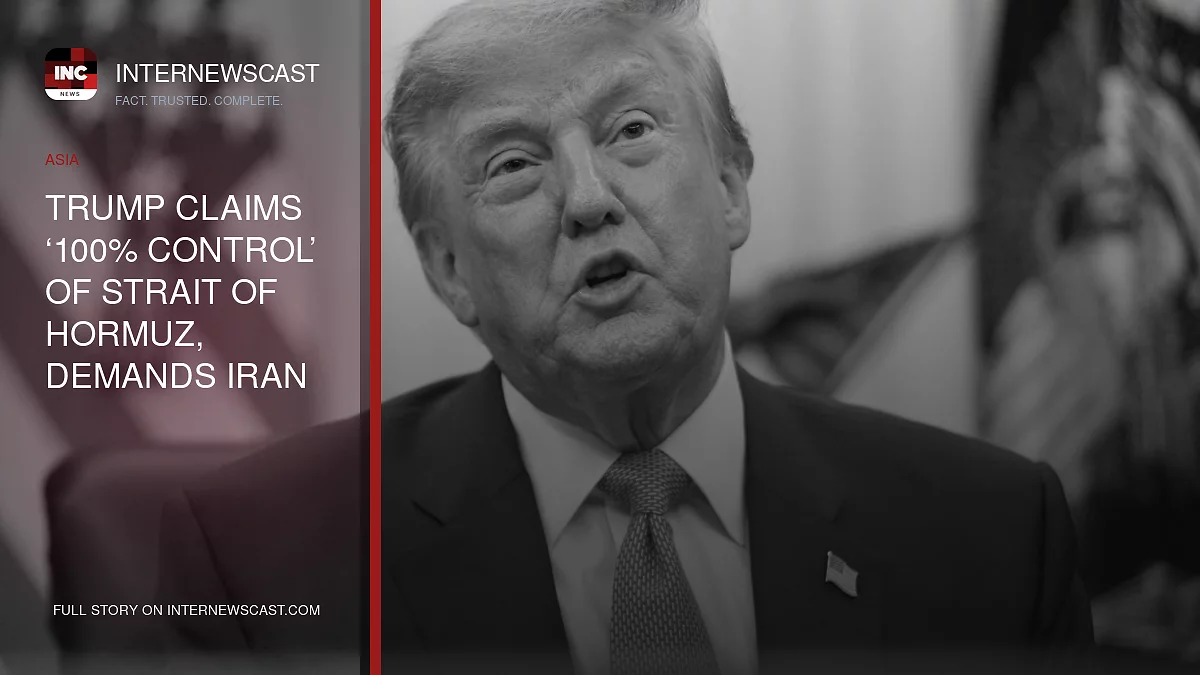

U.S. President Donald Trump speaks in the Oval Office before signing an executive order aimed at expanding vaccine research and flexibility at the White House in Washington, D.C., on August 10, 2026.
Jim Watson | AFP | Getty Images
The United States and Iran may be nearing “some sort of arrangement” concerning the Strait of Hormuz, a senior Pakistani official said Tuesday, signaling a possible opening for diplomacy even as both sides appear to be taking tougher positions in negotiations.
Pakistan Defense Minister Khawaja Asif told reporters that “things are shaping up again in favor of a peace arrangement or a deal,” according to Bloomberg News.
“The signals in the last two to three days are that we are close to some sort of an arrangement,” Asif said, though he did not elaborate on the potential terms or timeline.
His comments followed remarks from a Qatari Foreign Ministry spokesperson, who told Al Jazeera that discussions between Iran and Oman over opening a shipping channel through the Strait of Hormuz had reached a “critical juncture.”
When asked about Asif’s comments, the White House directed CNBC to remarks Trump made in the Oval Office on Monday evening, when journalists questioned him about what steps Washington might take next against Iran.
“You’ll find out,” Trump said.
U.S. and Iran trade reparation demands
Earlier Monday, Trump reacted to Tehran’s renewed demand for war reparations by announcing that he is “likewise demanding compensation from Iran.”
Trump, in a Truth Social post, also demanded payment to the families of Iranian protesters who have been killed “over the last 50 years.”
“I have instructed my representatives to put this firmly into any, and all, future negotiations,” he wrote.
In his Oval Office remarks Monday afternoon, Trump said Iran should pay for “the damage they’ve done” over the past half a century.
“If there’s damages to be paid, I think Iran should pay those damages,” he said.
Trump also repeated his claim that the Hormuz strait, the major oil-shipping route that Iran has used to gain leverage in the war, is under U.S. control.
“The only one that has control of the Strait of Hormuz right now is the United States Navy,” Trump said, praising the ongoing U.S. blockade of Iranian ports around the waterway.
But traffic through the strait, which saw 20% of the world’s oil trade before the conflict began in late February, remains at a relative trickle. The war-induced tumult in the strait has caused a global energy supply shock, sharply raising oil prices and causing broader economic consequences.
U.S. forces early Tuesday morning fired on a Panama-flagged vessel that tried to bypass the blockade, The Wall Street Journal reported. U.S. Central Command did not immediately respond to CNBC’s request for comment on the report.
Oil prices vacillated Tuesday morning amid the conflicting signals on whether any progress was being made toward a deal to resolve hostilities in the strait.
A major sticking point
Mohammad Bagher Zolghadr, secretary of Iran’s Supreme National Security Council, said Saturday the strait won’t reopen until Washington lifts its naval blockade and sanctions, withdraws American forces from the region, pays war reparations, and releases frozen Iranian assets. The council also called for an end to U.S. attacks on Iran’s regional allies.
Iran’s Foreign Ministry on Tuesday pushed back on the economic front. The spokesman, Esmail Baghaei, responded to the U.S. Treasury Secretary Scott Bessent’s claims that U.S. sanctions were “suffocating” Iran.
He said that Washington opts for sanctions whenever diplomacy fails and escalates them when they don’t work — a pattern he said has become less a “policy” than a “compulsive addiction.”
Hormuz deal hopes fade
The U.K. Maritime Trade Operations Centre, or UKMTO, said Tuesday morning it received a report of an incident involving a tanker and military forces in the Gulf of Oman, near the Strait of Hormuz.
“Vessels are advised to consider the latest maritime security information and maintain awareness of the evolving operational environment,” the maritime security body said. “Authorities are aware and relevant investigations remain ongoing.”
It was not immediately clear if the incident reported by UKMTO was the same one that the Journal reported later Tuesday morning.
Iranian officials have insisted that the strait would remain closed until the U.S. agrees to its demands — including lifting the naval blockade.
While Trump has frequently threatened to massively ramp up military action against Iran over its intransigence, he has also recently signaled that he is prepared to stick with an economic pressure campaign instead.
The impasse leaves Washington treating its naval presence as a permanent fixture guaranteeing access, while Tehran treats that same presence as the primary obstacle to normalizing traffic. Iran has insisted that it would not reopen the Strait of Hormuz as long as the U.S. continues to blockade its ports.
Energy supply disruptions remain a key market concern, with tanker traffic through the strait still subdued, said Lloyd Chan, senior currency analyst at MUFG Bank in Singapore, noting that Brent prices remain way above pre-conflict levels.
While periodic flare-ups remain possible, a full-blown regional war is still not the base case, Chan added.


