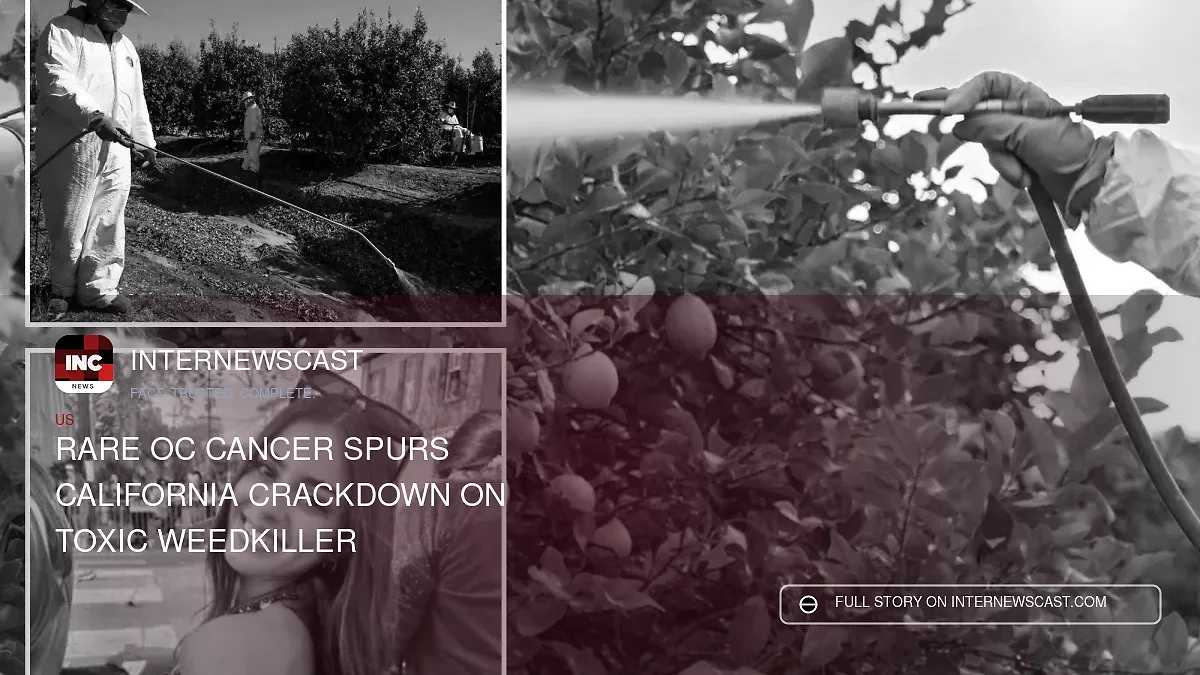

California is moving to remove a highly controversial weedkiller from store shelves as families in one Southern California community continue pressing officials for clarity after a troubling cluster of rare childhood cancer cases.
The California Department of Pesticide Regulation said Monday that it has canceled the state’s final registered pesticide product containing paraquat.
Under the decision, any remaining supplies must either be sold off or destroyed within the next two years.
Paraquat is the powerful active chemical used in industrial-strength herbicides sold under names including Gramoxone, Para-SHOT, Helmquat, Cyclone and Firestorm.
California’s action comes after years of campaigning by farmworker advocates, environmental groups and public health organizations calling for tighter restrictions on the toxic pesticide.
The herbicide has been associated with Parkinson’s disease and has already been banned in more than 70 countries around the world.
Despite those concerns, paraquat has remained one of the deadliest weedkillers still approved for use in the United States.
Health experts have long warned that paraquat poisoning is especially dangerous because there is no known antidote.
An Environmental Protection Act website carries the stark warning: “Paraquat Dichloride: One Sip Can Kill.”
Exposure can cause serious health problems even when it is not fatal, including cancer, heart failure, kidney failure, liver failure and scarring of the lungs.
California is the nation’s largest user of paraquat, with more than three-quarters of its use concentrated in eight San Joaquin Valley counties.
The chemical ranks among the state’s five most-used pesticides.
The crackdown comes as pesticide use is already under scrutiny in Ladera Ranch, an affluent Orange County community where residents have raised alarms over a reported cluster of rare childhood cancers.
Since 2007, about nine children connected to the community have been diagnosed with Ewing sarcoma, a rare cancer that primarily affects children and young adults.
Health officials have said no environmental cause has been identified, while families have questioned whether years of pesticide and herbicide use could be a factor.
The toll has been devastating. Brody Matteson, 17, died in March 2026 after battling Ewing sarcoma for nearly two years.
READ MORE: Alligator Attack Victim Identified as 58-Year-Old Mom as Fatal Mistake Comes to Light
Lily Dalton, 23, died in January 2026 after battling the disease following her college graduation.
The Capistrano Unified School District recently announced a 60-day pause on routine landscape chemicals, including herbicides and pesticide sprays, while officials review approved products.
The Ladera Ranch Maintenance Corporation also announced a temporary pause on certain landscape chemicals.
The local concerns have not been linked by officials to paraquat, but the timing has put a spotlight on the broader question of pesticide exposure.
California began reevaluating paraquat after conservation and public health groups sought to have its use banned. A.B. 1963, passed in 2024, required the state to continue reviewing the herbicide.
The state’s preliminary assessment found potential risks to birds and mammals, including the San Joaquin kit fox and Swainson’s hawk.
Officials also warned that restrictions meant to protect wildlife may not work because paraquat is so persistent in the environment.
The review found public health concerns including an association between paraquat and thyroid disease, as well as birth and reproductive harms.
Farmworkers and agricultural communities can face greater exposure because paraquat can spread in dust blowing from fields into neighborhoods.
Researchers have found that exposure in California agricultural communities is associated with increased risks of Parkinson’s disease and thyroid cancer.
California’s move contrasts with the federal government’s approach.
Vermont has already enacted the nation’s first paraquat ban, while the EPA recently announced plans for a roundtable with stakeholders to discuss regulation of the chemical.
“California and other states are taking aggressive steps to protect people from this dangerous poison, but the EPA continues to spin a web of red tape to obscure paraquat’s well-documented harms,” said Nathan Donley, environmental health science director at the Center for Biological Diversity.
“The writing is on the wall — paraquat is on its way out. The question now is how long it will take the EPA to actually do its job and start protecting people instead of the profits of pesticide companies.”
Farmworker groups, environmentalists and health organizations represented by Earthjustice sued the EPA in 2021 over its reapproval of paraquat
That legal challenge remains ongoing.
And the Ladera Ranch controversy has now reached Washington.
Last month, First Assistant US Attorney Bill Essayli asked EPA Administrator Lee Zeldin to investigate whether environmental factors could be contributing to the reported cancer cases and whether federal environmental laws may have been violated.