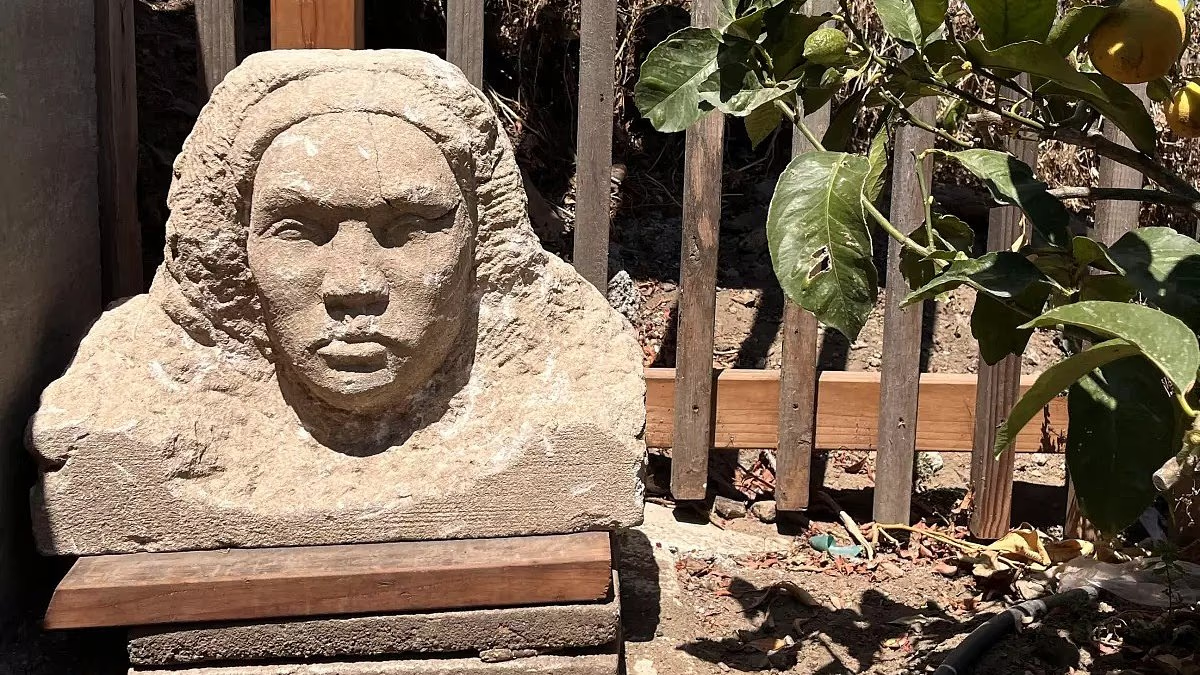

What began as a routine backyard makeover in California turned into an unexpected brush with history after a San Francisco couple unearthed a mysterious stone bust that may have been buried for decades, possibly since the 1930s.
Greg Gatwood, a professional landscaper, was reshaping and leveling the soil behind his San Francisco home in late May when his shovel struck a solid object beneath the dirt, the San Francisco Chronicle reports.
The 65-year-old initially assumed he had hit an old fence post footing or some other leftover piece of yard infrastructure, so he grabbed a pickaxe and began trying to pry it free.
But when the heavy slab finally shifted and Gatwood flipped it over, the object revealed something far more surprising: the carved face of a woman looking back at him.
Inside the house, his wife, Judy Gittelsohn, 68, spotted the unusual find moments after her husband brought it to light.
‘I look over and he has this head turned up,’ she recounted. ‘I said, “What the f**k? The last thing I need is a buried treasure.”‘
Her shock quickly gave way to fascination as she took in the careful lines and refined finish of the stone sculpture, realizing the bust had not been made by an amateur.
‘To get that smooth transition in carving a stone, any kind of stone, is really a masterful piece of work,’ Gittelsohn told KTVU.

A 150-pound limestone bust was found buried in the backyard of a San Francisco home

Greg Gatwood made the discovery while doing yardwork at his and his wife, Judy Gittelsohn’s, home in late May
At that point, Gittelsohn, a painter, reached out to about 50 scholars and art experts about the origins of the bust.
She soon learned that it was likely created by one of the students of Ralph Stackpole, a Works Progress Administration-era sculptor who taught at San Francisco Art Institute (then known as the California School of Fine Arts).
Stackpole, who focused on depicting indigenous people, had joined the faculty in 1918 and taught there up until 1941.
‘The thrilling part is the investigation and how many people are so excited about this,’ Gittelsohn told the Los Angeles Times.
MORE STORY: Lindsay Clancy Google Searches Before Children’s Deaths: Full List Revealed
‘We knew Ralph Stackpole’s canon of work but we didn’t know how many people he taught and how many people’s lives he touched,’ she continued. ‘I’m a painter, and it’s a fantastic big book opening.’
The couple now believe the nearly two-foot wide limestone bust came from the Golden Gate International Exposition, a World’s Fair held in 1939.
‘The likelihood is that it was made in the 1930s because of the style of execution,’ Gittelsohn suggested. ‘It’s pretty typical of the 1939 exhibition on Treasure Island.’
Anne Schnoebelen, a historian and vice president of the board of directors for the Treasure Island Museum in San Francisco, also said she would guess the bust is from an area of the World’s Fair called ‘The Court of Pacifica,’ which featured an 80-foot statue of the goddess Pacifica by Stackpole.
It also included a fountain of 20 other sculptures representing the Pacifica community.

The couple believes it was created by one of the students of Ralph Stackpole, a Works Progress Administration-era sculptor who taught at San Francisco Art Institute
Schnoebelen then suggested the sculpture was created by one of Stackpole’s students, like Adaline Kent, Helen Phillips or Sargent Claude Johnson.
Still, she said, that would not explain why it was buried underground.
‘It could have been somebody who didn’t like the way it turned out, or maybe Stackpole didn’t like it,’ she said. ‘But if they really didn’t like it, they could have taken a sledgehammer to it.’
If the couple now wants to get a more definitive answer about who carved the bust, Schnoebelen said they could get an expert to analyze the individual brush strokes.
‘There’s a sophisticated method to examine the strokes to examine how it was made and what kind of tools were used,’ she explained. ‘I just think that when sculptors are known for doing that kind of work, experts can determine who did what.’
While the exact origin of the bust remains unclear, Schnoebelen said she enjoys all of the attention it has brought to that period of art.
‘I love that it’s bringing attention to something that I care about very deeply,’ she said. ‘I appreciate that Judy and Greg have added to that mix of possibility.’
‘It looks like it could’ve been one of the faces made for the Court of Pacifica, but we don’t know,’ Schnoebelen noted.
Meanwhile, Gatwood said he will proudly display the nearly 150-pound sculpture ‘in a special way in our yard.’
‘I’ve always thought every yard deserves a nice piece of garden art,’ he said, noting it is not leaving their yard ‘unless we find out it is a priceless sculpture that needs to be in a museum.’