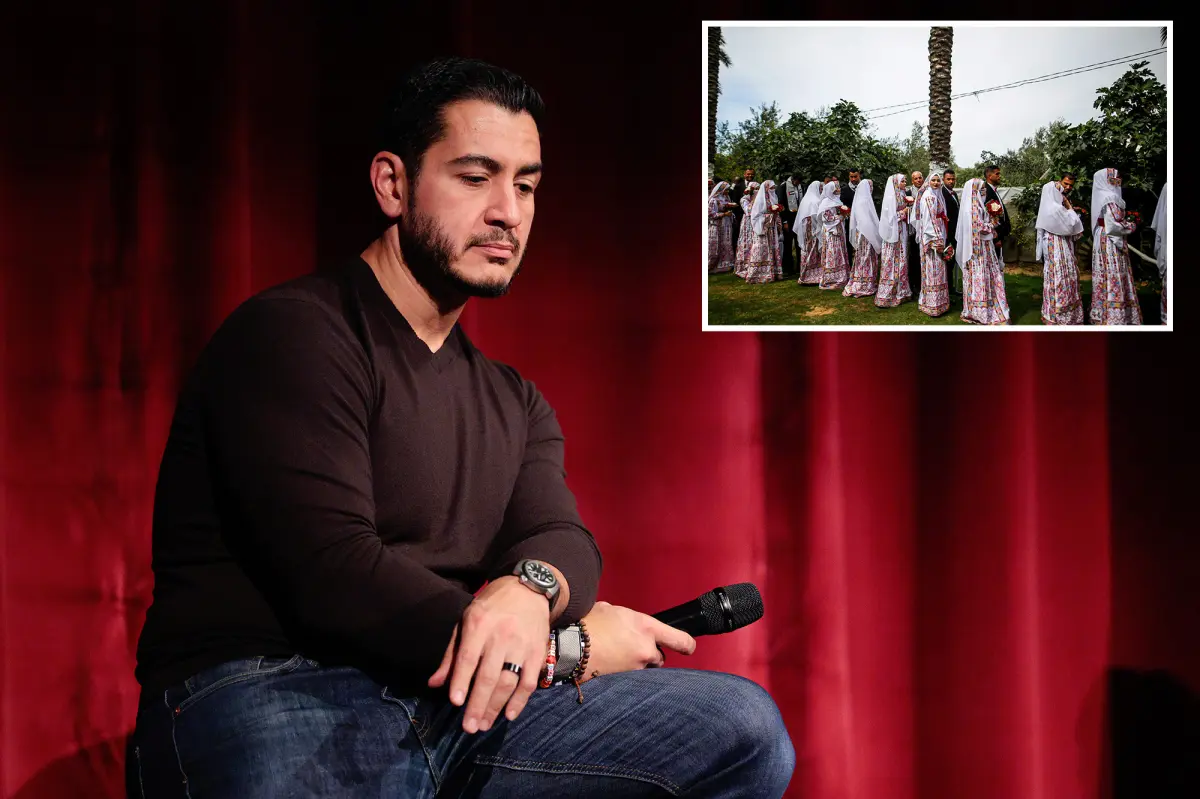

Left-wing Senate candidate Abdul El-Sayed is facing criticism over a resurfaced Columbia University research paper that critics say reached a “racist and eugenics” conclusion by suggesting Arab women had better health outcomes when they had children with Arab men rather than men from other ethnic backgrounds.
In the 2011 paper, published in the Journal of Immigrant and Minority Health, El-Sayed — who has repeatedly described himself as a physician despite not completing a medical residency — examined the potential risks of “interethnic mating.” He argued that relationships between people of different ethnic backgrounds were associated with a higher likelihood of premature birth.
“Our findings suggest that interethnic mating may be associated with increased risk for adverse birth
outcomes among Arab ethnicity mothers,” he wrote. At the time, El-Sayed published under the name Abdulrahman M. El-Sayed.
The study, titled “Interethnic mating and risk for preterm birth among Arab
American mothers,” opened by asserting that Arab mothers, described as “a growing ethnic group,” had “systematically better birth outcomes” than white mothers.
El-Sayed wrote that Arab American women were 16% less likely than white women to give birth prematurely, citing research he conducted in 2008. Critics have pointed out that the earlier study also found the difference disappeared after accounting for maternal and socioeconomic factors.
The NIH-funded research found that Arab women who had children with white men faced 18% higher odds of preterm birth — defined as delivery before 37 weeks — and 24% higher odds of late preterm birth, between 34 and 36 weeks, compared with Arab women whose children had Arab fathers.
The study found no statistically significant difference in very preterm births, defined as those occurring before 32 weeks, based on whether the father was Arab or white. Critics said the paper gave comparatively little attention to that finding.
Critics have condemned the research as pseudoscientific and argued that its conclusions promoted racial and ethnic separation.
“This is ‘science’ with ‘a pre-ordained racist & eugenics outcome,’” Sen. Ted Cruz, R-Texas, wrote on X. “Scary stuff.”
Other commentators questioned why El-Sayed chose to study the relationship between Arab women, interethnic relationships and premature birth in the first place.
“Senate candidate Abdul El-Sayed’s scientific research is…odd. Arab mothers who engage in ‘interethnic mating’ have worse birth outcomes than those who mate with Arab men?” wrote John David Haltigan, an honorary research fellow at the University of Buckingham. “Why research this?”
The article also referenced Islamic marriage rules, noting that under Sharia law, Muslim men may marry “chaste” Christian or Jewish women, while Muslim women may marry only Muslim men.
“The father’s ethnicity did not appear to affect pregnancy outcomes when the mother was a non-Arab white woman,” El-Sayed wrote in the paper.
READ MORE: Google’s Creepy AI: Can It Assign ‘Gay’ Traits From Faces?
The research also drew attention to differences between the groups, stating that Arab mothers in interethnic relationships were less likely to be married, were older on average and were more likely to smoke than Arab mothers who had children with Arab fathers.
El-Sayed further cited research claiming that people in interracial or interethnic relationships experienced higher levels of stress, which “in turn increase risk for adverse birth outcomes.”
For the study, he analyzed data on 617,451 women in Michigan, which he identified as the state with the largest concentration of Arab Americans in the United States.
The data came from birth records maintained by the Michigan Department of Community Health. The sample included 21,621 Arab women and 594,431 white women who gave birth between 2000 and 2005. Ethnicity was determined through self-reported ancestry.
El-Sayed, 41, argued in the paper against “racial heterogeneity.” He is the son of Egyptian parents.
He is also married to a non-Arab woman. El-Sayed’s wife, Sarah Jukaku, is Indian. The couple married in 2006, welcomed their first child in 2018 and have two daughters.
“So he, an Arab man, can mate interracially, no problem, but Arab women, in his scientific opinion, it seems, are better off staying within their own tribes,” writer Katya Sedgwick wrote on X.
“El Sayed exhibits great many third world attitudes that are repressive, violent, and incompatible with our way of life.”
At the time of his marriage, El-Sayed boasted that the couple was required under Islamic law to live separately for a year without consummating their union.
“The interesting thing about the Muslim perspective is that it’s a lot more serious,” he told The Michigan Daily in 2006.
El-Sayed, who is campaigning to become the first Muslim senator in US history, suggested at the end of the paper future researchers may want to “consider the effects of interethnic mating on risk for
other adverse birth outcomes,” including neonatal mortality and birth defects.
Other research he conducted at Columbia followed the same theme, including one where he looked at “ethnic inequalities in mortality.”
He withdrew his medical school residency application before he would’ve started it, to pursue public health instead.