
Ireland’s lack of a clear defence strategy is likely to be exposed this week, security analysts have warned, with one expert describing the country as the EU’s most vulnerable to hybrid attacks “by a country mile”.
Dr Eoin Drea, a senior researcher at the Wilfried Martens Centre for European Studies, said hospitals, schools and transport hubs such as airports could be targeted by cyberattacks this week as around 50 government leaders gather in Dublin for a European Political Community (EPC) meeting.
His warning came after Health Minister Jennifer Carroll MacNeill said schools and hospitals must prepare for potential threats, following a week in which Irish airlines and media organisations were targeted by bomb hoaxes.
Dr Drea told the Irish Mail on Sunday: “I would not be surprised if these threats continued over the course of next week in order to cause maximum inconvenience around the EPC meetings. Some form of hybrid cyber interference would be the obvious next step.
“Unfortunately, Ireland is like a sitting duck. We have very limited cyber-defence capabilities and no real defensive strategy. This is well known throughout Europe and, no doubt, in places such as Russia too.
“Should the attacks continue next week and actively disrupt the EPC meetings, I think our fellow EU members will truly understand just how lax Ireland has been when it comes to basic defence capabilities.”

Dr Eoin Drea, a senior researcher at the Wilfried Martens Centre for European Studies, said hospitals, schools and airports could be targeted by cyberattacks this week as around 50 leaders gather in Dublin for a European Political Community meeting
Sinéad O’Sullivan, from the think-tank Security Ireland, also told the MoS last night that Ireland is Europe’s most vulnerable country from a security perspective “by a country mile”.
She said malicious actors could gain a “massive political advantage” by continuing the bomb threats as Ireland prepares to host leaders including Ukrainian president Volodymyr Zelensky and Canadian prime minister Mark Carney.
Ms O’Sullivan warned that, if Russia is behind the bomb threats targeting media organisations, it has identified a vulnerability. “Once that is known, those responsible will keep exploiting it until they get what they want,” she said.
Ireland is “on the back foot” in every respect when it comes to security, she added.
The expert said that because Ireland lacks a defined threat landscape — a comprehensive assessment of its security risks — it cannot determine who is responsible or establish “what these non-State actors, or potentially even State actors, want”.

Sinéad O’Sullivan, from the think-tank Security Ireland, said Ireland is Europe’s most vulnerable country from a security perspective “by a country mile”

Dr Eoin Drea said hospitals, schools and transport hubs such as airports could be targeted by cyberattacks this week
Former Army Ranger and Independent TD Cathal Berry told the MoS that the events of this week followed the “same pattern as the Copenhagen EU summit last year”.
He said similar interference had taken place in the week before last year’s EU summit in Copenhagen, before additional security measures were introduced.
Although the leaders will not begin their meeting until Thursday, the security operation surrounding the events — described as “unprecedented” — will begin on Tuesday.
Last Friday, staff at several media organisations in Ireland were evacuated after bomb threats were received.
News outlets in Dublin, including RTÉ, were cleared after emails were sent to newsrooms in Ireland and the UK.
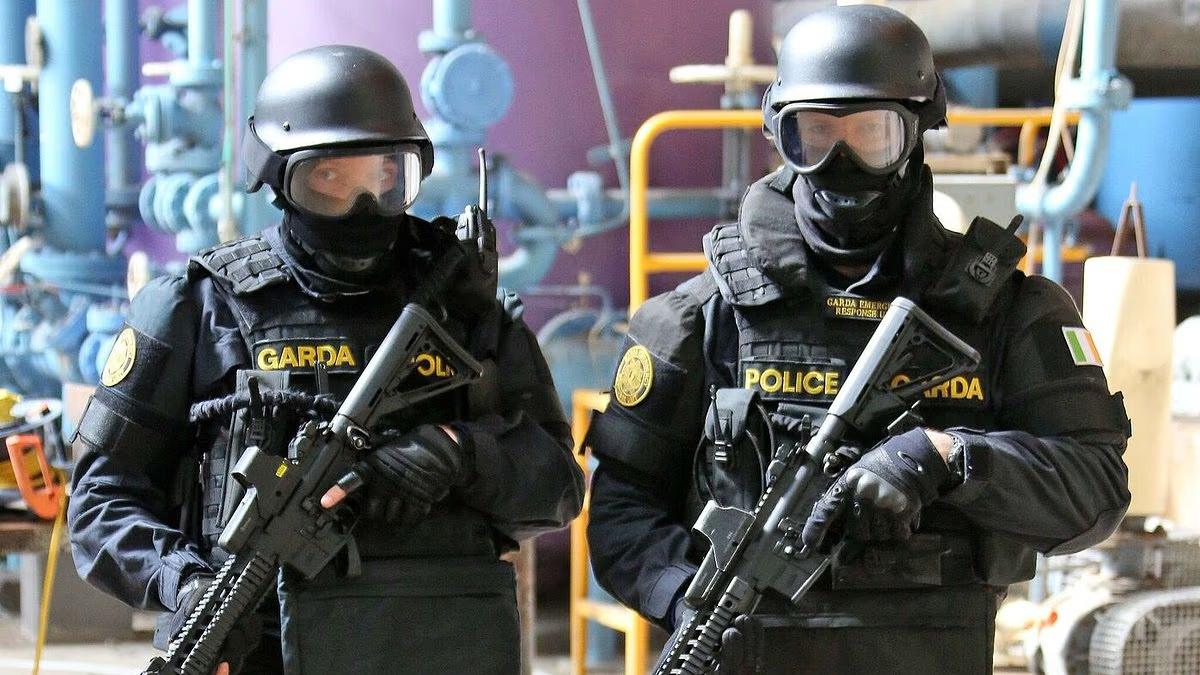
A significant Garda presence was deployed outside RTÉ’s headquarters in Donnybrook, Dublin 4, with armed response gardaí at the scene.
Gardaí were also sent to other locations named in the threats.

News outlets in Dublin, including RTÉ, were evacuated after emails were sent to newsrooms in Ireland and the UK
The threats followed a series of bomb warnings sent to airlines in recent days, including Irish carriers and flights travelling to and from Ireland.
Ms O’Sullivan said Ireland lacked “the most basic, basic thing, which is a defence strategy”.
“There is no other country that would not have something as simple as that. Ireland is on the back foot because we cannot even respond if we face a credible state-to-state threat.”
The security expert warned that, if Vladimir Putin’s Russia is responsible for the alarming events of the past week, the threats are likely to continue.

The security expert warned that, if Vladimir Putin’s Russia is responsible for the alarming events of the past week, the threats are likely to continue
“If it is Russia or Ukraine, there is a massive political advantage in continuing. And if you know you can do it, why would you not continue?”
She added that, although suspicion had immediately fallen on Russia, people “should not be handwaving about whether or not it is Russia”.
KEEP READING: Neighbor of Slain New Jersey Therapist Recalls Chilling Last Contact With Her Husband
“It could be South Korea, North Korea or Israel.
“It could literally be any actor. It could be a teenager in their basement in Ireland. These are all different types of threats and each would require a different response.”

The warnings followed a series of bomb threats sent to airlines, including Irish carriers and flights travelling to and from Ireland
At the Fine Gael Ard Fheis yesterday, there was growing acceptance that Ireland could face an attack.
Minister Carroll MacNeill acknowledged that malign operators could turn their attention to Ireland next week.
“Of course, the focus comes to Ireland because of our presidency of the European Union and because the European Political Community is being held here this week,” she told reporters at the Fine Gael Ard Fheis.
“We have seen in other countries that hospitals and schools have been targeted in hybrid attacks, and we condemn every element of that.
“Every part of our society has to take stock of the threats that exist right across Europe.”

Minister Carroll MacNeill acknowledged that malign operators could turn their attention to Ireland next week
Enterprise Minister Peter Burke also warned that Ireland faced “renewed and serious threats” to banks, the supply and export of goods, and businesses across sectors ranging from artificial intelligence to agriculture.
He criticised what he called the “irresponsibility” of Opposition efforts to limit Ireland’s response to the current threats.
He told the MoS yesterday: “Gardaí have warned that the threat is substantial and has been increasing in recent weeks. The same is true across Europe.
“We need to understand that the nature of war has utterly changed. It has evolved beyond boots on the ground.
“War is now being fought in cyberspace and through a wide range of new hybrid attacks across land, sea and air.
“Ireland is no longer separate from Europe, like Robinson Crusoe on his island.
“The Opposition’s response to this threat is irresponsible.”

Enterprise Minister Peter Burke warned that Ireland faced “renewed and serious threats” to banks, the supply and export of goods, and businesses ranging from artificial intelligence to agriculture
Minister of State Frank Feighan echoed Mr Burke’s concerns, warning: “We need to understand that we are no longer isolated from Europe or European conflicts.
“The sea is no longer a protection. There is significant concern that the precedent set by the HSE shutdown could happen again. Nothing is safe: major enterprises, security and supply chains for IT and pharmaceutical companies, banks — anything with a cyber footing is under threat.”
Mr Feighan said the full extent of a future attack, or even whether attacks were already under way, might not immediately be known.
He said: “For all we know, companies are under attack and simply have not told us.
“The major concern at present is not what we know, but what we do not know and what companies have not disclosed.”
On Friday night, Taoiseach Micheál Martin said he was confident the political summit would take place without incident.
“We’re confident that it will go off safely,” he said.
A Government spokesperson rejected the suggestion that Ireland was a sitting duck from a security standpoint.
The spokesperson told the Irish Mail on Sunday: “The Government is satisfied that the State’s strategic approaches to defence and security remain aligned with the changing and complex domestic and international security environment.
“The Council on National Security, chaired by the Taoiseach, receives regular and detailed updates on the security situation, as well as on national and international security and defence policies, from the Garda Commissioner, the Defence Forces’ chief of staff, the director of the National Cyber Security Centre and relevant senior officials.
“The council met earlier this week and received a full, current threat assessment, along with a detailed briefing on the security arrangements put in place by gardaí and the Defence Forces for next week’s EU Presidency meetings.”


