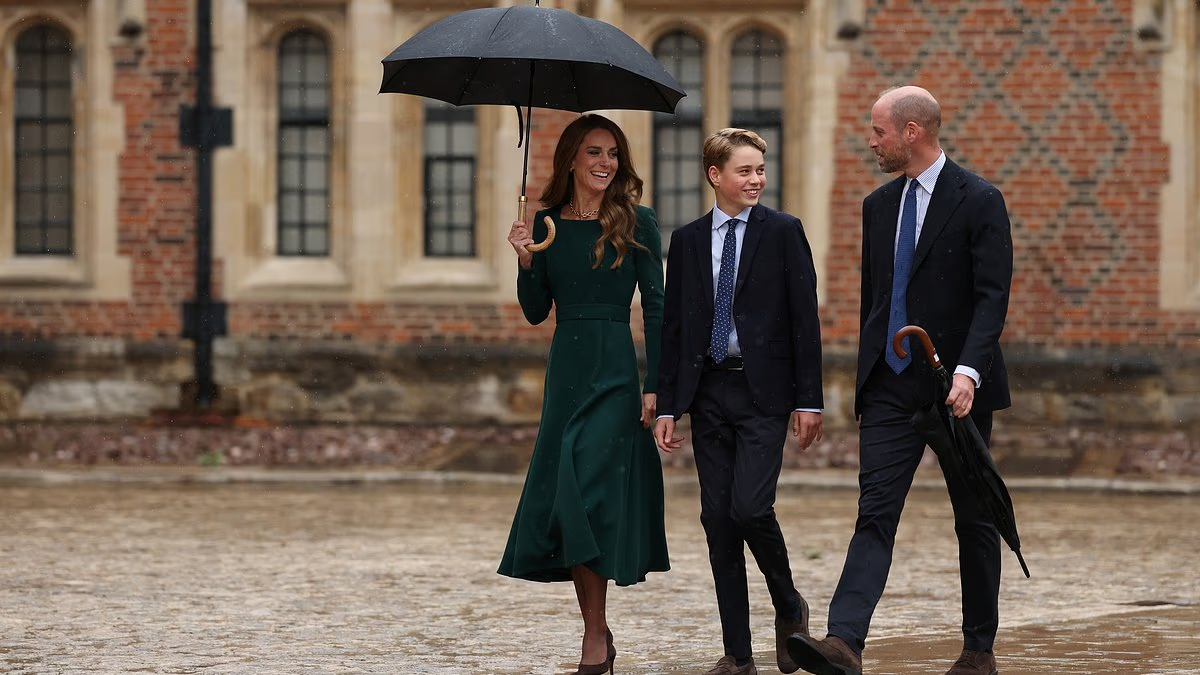

Prince William has indicated that the monarchy will undergo significant change when he becomes king.
In his view, The Firm has grown unwieldy, with too many members enjoying the privileges of royal life without accepting the hard work and responsibility expected of those who carry royal titles.
Yet before the Prince of Wales begins cutting back the institution, he will face an important question: who will remain to carry out the work?
In his forthcoming book, Dukes of Hazard, royal author Tom Sykes claims that William wants to undertake a sweeping restructuring of the monarchy. Under his reported plans, royal titles and the coveted HRH status would function more like professional appointments, reflecting active service rather than being guaranteed by birth.
The proposed system would allow only those who carry out official duties on behalf of the Crown to retain their titles. On that basis, Prince Harry, Meghan and their children, Archie, 7, and Lilibet, 5, could lose their titles when William becomes king.
However, the proposal would be a bold move at a time when the monarchy already has a relatively small working team. William would also face the optics of removing his own brother’s royal title, potentially making the future king appear petty or punitive and allowing a necessary modernisation programme to be interpreted as an extension of a family dispute.
Royal commentator Richard Fitzwilliams has now warned that an excessively streamlined monarchy could prove disastrous.

If William’s plans were implemented, the royal family could become skeletal, particularly if speculation about removing Charlotte and Louis’s titles should they decline to become working royals proved correct

The photograph taken after King Charles’s Coronation highlights the monarchy’s high average age, reflecting the difficult reality that the institution largely depends on an ageing workforce
“The report suggesting that William would remove titles from non-working royals was expanded to include speculation that the policy could also affect Charlotte and Louis if they chose not to undertake royal duties.
“If that happened, although it is highly unlikely, the royal family would be left looking skeletal. That would amount to a crisis. Some would argue that the arrangement resembles the systems in the Netherlands, Sweden, Spain and other European monarchies. George is likely to marry and have children, allowing the institution to continue at a much lower cost and with a lower public profile,” he told Our News Outlet.
A smaller and more accountable royal family would clearly appeal to a public concerned about the cost of the institution during difficult economic times. But William could also discover that he has too few royals available to cover the monarchy’s demanding schedule.
The uncomfortable reality is that the institution relies heavily on an ageing workforce. At 76, Princess Anne remains one of the Crown’s most dependable assets, completing an extraordinary number of engagements. Even the tireless Princess Royal, however, cannot be expected to keep the monarchy moving indefinitely.
Her brother, King Charles, 78, cannot provide a permanent answer to his son’s staffing challenge either as he continues treatment for cancer.
“With only two working royals under 60, the institution is currently understaffed,” Richard Fitzwilliams says. “The photograph taken after King Charles’s Coronation clearly shows its high average age.
“The Duke and Duchess of Edinburgh and Princess Anne are deeply committed to duty and could prove central to any reorganisation. Such a change would also affect Beatrice and Eugenie, who undertake charitable work but do not carry out official royal duties and remain associated with the controversial York brand.”

Under the reported proposals, Prince Harry, Meghan and their children, Archie, 7, and Lilibet, 5, could lose their titles when William becomes king

Would William bring his cousins Beatrice and Eugenie into the monarchy’s inner circle while the reputational shadow surrounding their parents continues to linger?
William would therefore need a new generation of royals to handle the countless engagements, overseas tours, charity visits, ceremonial openings and diplomatic responsibilities expected of official members of the Crown.
The difficulty is that the most obvious candidates are far from uncomplicated choices.
Among them are Princess Beatrice and Princess Eugenie, 36, the daughters of disgraced former Prince Andrew and Sarah Ferguson, the former Duchess of York.
Both women hold royal titles and have pursued careers and charitable interests outside the working Royal Family. Princess Beatrice, 38, for instance, co-founded the charity social enterprise Big Change with Holly and Sam Branson, the children of billionaire Richard Branson.
Neither woman, however, has developed the public profile or international star power associated with the late Princess Diana or the Princess of Wales.
Would William want to bring his cousins closer to the centre of royal life while the controversy surrounding their parents continues to cast a shadow? The sisters could provide useful support for less glamorous engagements, such as opening hospitals and charity centres outside London. Yet William may conclude that their involvement would undermine the purpose of his reform agenda.
Zara and Mike Tindall could offer another source of support for a smaller monarchy. A British equestrian Olympian, Zara, 45, has inherited her mother Princess Anne’s work ethic and sporting ability. Mike, 48, combines northern charm, rugby credentials and a podcasting career, giving the couple a distinctly modern appeal. The question is whether they possess the star power needed to fill the gap left by the family’s most prominent members.

Zara and Mike Tindall could provide valuable support for William’s smaller monarchy. As a British equestrian Olympian, Zara, 45, has inherited Princess Anne’s work ethic and sporting ability
Zara can attract attention, but is her public image too closely tied to the traditional equestrian world and the country set? Mike has an approachable manner, yet would a sporting couple provide the glamour and global interest required by a modern monarchy?
Richard Fitzwilliams believes the family has limited options. “With only two working royals under 60, the institution is currently understaffed. The photograph taken after King Charles’s Coronation illustrates its high average age. The Duke and Duchess of Edinburgh and Princess Anne are devoted to duty and could be crucial in any rearrangement. That would also affect Beatrice and Eugenie, who carry out charitable work but no official royal duties and remain part of the controversial York brand.”
Then there is the continuing Sussex dilemma. When Harry and Meghan stepped away from royal duties in 2020, the monarchy lost two of its most recognisable and photogenic representatives. Whatever tensions existed within the so-called “Fab Four”, the couple had brought considerable visibility to the institution.
As a former serving soldier, Harry had a natural connection with military charities, while Meghan generated media attention and brought an element of American glamour.
William may believe that royal status should be earned rather than inherited. However, removing the titles of his brother and sister-in-law could prompt questions about whether personal animosity had influenced the decision.
The couple have already stopped using their HRH styles in an official capacity since withdrawing from royal duties. Removing the Duke and Duchess of Sussex’s peerages would require an Act of Parliament and could make the new king appear particularly severe and punitive in the eyes of the public.
The situation involving Archie and Lilibet would be even more difficult. Removing titles from children who played no role in the family conflict would be unlikely to reflect positively on the monarchy.
Prince George’s future role as heir is secure, but William’s other children, including Princess Charlotte, 11, and Prince Louis, 8, will eventually be able to decide whether they want to become working members of the Crown or pursue an alternative path at the cost of their titles.
All of this highlights a central issue: the monarchy needs more than a reduced payroll. It needs compelling personalities.
The late Queen understood the importance of maintaining a broad cast of royal figures who could provide approachable faces for The Firm at its endless engagements. William and Catherine, together with their children George, Charlotte and Louis, are clearly the monarchy’s future. But the children are still young, and Catherine’s health and family responsibilities mean she cannot take on an unlimited workload.
Royal expert Richard Fitzwilliams also points out that recent events have demonstrated that even the most privileged members of the family are not protected from illness or misfortune.
“If Charlotte and Louis did not become working royals, they and their families would form part of the extended royal family without contributing to its official activities. On paper, only William, Catherine and George would be active royals. We have already seen how illness can affect two senior members of the Royal Family at the same time, while celebrating Catherine’s recovery and the remarkable level of activity King Charles, who is battling cancer, has maintained. It could happen again. William will not want to take that risk.”
William’s modernisation plans are understandable. The public wants value for money and a royal family that remains connected to everyday life. But there is a crucial difference between a streamlined monarchy and one so reduced that it begins to buckle under the pressure.
The Firm is, after all, a family business—and one that depends on visibility, personality and a considerable measure of glamour to survive.
William may be right that the era of a sprawling royal family dining out on its privileges while avoiding responsibility has passed.
But if he wants to build a truly modern monarchy for the future, he must ensure that enough people remain to keep the institution running.


