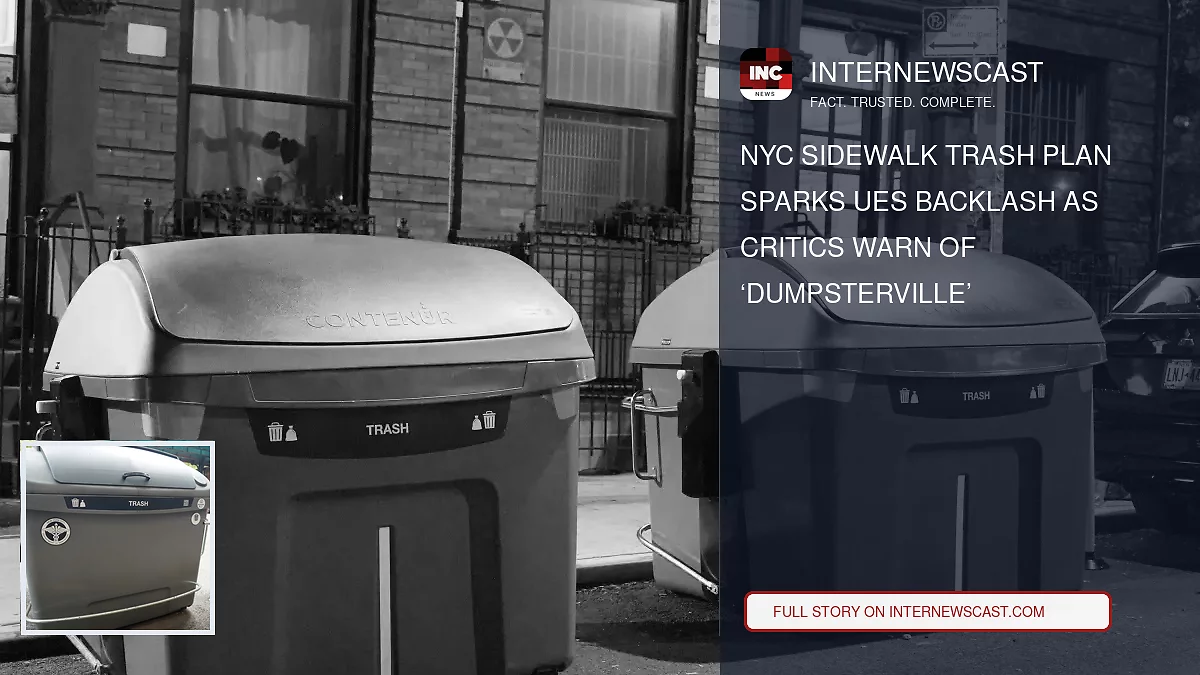

Upper East Side residents are blasting NYC Mayor Zohran Mamdani’s plan to remove nearly 30,000 parking spaces across the five boroughs and replace curbside space with tens of thousands of large street garbage containers, warning the proposal could make the affluent Manhattan enclave look like “Dumpsterville.”
The bulky metal receptacles, branded as “Empire Bins” and likened by critics to UFOs, would be installed block after block, forming what opponents describe as “permanent walls” along the curb. Valerie Mason, chair of Manhattan Community Board 8, cautioned that the containers could become magnets for graffiti, block street lighting and raise nighttime safety concerns.
“We are concerned about the resulting 24/7 visual blight, and perhaps even more significant than the effect on our quality of life, we are concerned about public safety, especially at night, as ambient light from street traffic, which helps illuminate the sidewalks, may be blocked by these tall and wide non-transparent containers,” Mason wrote in the board’s Aug. 7 letter to Sanitation Department officials.
Mason added that residents “do not want to . . . live in ‘Upper East Dumpsterville,’” while urging the city to give the public more time to review and comment on the contentious sanitation proposal.
According to the plan, the Upper East Side would face the largest neighborhood impact anywhere in New York City.
Community Board 8 would lose 1,658 parking spaces — close to 10% of its total — to make room for 3,648 containers, according to a July 1 environmental impact document for the program. Additional curb areas not currently used for parking would also be used for the large metal bins, which measure about 6 feet long, 5 feet wide and 5 feet tall.
On the Upper West Side, Manhattan Community Board 7 would see 1,460 parking spots removed, representing 10.3% of its supply, to accommodate 3,211 containers.
Together, the Upper East Side and Upper West Side would receive 6,859 of the projected 66,817 Empire Bins citywide — about 10.2% of the total. The two neighborhoods would also account for 3,118 of the estimated 29,842 New York City parking spaces expected to be eliminated under the program.

Empire Bins were first introduced through a 10-block pilot program in 2023 in West Harlem as part of former Mayor Eric Adams’ infamous “war on rats” that called for eliminating trash bags on curbs. The program — which targets residential buildings with more than 30 units — was expanded throughout West Harlem’s Manhattan Community Board 9 by June 2025, and now Mamdani wants to make it permanent citywide and roll it out through 2032.
Victor Edwards, who chairs CB9, told The Post the pilot program has had “mixed results.”
While the local rat population might have dropped slightly, many residents are still furious about losing parking to make way for “ugly,” huge dumpsters being plopped in front of their multimillion-dollar townhouses and brownstones, he said.
The city also needs to give communities more input on bin placement because many throughout West Harlem were placed in front of smaller homes, not only 30-plus-unit residential buildings, he added.
Despite the ire in her district, UWS Democratic Councilwoman Gale Brewer said she supports the program.
“Parking is a huge issue . . . Oh my God!” she exclaimed. “I don’t have a car, but people want them for family-member needs, medical needs, leisure, and parking [in an UWS parking lot] can be $1,400 a month.”
Sanitation Department spokesman Vincent Gragnani defended the Empire Bins program, saying the former “decades-old practice of leaving trash bags in stinking mounds” was “unacceptable.”
He also insisted communities will have another shot to provide additional input before bins and are dumped on their respective neighborhood, and he claimed the bins would “block less ambient light than the private vehicles that currently occupy the exact same curb space today.”
“All New Yorkers should be proud of the cleaner city that is emerging each day,” he added.