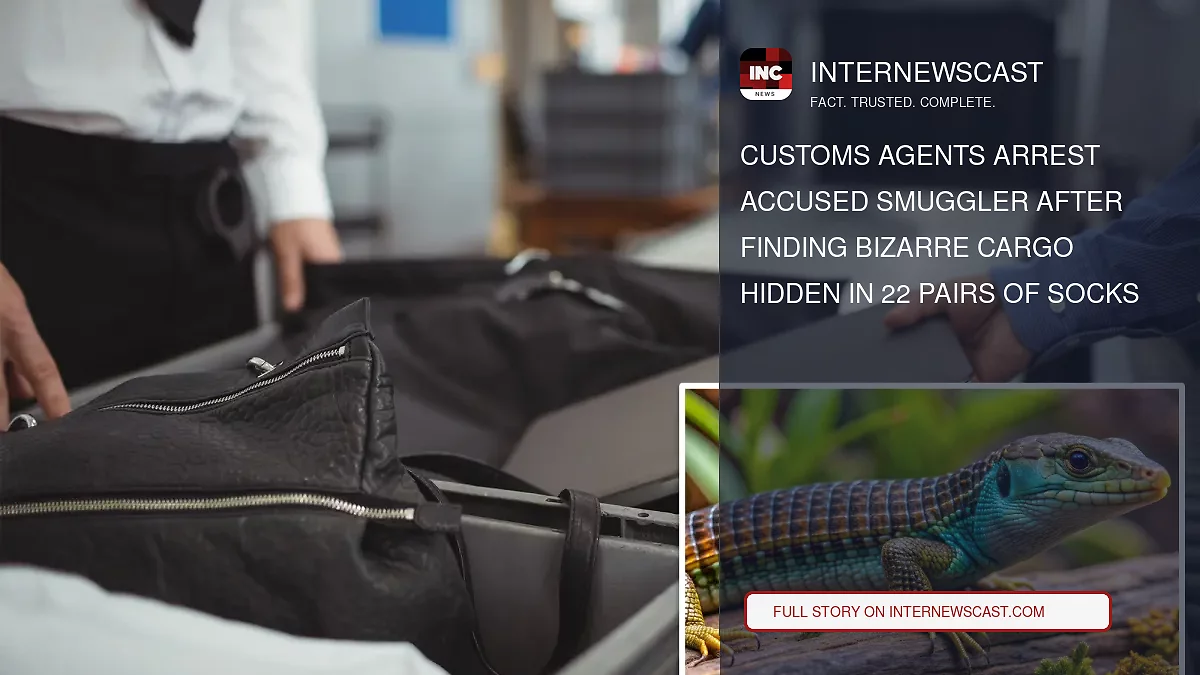

A man was arrested at a Tokyo airport after customs authorities reportedly found roughly 200 lizards concealed inside 22 pairs of socks packed in his suitcase.
The 23-year-old Mexican national had arrived at Haneda Airport from South Korea on Aug. 8 when officials discovered the reptiles hidden among his belongings, The Times of India reported.
Investigators said the lizards had been placed inside socks and tucked into the luggage. One of the reptiles was already dead by the time authorities opened the suitcase, according to the outlet.
The haul included nine Mexican alligator lizards, an endangered species subject to strict international trade restrictions, The Times of India reported.
The man allegedly told investigators he had purchased the lizards in Mexico for about $3.50 to $4.70 apiece.
In Japan, some of the reptiles can fetch around $630 each, according to reports, underscoring the lucrative black-market demand for exotic animals.
Keith Jeffries, vice president of K2 Security Screening Group and a former federal security director at Los Angeles International Airport, told Fox News Digital that profit is often behind bizarre wildlife smuggling cases.
“If there’s a market for it, people will attempt to smuggle it,” said Jeffries, who is based in Orlando.
“We’ve seen this before many times,” he added. “It happens more frequently than any of us would like.”
MORE STORY: Folded Laundry Became the Chilling Clue That Led a Mother to Her Son’s Killer
Airport screening procedures can vary depending on the agency involved and the types of prohibited items officers are tasked with finding, Jeffries said.
In the United States, for example, TSA officers are primarily searching for items that could threaten aviation security, such as weapons and explosives, rather than conducting searches specifically for smuggled wildlife or drugs, he said.
“The TSA security directives do not look for items from just a smuggling standpoint,” Jeffries said. “They look for guns, knives, explosives, incendiary devices — and it’s very specific and narrow to that.”
However, wildlife smuggling attempts are not unheard of, Jeffries added.
During his time with TSA, he recalled cases involving exotic turtles, as well as another incident in which nearly 100 exotic birds were discovered inside checked luggage arriving from overseas.
The discovery of the 200 lizards comes weeks after another suitcase containing wildlife products was intercepted at a U.S. airport.
Fox News Digital previously reported that a U.S. Customs and Border Protection agriculture detector dog helped officers find nearly 100 pounds of prohibited meat, plants and wildlife products in luggage arriving from Thailand.
K-9 Maisy alerted officers to the suitcase, which contained 50 pounds of meat, including raw meat, along with 33 pounds of mangoes, garlic, bamboo, banana plants and approximately 16 pounds of Bengal monitor lizard, according to CBP.
The U.S. Fish and Wildlife Service took custody of the monitor lizard.
CBP agriculture specialists inspect international luggage for prohibited items that could bring pests, animal diseases or invasive species into the United States.