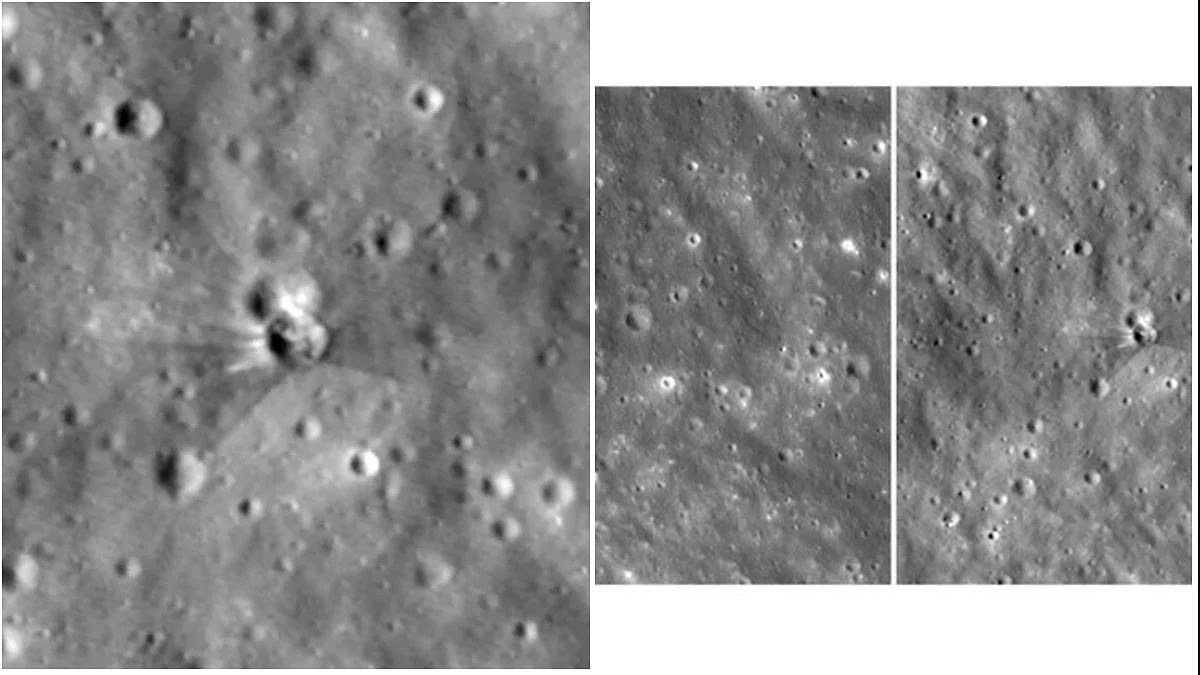

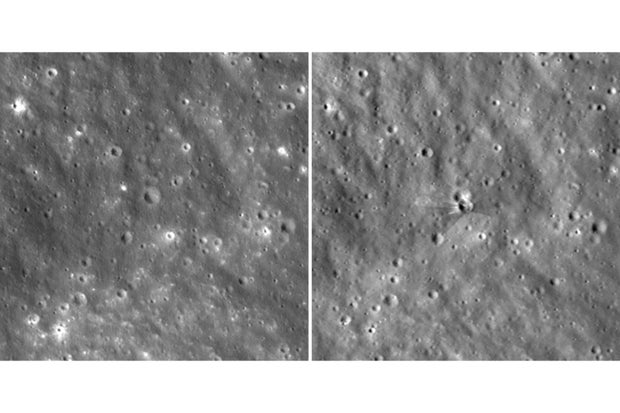
A NASA spacecraft orbiting the moon has captured the clearest images so far of the scar left behind by a crashing SpaceX rocket.
The agency released before-and-after images of the lunar impact site on Tuesday, offering scientists a closer look at the newly formed crater.
The 8,800-pound SpaceX Falcon 9 rocket booster slammed into the moon on Aug. 5 at about 5,400 mph after spending more than a year drifting through space. Measuring roughly 45 feet long and 12 feet wide, the booster hit with an energy equivalent to nearly 3 tons of TNT. While the moon is frequently struck by natural objects such as meteoroids, human-made impacts remain comparatively rare.
The Falcon 9 launched in January 2025, carrying two privately built moon landers loaded with experiments and even a small rover, part of NASA’s broader effort to expand commercial lunar exploration. After launch, the rocket’s upper stage continued wandering through space before its trajectory eventually carried it toward the moon’s Earth-facing side, where it crashed.
Using the latest images from NASA’s Lunar Reconnaissance Orbiter, scientists estimate the fresh crater is about 60 feet wide and less than 10 feet deep.
NASA via AP
The new views show distinct dark and bright streaks spreading outward from the crater in a pattern resembling butterfly wings. Scientists say the darker rays are material excavated from near the surface, where lunar soil has been altered over time by solar wind, cosmic rays and micrometeorite impacts. The brighter streaks mark fresher rock and dirt blasted up from deeper below.
The orbiter photographed the crater one week after the impact from an altitude of about 60 miles while racing over the lunar surface at 1 mile per second. To capture the scene, flight controllers had to tilt the spacecraft so its cameras could point directly at the impact area.
Because the spacecraft completes a polar orbit around the moon every two hours while the moon rotates beneath it, controllers had to wait six days before the crash site moved into view.
South Korea’s Danuri spacecraft was first on the scene to beam back photos.
The Lunar Reconnaissance Orbiter has been orbiting the moon since 2009, serving as NASA’s up-close eyes as the space agency works to return astronauts to the lunar surface.
In 2009, NASA intentionally crashed a rocket stage into a permanently shadowed crater at the moon’s south pole to search for water ice. The impact confirmed water ice exists at the location, helping make the region a prime target for future moon bases by the U.S. and China.


