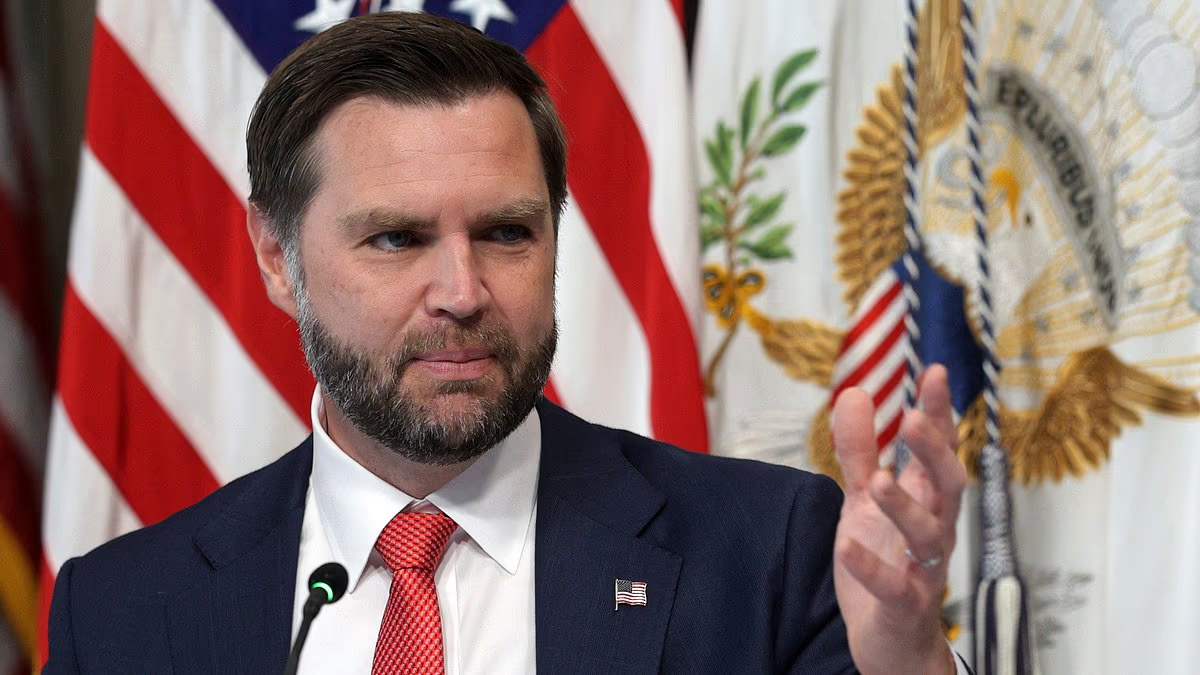

Jon Ossoff is emerging as one of the strongest-performing Democrats in a hypothetical 2028 presidential matchup against JD Vance, despite the Georgia senator repeatedly saying he has “zero interest” in a White House bid.
A new Emerson College Polling survey of 1,000 likely voters nationwide shows Ossoff leading Vance by five points, 49 percent to 44 percent.
That advantage tightens when the Republican named in the matchup is Secretary of State Marco Rubio, with Ossoff’s lead shrinking to three points.
The results place Ossoff among the top tier of Democratic figures tested by Emerson in early 2028 election polling, though the survey reflects a set of hypothetical contests rather than a firm forecast of the next presidential race.
Still, there is another reason the Georgia Democrat’s numbers are drawing fresh scrutiny.
Ossoff recently ignited a political backlash after taking aim at Trump with a sharp remark about aide Natalie Harp, saying the president would rather “build his ballroom and travel with Natalie” than do his job.
The comment rapidly spread online, becoming a viral political moment that pushed Ossoff deeper into the 2028 presidential conversation and underscored his willingness to confront Trump directly.
For now, however, the 39-year-old Georgia senator is focused on his Senate re-election campaign, not a run for the White House.

The latest Emerson College Polling survey of 1,000 likely voters, conducted August 16-17, puts Georgia Senator Jon Ossoff ahead of Vice President JD Vance by five points for the 2028 presidential election

Vance has not formally announced a 2028 campaign, but he has openly acknowledged that he is considering one
He has repeatedly rejected speculation about a presidential campaign, saying in June that he was ‘not running for president in 2028’ and had ‘no interest’ in doing so.
For now, Ossoff’s stated focus is Georgia.
But a big re-election victory in the Peach State could change the political conversation.
A decisive win would give Ossoff another statewide victory, greater national visibility and a fresh mandate heading into the period when Democrats will begin seriously considering their 2028 options.

23 percent of likely voters say they consider themselves supporters of the Democratic Socialists of America, while 60 percent say they are not supporters and 17 percent are unsure
The Emerson survey tested Vance and Rubio against five Democrats: Ossoff, former Transportation Secretary Pete Buttigieg, California Governor Gavin Newsom, New York Representative Alexandria Ocasio-Cortez and former Vice President Kamala Harris.
The August poll has a margin of error of +/- 3 percent.
A national vote does not elect the president. The White House is won through the Electoral College — meaning the battleground states, not a nationwide popularity contest, will ultimately decide who takes the Oval Office next.
Buttigieg produced the same five-point advantage against both Republican contenders, making him the only Democrat in the survey to hold an identical margin against Vance and Rubio.
Buttigieg leads Vance by five points, 49 percent to 44 percent, the same lead Ossoff had secured. Ossoff’s advantage was three against Rubio.
Newsom also led Vance, with his advantage narrowing to two points against Rubio.
Harris led Vance by four points but trailed Rubio by five, illustrating how much the Republican matchup mattered in the hypothetical contests.
The presidential hypotheticals come amid a difficult national environment for Republicans in the survey.
President Donald Trump’s job approval stands at 40 percent, compared with 56 percent who disapprove. Among independents, disapproval reaches 66 percent, while 92 percent of Democrats disapprove.
The economy is the top issue for voters at 37 percent, followed by threats to democracy and healthcare, both at 16 percent, and immigration at 13 percent.
And the survey contains another striking finding: 23 percent of likely voters say they consider themselves supporters of the Democratic Socialists of America, while 60 percent say they are not supporters and 17 percent are unsure. Among Democrats, 46 percent identify as DSA supporters.
The Democratic Socialists’ growing push inside the Democratic Party has produced a string of headline-grabbing primary battles this summer — with mixed results.
In Wisconsin, Democratic socialist Francesca Hong led the governor’s race in the polls before narrowly losing the August 11 primary to Milwaukee County Executive David Crowley by roughly 3,000 votes.
But elsewhere, the movement has scored major victories. Michigan progressive Abdul El-Sayed won his Senate primary.
Florida state Representative Angie Nixon, a DSA-backed Democratic socialist, stunned the political establishment by defeating heavily funded rival Alex Vindman to win the Democratic Senate nomination.


