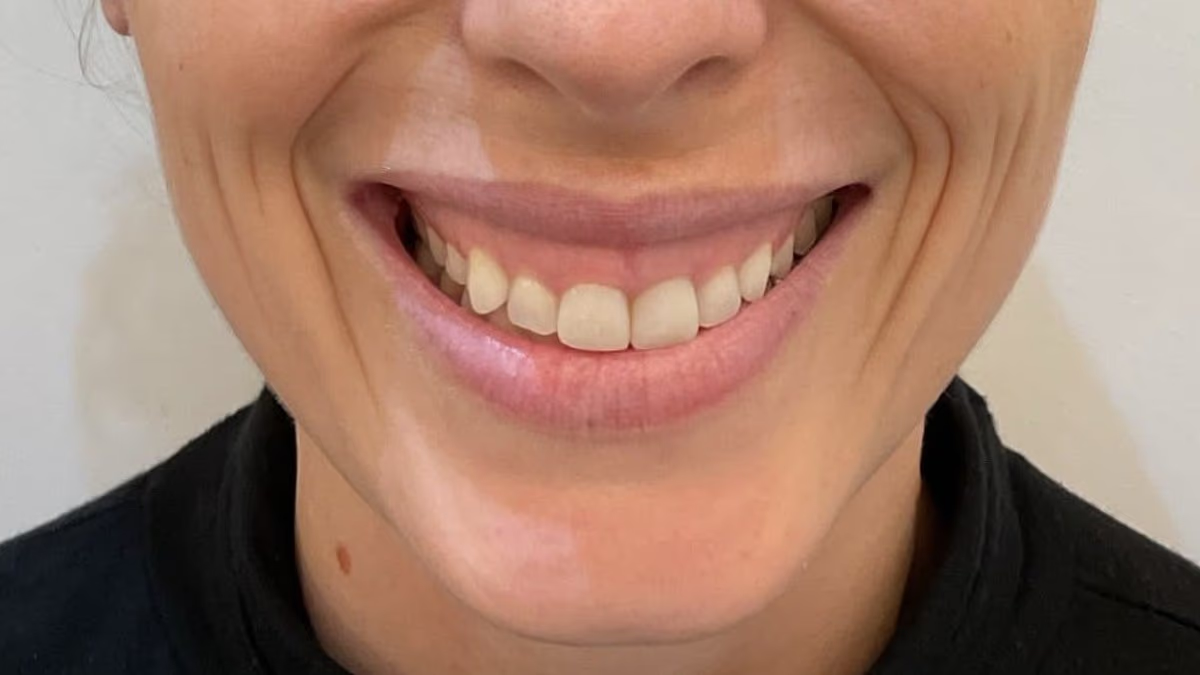

For years, Sally White did everything she could to hide her smile. A laugh or broad grin would instantly make her conscious of the feature she believed set her apart: an upper lip that lifted high enough to expose what felt like an overwhelming amount of gum.
Social occasions, parties and family celebrations often filled her with dread, especially when someone reached for a camera and began taking pictures.
The 53-year-old office manager from Hertfordshire recalls: ‘I absolutely hated having my picture taken or seeing photos of myself – I felt uncomfortable and self-conscious because of my horrible, gummy smile. If I started smiling or laughing in public, I would either cover my mouth – or else force myself to stop.’
But two years ago, a chance conversation led Sally to a discovery that would transform her confidence. The “gummy smile” she had struggled with for so long was not simply a cosmetic quirk, but a recognised medical issue.
Even more surprising, she learned there was a straightforward treatment available — a course of anti-wrinkle injections.
She says: ‘It was a game-changer. It wasn’t something I’d ever heard of. I only wish I’d found out about it earlier.’

Sally White once felt deeply self-conscious about her gummy smile, but treatment with anti-wrinkle injections has helped restore her confidence
The medical term for a gummy smile is “excessive gingival display”. While there is no single strict clinical definition, dentists generally consider a smile that reveals more than three or four millimetres of gum above the upper teeth to be out of proportion.
Overall, an estimated 14 per cent of women and 7 per cent of men in the UK are affected.
The most common cause is over-activity in a muscle with the longest name of any in the human body – the ‘levator labii superioris alaeque nasi’, also known as the LLSAN.
Running downwards from the upper part of the jaw-bone beside the nose, it lifts the upper lip, flares the nostrils and helps form facial expressions such as a smile or snarl.
In many people with a this sort of smile, the muscle is too strong and pulls too hard, meaning it lifts the top lip higher than normal and reveals too much of the gum.
Dr Kate Carr is a former GP who runs Dr Kate Aesthetics in north London, one of many private clinics around the country offering treatment.
She said: ‘A significant number of people have excess gum tissue on show and feel very self-conscious about it.
‘Often it has been a problem from a young age. Kids can be cruel – and if someone has been bullied or called names because of their smile, it can have a really profound and lasting impact. Some patients could never relax when smiling and even altered the way they smiled in public or when having a photo taken.’
Treatment involves injecting a small dose of botulinum toxin, which is best known by the brand name Botox.
The chemical is a powerful natural poison widely used in medicine and the beauty industry. By blocking signals between nerves and muscles, it causes temporary muscle relaxation or weakness.

Sally’s smile before treatment… the most common cause is a muscle called the LLSAN pulling too hard, meaning it lifts the top lip higher than normal

A small dose of Botox injected into Sally’s lip caused the LLSAN muscle to relax, so that less gum is exposed when she smiles
As a cosmetic treatment, it can be injected into the face to smooth out wrinkles, frown lines and crow’s feet.
Doctors also use it for conditions including chronic migraines, overactive bladder and severe underarm sweating.
For a gummy smile, the botulinum toxin is injected into the LLSAN, to relax the muscle so it exposes less gum when smiling.
Dr Carr says: ‘It doesn’t paralyse the muscle, just weakens it slightly, so when someone smiles the lip isn’t pulled as strongly and doesn’t lift as much.’
It’s important, she explains, to start with a tiny dose.
‘It’s a fine balance,’ she says. ‘A larger dose might last longer. But if you overdo it, the lip drops too far. Instead of showing too much gum when they smiled, they would end up not showing enough of their teeth. It’s better erring on the side of caution.’
The effects of the botulinum are not immediate but increase gradually over three weeks, before starting to wear off again after six to eight weeks.
As a result, the treatment – which costs around £180 each time – typically needs to be repeated every three to four months.
Dr Carr says: ‘For many people with a gummy smile, this treatment works really well and gives them a smile they feel happy and confident with.
‘It’s quick and relatively straightforward but can be life-changing. The ability to just smile in a natural way can really improve a patient’s confidence. Yet many people with a gummy smile aren’t aware it can be treated.’
Sally only found out about the botulinum injections while chatting with her dentist. ‘When Botox first came out, you’d see celebrities with stiff-looking faces,’ says Sally. ‘I swore I’d never touch it – that I’d just grow old gracefully.
‘But then I discovered that just a tiny bit could completely change the way I feel.’
Although it doesn’t interfere with eating, drinking or talking, the muscle-weakening effect of the botulinum means that she cannot tighten her lips like she used to when applying lip balm or lip-stick.
However, every morning, while putting on her makeup, she’s delighted to check her smile in front of the mirror.
Sally adds: ‘I can tell when it’s time to book the next appointment. I’m just gutted it took me so long to find out about the treatment. I wouldn’t ever want to be without it. It’s fantastic to finally be able to smile again.’


