
Harvard University is selling a $699 entrepreneurship course that uses AI agents to coach would-be founders — including digital versions of some Harvard professors.
The program, called Harvard Business School Foundry, is an eight-week, AI-powered startup course available around the clock. Unlike many offerings tied to the elite business school, it is not limited to Harvard students and is open to aspiring entrepreneurs outside the university.
‘Foundry brings together Harvard Business School’s time-tested teaching methods with an AI that understands you and your specific startup idea and stage, and builds your startup alongside you,’ the course website states.
According to the New York Times, Foundry has been available since April. The goal is to expand access to Harvard’s entrepreneurship instruction well beyond the roughly 900 MBA students admitted to Harvard Business School each year.
A notable feature of the course is its use of AI agents modeled on real Harvard faculty members, including professor Jeff Bussgang, to offer guidance to participants as they develop their startup ideas.
These AI avatars were trained on Harvard professors’ course materials and teachings, while also being able to pull from wider sources of information when needed.
Harvard built the AI clones in collaboration with HeyGen, an AI avatar company. University officials said they were struck by the strong response from people using the entrepreneurship program.
‘It was just so clear from what the users were telling us and what the numbers were saying,’ Katharina Rings, Foundry’s project director, told the Times.

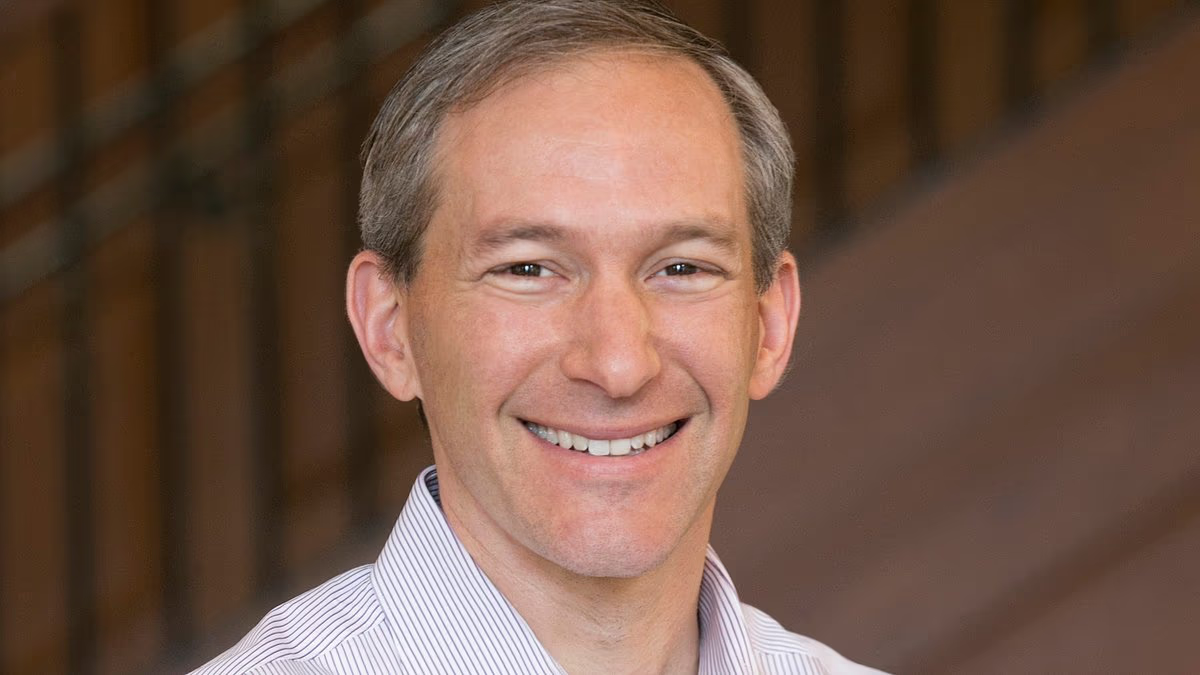
Harvard University is offering students a $699 entrepreneurship course that uses AI avatars of professors such as, Jeff Bussgang (pictured) to help students build start-ups

The course is offered to aspiring founders beyond the university’s student body and last eight weeks
‘It seems like people actually much prefer the AIs, and they actually trust more, if it is based on one specific person’s input.’
Bussgang, a senior lecturer at HBS, told the Times that he was one of several professors who volunteered to help create AI versions of themselves, though he still finds the technology somewhat ‘creepy.’
Sarah Kessler, a reporter for the outlet, tested the course and described how Bussgang’s AI clone appeared calm and maintained an unwavering smile throughout their interaction.
Kessler noted that the shadows on the AI avatar’s shirt did not move naturally, while its shoulders hovered back and forth in a repetitive manner.
Despite the dystopian nature of the technology, Bussgang said his students ‘love it.’
In addition to the AI resources, experienced speakers, investors and HBS faculty lead weekly live sessions.
Tom Eisenmann, a faculty co-chair for Foundry, told The Times that while students are embracing the avatars, online forums with peers have proven just as popular.
‘They love the AI They’re using the AI, they’re learning a lot,’ he said.

Bussgang told the New York Times that while he admits the avatar is a little ‘creepy,’ his students love the technology

The AI avatars were trained on the teachings and materials of Harvard faculty, but they can also draw on broader information when necessary (Stock Image)
‘But it keeps coming back to humanity.’
According to the outlet, about 45 percent of participants in the summer sessions paid for the program themselves, while the remainder were sponsored by universities.
Several users on LinkedIn expressed how they thoroughly enjoyed the Foundry course or were at least interested in the opportunity to try the AI aspects.
‘Absolutely loved my HBS Foundry experience (July cohort) — genuinely one of the best learning experiences I’ve had. Such a great resource for Founders,’ wrote one user.
‘You and your colleagues rock Jeffrey Bussgang, I have participated in them via Harvard Business School Foundry,’ added another.
‘This is really funny, I saw it and I thought I would just take the classes just to see the AI clones,’ a third said.