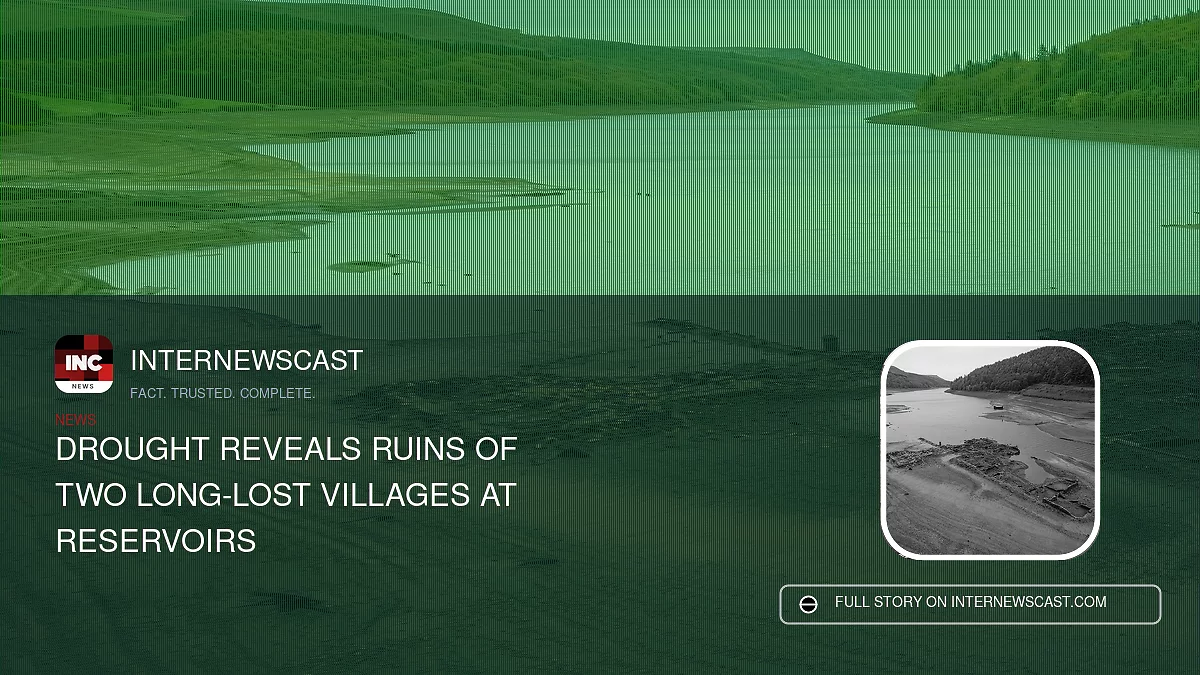

The remains of two villages abandoned more than 80 years ago have emerged from beneath a drought-stricken reservoir.
Derwent and Ashopton have resurfaced at Ladybower Reservoir in Derbyshire after prolonged dry weather caused water levels to fall sharply earlier this summer.
The villages, last seen above the water in 2018, were intentionally flooded during the 1940s to make way for the Upper Derwent Valley reservoir, which has a capacity of approximately 2,869 megalitres.
Historic buildings, churches and limestone cottages disappeared when the Derwent Valley was flooded between 1935 and 1943. The reservoir now supplies water to Derby, Sheffield, Nottingham and Leicester.
Following Britain’s summer-long drought, however, the reservoir has fallen to just 32 per cent of capacity. The drop has exposed long-forgotten streets, foundations, former homes and stonework from Derwent and Ashopton.
Aerial photographs show the precise outlines of dozens of limestone cottages that once housed more than 100 people, providing a rare view of communities that vanished beneath the water more than half a century ago.

The abandoned villages of Derwent and Ashopton have reappeared after drought affected Ladybower Reservoir (Pictured: An aerial image showing long-lost streets and foundations from the villages)

The villages were deliberately flooded in the 1940s to create the Upper Derwent Valley reservoir (Pictured: Remains of brick walls exposed as water levels fell)

The outlines of dozens of limestone cottages, once home to more than 100 people, are now visible

A brick wall remains as a striking reminder of the villages that disappeared beneath the water more than half a century ago
The discovery comes as England’s drought crisis deepens, with ministers reportedly warned this week that reservoirs could run dry, potentially causing disruption for families in the run-up to Christmas.
IN CASE YOU MISSED IT: Police Search for Father of Teen Killed in A66 Crash After He Fails to Appear in Court
Record-breaking heatwaves over the summer triggered widespread drought conditions. Some parts of England remain under hosepipe bans, even after two autumn storms swept across the country.
Cobra, the Government’s emergency committee, is now holding crisis talks twice a week over water supplies in south-west England and Sussex.
Officials have prepared a ‘reasonable worst-case scenario’ in which water stocks could fall to 0 per cent within weeks. Emergency plans have also been developed for a frightening ‘Day Zero’ situation, when reservoirs in each affected area run completely dry.
If no action is taken, household taps could run dry and construction work on a nuclear power plant could also be affected.
Wimbleball Reservoir, which supplies more than 400,000 people in Somerset, is currently at 13 per cent capacity. Ardingly Reservoir, serving 280,000 customers in West Sussex, has fallen to just 17 per cent.
Sussex and the south-west have been among the regions hardest hit by the lack of rainfall. They recorded their driest April-to-September period in more than a century and continue to face critically low water supplies.

The discovery comes as England’s drought crisis worsens, with ministers reportedly warned this week that reservoirs could run dry

Ladybower Reservoir in Derbyshire supplies water to Derby, Sheffield, Nottingham and Leicester
Doug Clarke, Severn Trent’s water resources lead, said: ‘We’ve seen six months of below-average rainfall and above-average temperatures, so reservoir levels will take time to recover. However, across our region, we have more water stored than we did at this time last year.’
‘Reservoirs make up around a third of our water supplies, with the rest coming from rivers and groundwater, and our teams are continuing to work around the clock to treat more water and fix leaks at record levels.
‘But we’re also asking customers to continue using water wisely all year round, to help ensure there is always enough to go around.’


