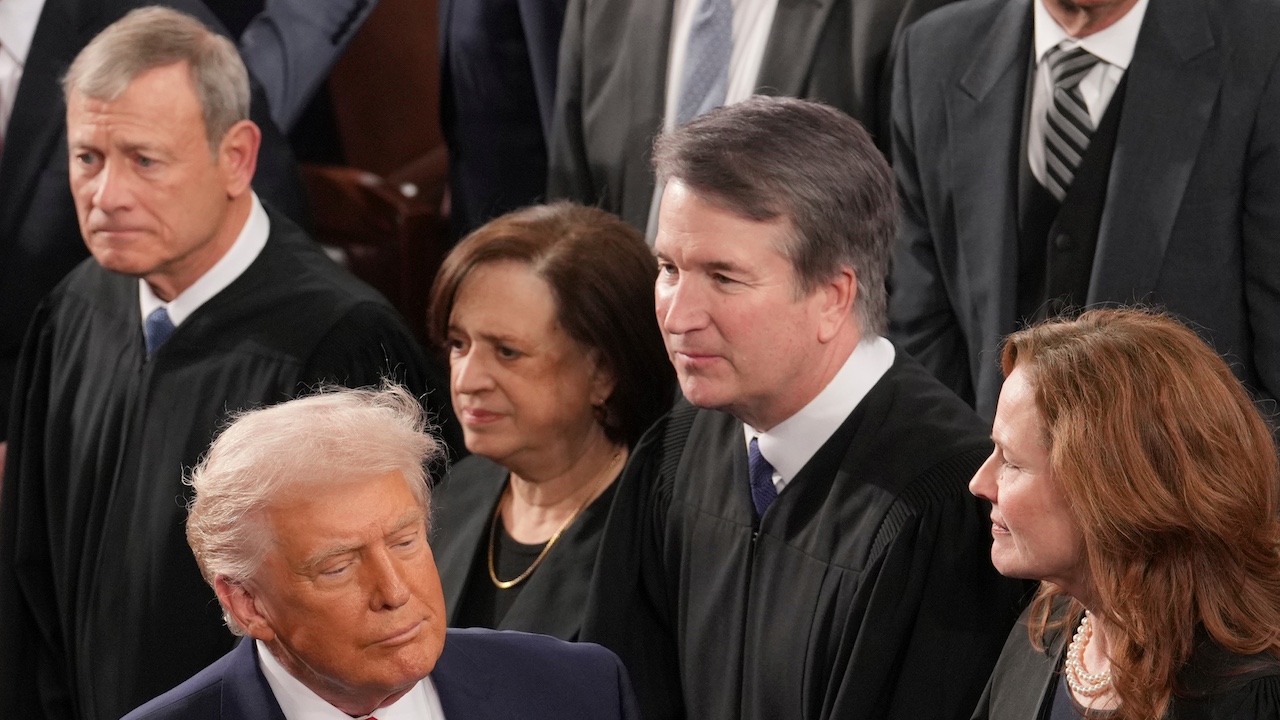

President Donald Trump passes in front of, from left, Chief Justice John Roberts, Justice Elena Kagan, Justice Brett Kavanaugh and Justice Amy Coney Barrett as he enters the House chamber to deliver his State of the Union address before a joint session of Congress at the U.S. Capitol in Washington on Tuesday, Feb. 24, 2026. (AP Photo/J. Scott Applewhite).
The U.S. Supreme Court’s conservative bloc, with Chief Justice John Roberts notably breaking away, ruled Monday that the architectural historian seeking to halt President Donald Trump’s plan for a new White House ballroom on the former East Wing site lacked the legal standing needed to bring the case.
For court watchers following the Supreme Court’s recent moves and the related fight in the U.S. Court of Appeals for the District of Columbia Circuit, the stay itself was not entirely unexpected. What made the order striking was Roberts’ dissent — an unusual alignment in which the chief justice was joined only by the court’s liberal justices.
Roberts, who serves as the circuit justice for Washington, D.C., had already issued a temporary administrative stay of a lower court injunction 10 days earlier while the justices weighed the Justice Department’s request to keep the White House ballroom construction moving.
The Trump administration later told the high court that a longer stay was justified, arguing that Senior U.S. District Judge Richard Leon and the D.C. Circuit had erred in finding that the National Trust for Historic Preservation and architectural historian Alison Hoagland could sue based on alleged “aesthetic injury.”
A divided D.C. Circuit panel had previously rejected what it described as the government’s sweeping claim that the executive branch could operate beyond judicial review, even if it meant demolishing cherished national landmarks and injuring private interests. The appellate court said such a view ran counter to the constitutional system. Still, the panel’s lone dissenter — a Trump-appointed judge — appeared to anticipate where the dispute was headed.
U.S. Circuit Judge Neomi Rao accused her colleagues on the D.C. Circuit of turning themselves into overseers of the president’s construction plans by upholding what she called Leon’s “blatant abuse of discretion.” In her dissent, Rao argued that the majority had placed the “aesthetic displeasure of a single passerby” above Trump’s stated judgment that the ballroom was needed both for White House security and for hosting large presidential events in a protected setting.
The Justice Department relied heavily on Rao’s dissent in pressing the Supreme Court to intervene, repeating the argument that neither Hoagland nor the National Trust had standing to sue and that the president’s White House ballroom project should be allowed to proceed.
READ MORE: Jerry Dammers’ Front Teeth Comes Into Highlights After “The Specials Reunion” Did Not Include Him
On Monday, the Supreme Court sided 5-4 with the administration, even as the conservative majority said “we do not pass upon the legality of the government’s East Wing project.”
“We conclude only that, based on the submissions before us, the government is likely to prevail in showing that the Trust lacks Article III standing to challenge the project in federal court and that the remaining stay factors favor relief,” the per curiam decision said, issuing a stay as the government files a petition for a writ of certiorari.
Roberts, with Justices Sonia Sotomayor, Elena Kagan, and Ketanji Brown Jackson joining him, led the charge in the opposite direction, noting that Congress “has not passed any law resembling ‘express authority’ for the Executive’s construction of it,” the ballroom.
The chief justice said that Hoagland “is not just any person” and the White House is “not just any building,” also lamenting that “[t]oday’s decision is no victory for the separation of powers.”
Roberts then wondered what the repercussions of this decision will be for the realm of environmental law, if a “standalone concrete and particularized aesthetic injury” like Hoagland’s “can be recast as mere offense[.]”
“What saved their aesthetic injuries from being classed as mere distaste for the actions of government or private industry?” the chief asked, before concluding with a Winston Churchill quote that “[w]e shape our buildings, and afterwards our buildings shape us.”
“All the more reason to ensure that those responsible follow the rules in deciding what to tear down and what to build up at the People’s House,” Roberts said.
Hoagland and the Trust maintained that the Trump administration was trying to “outrun judicial review” and didn’t deserve a stay.
The post Chief Justice Roberts deems Trump’s ballroom ‘likely unlawful’ and laments that the ‘separation of powers’ lost in unusual dissent first appeared on Law & Crime.