

LAKE COUNTY, Fla. – A tense local fight over privacy rights, public safety concerns and the expanding use of police surveillance technology came to a close Tuesday with a unified vote from Lake County leaders.
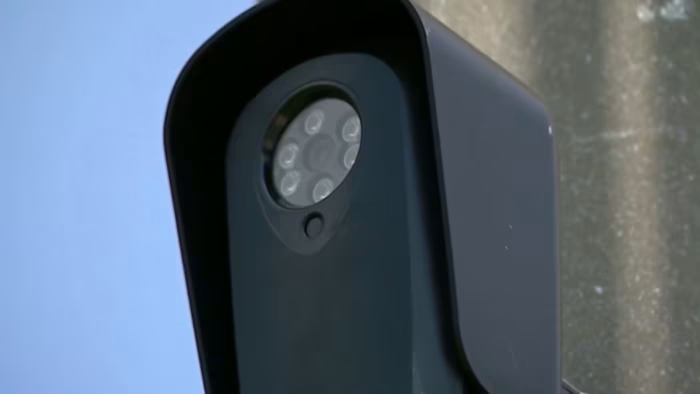
The Lake County Commission voted 5-0 to cancel permits for automated license-plate readers placed in county rights-of-way, effectively withdrawing the county’s approval for those devices in those specific public areas.
The limits of the decision matter. Commissioners were weighing only the county’s permission for license-plate reader cameras located within Lake County rights-of-way. As written, the vote does not apply to every license-plate reader that may be operating in other parts of Lake County.
The move followed action taken just a day earlier by the Florida Department of Transportation, which addressed the use of similar license-plate reader technology along state-maintained roads.
‘What the Flock are you guys doing?’
From the start, the Lake County discussion made clear how strongly residents felt about automated license-plate readers and government oversight.
In the first moments of the meeting, audience members repeatedly shouted from their seats while commissioners attempted to set the rules for public comment. One speaker pressed officials on who was monitoring law enforcement’s use of the camera system. Another called out, “Follow the Fourth Amendment.” Commissioners repeatedly urged the crowd to let the meeting proceed under the established public-comment process.
Later in the meeting, Edward Laney stepped up to the microphone and delivered a much more concise message.
“Lake County, Florida. What the Flock are you guys doing?” Laney said.
Commissioner Anthony Sabatini, who brought the issue forward, made clear early in the discussion that he wanted the county’s authorization revoked.
“Here’s the actual discussion,” Sabatini said. “The camera’s gotta go.”
Sabatini said he intended to make a motion directing county staff to revoke authorization for the cameras in the public right-of-way.
Commissioners ultimately approved the action 5-0.
Privacy concerns dominated public comment
Speaker after speaker during the first hour focused on privacy and government surveillance.
Dora Betancourt identified herself as a Mount Dora homeowner and told commissioners she bought her property in 2020 intending for it to be her permanent home.
“I don’t want my home invaded,” Betancourt said. “We are to govern by consent of the people, and we do not consent.”
Amir Asghar told commissioners he has lived in Lake County essentially his entire life and wants to raise his family in Tavares.
“This is the place where I wanna raise my family,” Asghar said. “I don’t wanna be living under George Orwellian, 1984.”
CJ Blancett, who identified herself as a retired criminal investigator, argued that the central concern was the collection of vehicle-location information involving people who are not suspected of a crime.
She ended her comments with a direct request to the board.
“Our message is simple: take these cameras down immediately. Do not renew the contract. Do not wait for another study or committee.”
Other speakers made broader claims about cybersecurity, artificial intelligence, data sharing and the technical capabilities of various camera systems. Those claims were made during public comment and were not independently established during the first hour of Tuesday’s meeting.
Commissioners debated whether to act before hearing from the sheriff
The discussion was not simply about whether commissioners had privacy concerns.
A significant part of the early debate centered on whether the board should make its decision before hearing directly from Lake County Sheriff Peyton Grinnell.
One commissioner said the issue had initially been placed on the agenda for discussion and questioned “forcing a decision today to rescind” the authorization without first talking to the sheriff.
Another commissioner said the sheriff should be given an opportunity to present information about the technology before the board made its decision.
“I don’t think you can make a decision on this until you at least let the chief law enforcement officer come in,” the commissioner said before being interrupted.
Sabatini argued the county already had enough information to act and said the issue was not new.
“He should have been here,” Sabatini said during the exchange. “Move forward without him.”
The sheriff was not part of the first-hour discussion contained in the transcript provided to News 6.
Despite that early disagreement over process and timing, the final county vote to revoke the permits was unanimous.
Why law enforcement uses license-plate readers
The public-safety side of the debate has been part of Lake County’s use of license-plate reader technology for years.
The Lake County Sheriff’s Office’s 2019 annual report said its Criminal Investigations Bureau had purchased a mobile license-plate reader trailer and received a grant that added stationary cameras at four major intersections.
The sheriff’s office described the technology as an investigative tool that could allow a detective to quickly determine whether a particular vehicle had passed a camera.
The agency specifically cited investigations involving suspects and missing people as examples where time can matter. It also said the mobile LPR trailer could be moved to a specific location or problem area when investigators needed it. (Lake County Sheriff’s Office)
That illustrates one of the central tensions in the current debate: law enforcement has described license-plate readers as an investigative tool, while opponents who spoke Tuesday argued the privacy cost is too high.
Florida took action one day earlier
Lake County’s vote came one day after a major change at the state level.
On Aug. 31, the Florida Department of Transportation issued Engineering and Operations Memorandum 26-01: “Revocation of General Use Permits for Automated License Plate Readers.” FDOT lists the memorandum as effective Aug. 31, 2026. (FDOT)
The memorandum applies to automated license-plate recognition systems placed by local agencies within rights-of-way on the State Highway System.
FDOT said it has authority under Florida law to approve or deny requests from local law-enforcement agencies to put LPR systems in those state rights-of-way and to remove them at the department’s discretion. (FDOT Blob Storage)
FDOT said the rapid increase in the technology, combined with reports involving misuse, data-privacy concerns and surveillance, warranted immediate action.
The department revoked its existing LPR-related approvals to local law-enforcement agencies and gave permit holders 30 days from the Aug. 31 memorandum to remove devices covered by the state action. FDOT said it could remove remaining affected devices after that period. (FDOT Blob Storage)
The department also said it would stop issuing future approvals for LPR systems within its jurisdiction. (FDOT Blob Storage)
That 30-day provision applies specifically to the FDOT action involving the State Highway System. Tuesday’s Lake County discussion concerned the county’s own authority over county rights-of-way.
License-plate readers are not the same issue as automated ticketing cameras
Tuesday’s meeting also included discussion about another type of roadside technology: automated cameras used to issue traffic violations.
At the beginning of the meeting, commissioners emphasized that the Lake County Commission had previously rejected requests for automated ticketing cameras in county rights-of-way.
The distinction came up again when a resident discussed receiving an automated school-zone speeding violation in Eustis.
A commissioner responded by again stressing that the county commission had been asked to authorize automated ticketing cameras and had said no.
Tuesday’s 5-0 vote concerned license-plate readers in county rights-of-way, not a county vote on automated school-zone speeding cameras.
What Tuesday’s vote means
The clearest immediate result of Tuesday’s action is that Lake County commissioners have unanimously withdrawn county approval for license-plate readers operating under permits in county rights-of-way.
The vote followed a morning in which residents repeatedly raised concerns about privacy and surveillance, commissioners debated whether they should first hear directly from the sheriff, and Sabatini pushed for immediate action.
It also places Lake County’s decision alongside a separate state action taken just one day earlier.
FDOT has revoked its approvals for affected LPR systems in state highway rights-of-way.
Lake County has now voted to revoke its permits for the technology in county rights-of-way.
The jurisdictions are different, but the developments point to the same larger debate now unfolding in Florida: how governments balance the investigative value of license-plate reader technology against concerns about privacy and surveillance.
In Lake County, commissioners ultimately agreed on what to do within the county’s own rights-of-way.
The vote was 5-0.