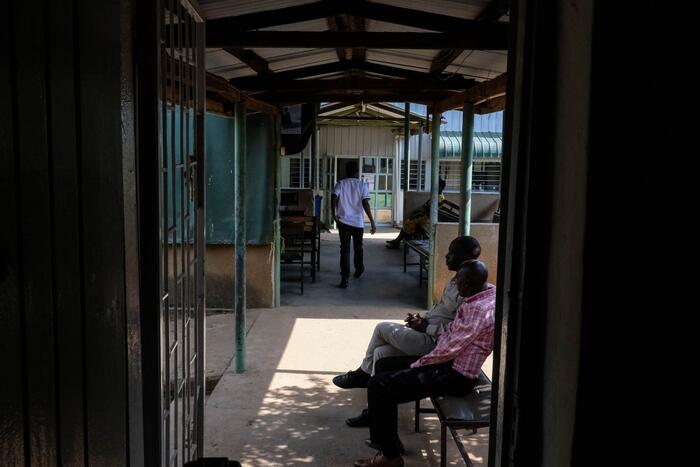


MBARARA – In Mbarara’s red-light district, a part of this western Ugandan city associated with sex tourism, Lisa Mutoni insists that clients use condoms to reduce her risk of HIV and other infections. Yet some men try to remove or deliberately damage the condom during sex.
Mutoni also takes preexposure prophylaxis, or PrEP, an HIV-prevention treatment available as daily pills or periodic injections. Now, another option is emerging for her and millions of others: lenacapavir. Clinical studies indicate that two injections a year can provide almost complete protection against HIV.
Mutoni said lenacapavir could be especially useful for sex workers who move to other areas for several months at a time.
“If you know that you have that injection for six months, you feel like you are safe,” she said. “It is very good because with the pill, sometimes you can forget to swallow it.”
Lenacapavir offers hope — and frustration
But whenever Mutoni tries to obtain what is commonly called “lena,” the medication is unavailable. “They tell me that it is finished,” she said.
Her experience captures both the promise and the frustration surrounding lenacapavir, developed by Gilead Sciences. Existing PrEP options, including daily pills and the every-other-month cabotegravir injection, are highly effective and broadly available. Still, health experts say lenacapavir’s long-lasting protection could do more than safeguard individuals; it could help alter the course of the global HIV epidemic.
For now, however, supplies remain far below what is needed in Uganda and across the world.
“The rate of growth (of lenacapavir rollout) isn’t fast enough. We need to be getting to the millions pretty soon,” said Andrew Hill, an HIV treatment specialist and senior visiting research fellow at the University of Liverpool in northwest England.
FDA clears a generic version
That could begin changing in the months ahead. The U.S. Food and Drug Administration has tentatively approved a generic form of lenacapavir, potentially accelerating production and distribution to 120 low-income countries. The medication could cost about $40 per year, dramatically below its U.S. list price of $28,218. The approval was announced Monday.
The Global Fund hopes the generic drug will reach 3 million people by the end of 2028.
Critics, including Doctors Without Borders, known by its French initials MSF, argue that target falls well short of the need. The organization is urging Gilead to supply affordable doses to more countries and sell directly to MSF, allowing it to expand access more quickly.
“Gilead says it wants to end the HIV epidemic ‘for everyone, everywhere,’ but its actions say otherwise,” Melissa Barber, MSF USA’s global health advocacy and policy adviser, said in a recent statement.
Until supplies improve, people in Mbarara — where an estimated 10% of adults live with HIV, twice Uganda’s overall rate — must rely on less convenient alternatives.
Demand is surging, but doses remain scarce
Julius Bampe, a polygamous man, was shocked earlier this year when tests showed that his younger wife had HIV. She immediately began treatment to suppress the virus, while Bampe sought lenacapavir to protect himself.
But the itinerant builder found the clinic had run out of injections when he arrived.
“When I got here, they said that is what they would have given me, but they said they didn’t have enough doses for everyone,” he said.
The facility received 40 lenacapavir doses in April and was initially instructed to reserve them for pregnant women at risk of contracting HIV. The guidance was later broadened to include couples like Bampe and his wife, sex workers and other vulnerable groups.
That supply was quickly administered. A second shipment of 70 doses arrived in June and was exhausted within 10 days, said Tarsisio Biryeija, a nursing officer and counselor at Mbarara Health Centre IV.
Uganda has sharply reduced its HIV prevalence over the past 30 years, leaving its rate well below that of several southern African nations. Even so, health officials say new infections are driven largely by transactional sex, including encounters in places like Mbarara — precisely the kind of transmission lenacapavir could help prevent.
Mutoni receives counseling, condoms and other assistance from Immaculate Nyamwija, founder of Action for Improved Health and Wealth, a Mbarara organization that supports women who may face discrimination when seeking services elsewhere.
“It is a challenge, because the demand is high and the doses are few,” Nyamwija said. “Who would not wish to take (lenacapavir) for six months? Who would wish to be on drugs every day?”
___
Gerald Imray in Cape Town, South Africa, and Laura Ungar in Louisville, Kentucky, contributed to this report.
___
For more on Africa and development: https://apnews.com/hub/africa-pulse
___
The Associated Press receives financial support from the Gates Foundation for its coverage of global health and development in Africa. The AP is solely responsible for all content. AP’s standards for working with philanthropies, along with a list of supporters and funded coverage areas, are available at AP.org.