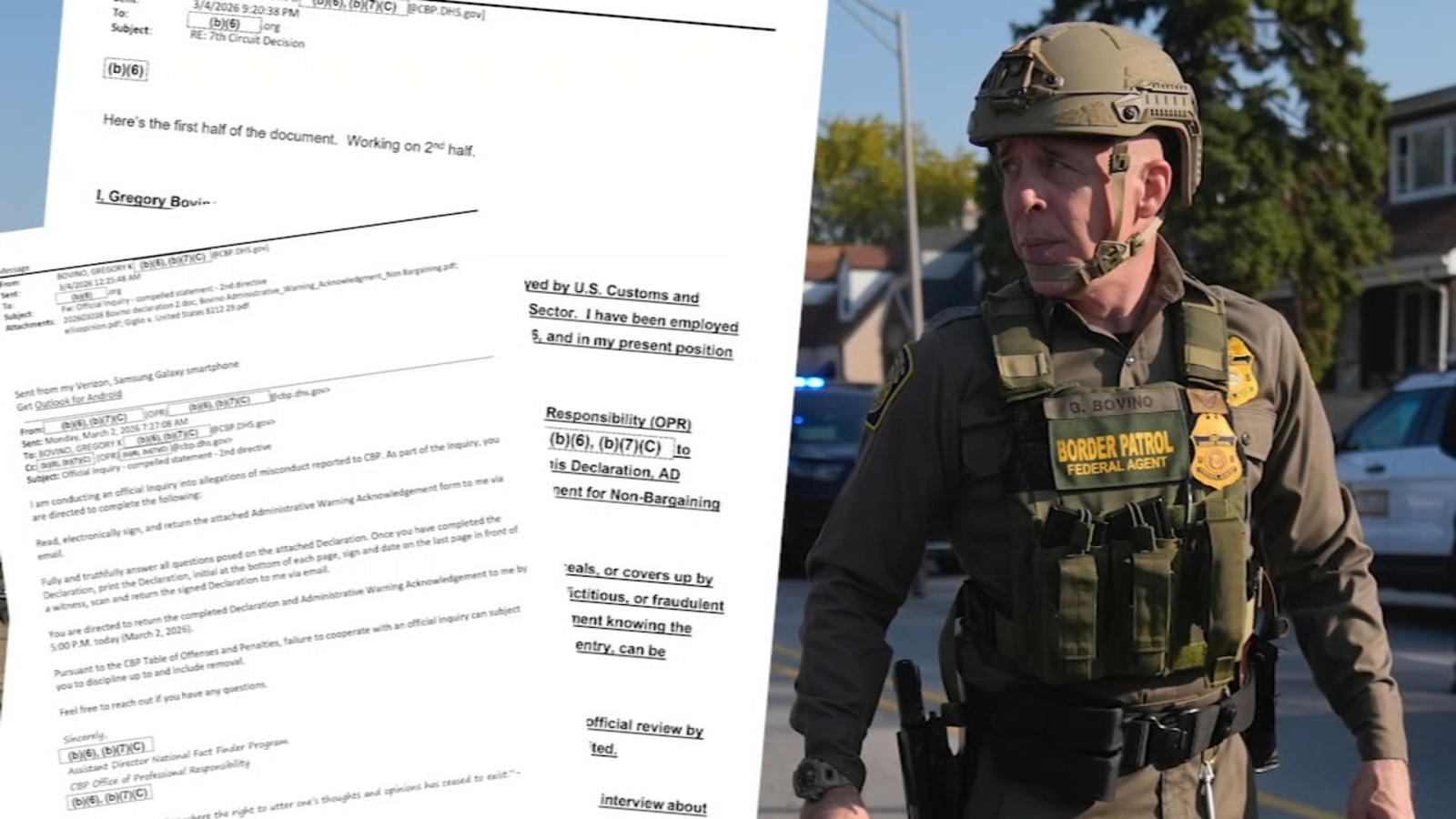

CHICAGO () — Newly released internal emails from U.S. Customs and Border Protection are offering fresh insight into the sudden departure of Gregory Bovino, the former official who oversaw aggressive immigration enforcement efforts in the Chicago area last fall.
Bovino, a former U.S. Border Patrol commander-in-chief, became the public face of “Operation Midway Blitz,” a crackdown that drew anger from residents who accused agents of creating chaos through their use-of-force tactics.
The emails, released by the federal government, indicate Bovino was the subject of an internal investigation at the time he announced his retirement last March.
Speaking to the I-Team on Tuesday, Bovino said he was “forced to leave.”
In a March 2, 2026, email, an internal investigator notified Bovino that officials were “conducting an official Inquiry into allegations of misconduct reported to CBP.” The message also directed him to answer a set of questions “fully and truthfully.”
Those questions focused on allegations that Bovino lacked credibility in a Chicago federal court case, as well as claims that he made an antisemitic remark to a prosecutor in Minnesota.
In response to questions from the I-Team, Bovino provided a statement he attributed to an attorney, saying in part that “Greg Bovino was forced to retire” and describing the investigation as politically motivated and “weaponized.”
“Bovino had enough experience to know he wouldn’t get a fair shake, a fact driven home by legal counsel who advised him to retire immediately,” the statement said.
Last November, Bovino’s tactics during Operation Midway Blitz were the focus of a federal use-of-force lawsuit filed in Chicago federal court.
In that case, U.S. District Judge Sara Ellis questioned the credibility of Bovino’s testimony, writing he was “evasive over the three days of his deposition, either providing ‘cute’ responses to Plaintiff’s counsel’s questions or outright lying.”
During a deposition, Bovino was asked about an incident where federal agents shot pepper balls at a Reverand protesting outside of the Broadview ICE detention center.
An attorney asked Bovino, “Can you look me in the eye and acknowledge that the use of force applied against Reverend Black that is depicted in the video and in these photographs is unacceptable and inappropriate and should not have happened?”
“I can tell you that I don’t know what the use of force was here, and I can’t make a judgment either way because I don’t know,” Bovino responded.
Judge Ellis cited that exchange and in a court order, wrote, “when shown video of agents hitting Rev. Black with pepper balls, Bovino denied seeing a projectile hit Rev. Black in the head.”
Ellis also referenced Bovino’s denial of his own use of force against a man he tackled outside of the facility, and another incident in Little Village captured on cell phone video showing Bovino throwing a tear-gas cannister into a crowd.
Bovino “admitted…that he lied multiple times about the events that occurred in Little Village that prompted him to throw tear gas at protesters,” Judge Ellis declared.
Bovino has repeatedly defended all use of force by immigration agents in Chicago.
“I believe that all uses of force that I’ve seen, and all arrests that I’ve seen, have been more than exemplary,” Bovino said during a Nov. 4 deposition.
In his text response to the I-Team, Bovino denied any wrongdoing, saying the country should be uniting conservatives toward true mass deportations ahead of the midterms, not doing the opposite.
The newly released emails show sixteen days after Bovino was notified of the misconduct inquiry, he announced his retirement in late March.