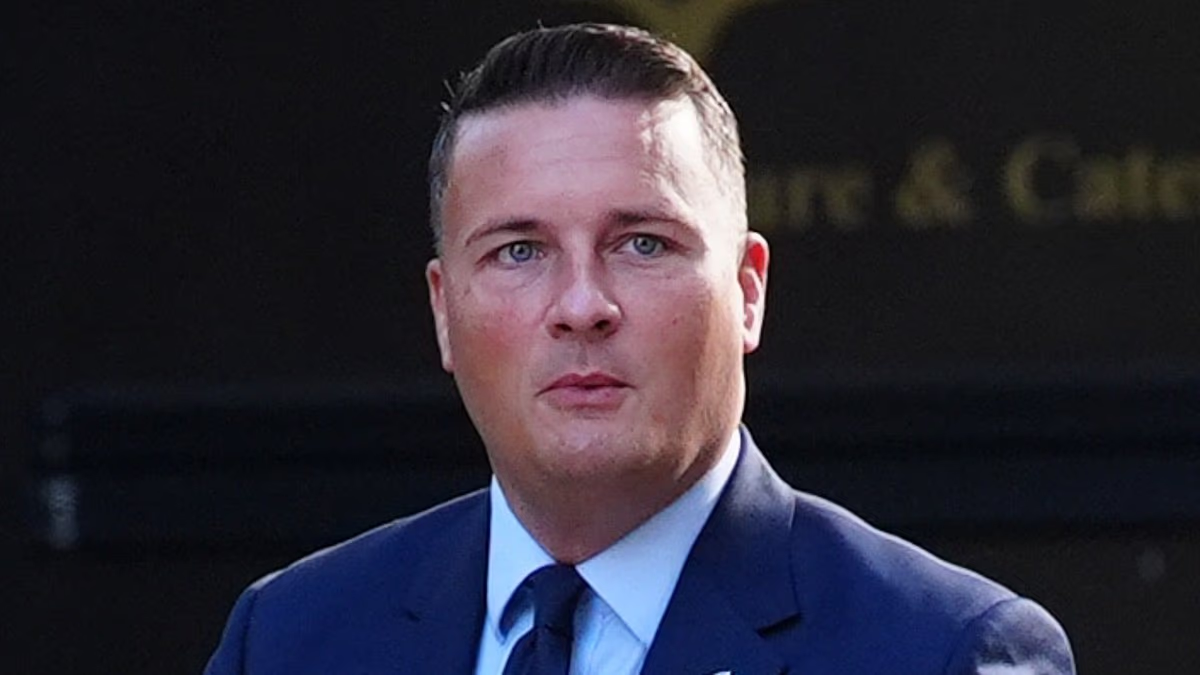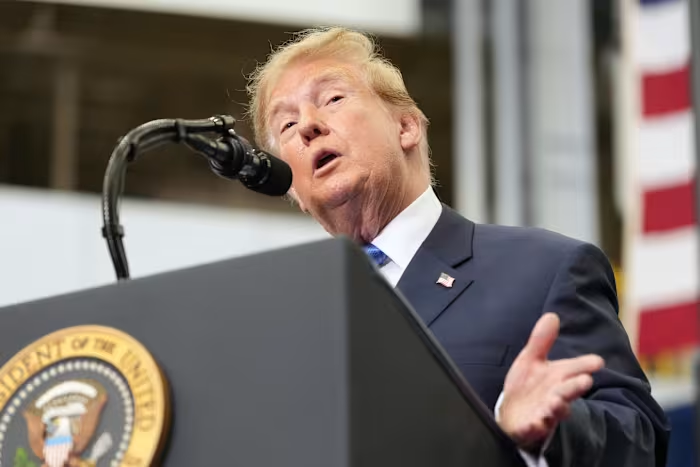

Main: East Potomac Golf Course in Washington, D.C., where the president faces a lawsuit after 37,000 cubic yards of debris from construction of the White House ballroom was left in East Potomac Park. The debris contained elevated levels of lead, mercury, arsenic and petroleum by-products, according to an emergency lawsuit filed by the DC Preservation League and members of the golf course. May 5, 2026 (mpi34/MediaPunch /IPX). Right inset: President Donald Trump walks at Trump National Golf Club in Sterling, Va., Saturday, Aug. 30, 2025 (AP Photo/Manuel Balce Ceneta).
Fresh off consecutive interim victories at the U.S. Supreme Court involving President Donald Trump’s White House ballroom project and his attempted reshaping of the Postal Service before the midterm elections, the Department of Justice is now leaning on a familiar legal playbook to defend plans for a “new” golf course at East Potomac Park.
During a Thursday afternoon hearing in the Washington, D.C., courtroom of U.S. District Judge Ana Reyes, attorneys for the federal government — representing the Department of the Interior and Interior Secretary Doug Burgum — clashed with lawyers for the D.C. Preservation League over the near-term fate of the lawsuit. The proceeding produced little progress, due in significant part to a fresh tree-related filing that landed just 10 to 15 minutes before court began.
“Isn’t it ironic?” Reyes asked from the bench. “We are here talking on the 250th anniversary of our nation’s founding about a president yet again chopping down cherry trees.”
The judge acknowledged the intensity of public concern surrounding the East Potomac Park dispute, saying, “People are pretty upset.” Reyes added that she has “received countless emails and voicemails about this issue,” including messages from one man who called “more than once and threatened to have me removed from the bench if I do not help the trees.”
“And to you, sir, I say take a number. Plenty of people are way ahead of you trying to get that done,” Reyes said pointedly. “I am not the Lorax. I do not speak for the trees. I am a judge. My job is to resolve disputes.”
With that framing, Reyes turned first to DOJ attorney Michael Robertson. She also made clear that the removal of roughly 150 “hazardous, dead, dying, or invasive” trees had not violated any order she previously issued in the case.
That was not the outcome the plaintiffs had been seeking. Instead, Reyes commended Robertson’s “terrific” work as a lawyer and said she had no basis to question his representations to the court, even as the plaintiffs remain deeply concerned that the tree removal may be tied to a broader executive plan rather than ordinary park maintenance.
“I just want to make it clear for the record, you know, because I obviously take the government following orders incredibly seriously. And in my courtroom, I can’t speak for anyone else’s courtroom, but in my courtroom today, no government attorney has violated one of my orders, and certainly not Mr. Robertson, who I think has, and I’ve said this before. I’ll say it again,” she said. “I think he’s been a terrific advocate for the government, and you have given me no reason to doubt what you said.”
Robertson said that out of some 3,800 trees in the park, 77 “invasives” and 73 “dead, dying, or hazardous” were cut down, naming mulberry trees and trees of heaven.
Mark Samburg, an attorney for the plaintiffs, complained that the government didn’t tell them about the tree removal operations that were the subject of recent news reports, activities including the “cutting down a cherry tree next to the Blue Course’s 14th hole.”
“I don’t think anything wrong has happened here because they have just been doing what I said they could do, which was continue to get rid of the invasive trees or to deal with the dying trees,” Reyes shot back, expressing frustration about discussing trees “ad nauseam.”
“If you have reason to believe that they’re cutting down live, healthy trees, by all means, let me know, and we can get on it then,” the judge said, before getting to the main purpose of the hearing.
When the DOJ recently challenged a Massachusetts federal judge’s injunction blocking the USPS from implementing Trump’s executive order, it persuaded the conservative majority on the Supreme Court that blue states didn’t have standing to sue because there was not yet a “final rule” to block. Even more recently, Chief Justice John Roberts led a dissent, joined only by the court’s liberal bloc, lamenting that the majority allowed Trump’s “likely unlawful” White House ballroom project to continue.
The majority said the administration was “likely to prevail in showing” that the National Trust for Historic Preservation and architectural historian Alison Hoagland lacked standing to bring “aesthetic injury” claims after the president’s East Wing teardown.
These are the kinds of “substantial developments” that Reyes, a Joe Biden appointee, may have anticipated in her Aug. 13 order.
That day, she found that the D.C. Preservation League’s “operative complaint” was “outdated” and ordered the plaintiff to tell her if the group would amend its lawsuit.
On Aug. 18, the plaintiffs expressed their intent to “file an amended and supplemental Complaint.” Thereafter, the parties clashed on how best to handle briefing ahead.
The DOJ has gone back to the well, arguing that there’s nothing for Reyes to block because there’s no “final agency action” and no standing to sue over “offense, disagreement, or distaste,” citing the high court’s reasoning in both the USPS and ballroom cases.
On Thursday, Samburg expressed concerns that the government might move quickly on construction and asked Reyes to compel the Trump administration to file notices on whether it is following the law.
The plaintiffs, not wanting the case to be bogged down by “serial complaints and briefing schedules,” had asked the judge to “require” that the Trump administration “give notice to the Court and Plaintiffs within 24 hours after Defendants’ completion or decision to forgo” various “legal compliance steps” before they “break ground on the overhaul of East Potomac Golf Course.”
Those steps include the “preparation of an environmental assessment or environmental impact statement; National Historic Preservation Act consultations; preparation of an [National Park Service] Organic Act non-impairment determination; and obtaining [National Capital Planning Commission] NCPC approval.”
“It just strikes me as a little bit odd for me to say to the government, ‘You need to tell the plaintiffs when you’re following the law,'” she said. “The government just either follows the law or they don’t follow the law. They don’t sort of provide notice that ‘hey, we’re following the law, or hey, we’re breaking the law.'”
There were a few references to the Supreme Court’s intervening rulings and how they may impact the D.C. Preservation League’s case, and one of them got right to the heart of the matter: “standing.”
Reyes asked if the plaintiff “still has a claim” if the government follows all the procedural steps.
Samburg answered that the group has “live claims” regarding the “dirt.”
“Well, the dirt you’re going to have a standing issue with, no?” Reyes asked. “I mean, given the Supreme Court’s recent —”
According to the group’s attorneys, who also include Abbe Lowell and Norm Eisen, “both” Supreme Court rulings the DOJ relies on “are inapposite to this case” due to the environmental implications of dumped “toxic debris”.
Whatever the case may be, Reyes would not force the DOJ to file notices of compliance and suggested the parties “figure that out” on their own.
“Look, I understand the government’s concern with not wanting litigation lingering that they don’t believe should be in the court system. I understand plaintiffs’ concern. I mean, in fairness to the plaintiff, Mr. Robertson there is a reason that they have very little faith that things won’t happen before they can do something about it. Not based on your conduct, and not based on this case, but based on other things that have happened. Those are all out of my hands. I have no — I take no position on them other than to say I understand where the plaintiffs are coming from. I understand where you are coming from.”
“We’re going to move forward,” she said. “I want an amended complaint so I have something clean to work off of.”
The post Judge unswayed by ‘odd’ request to act as watchdog over DOJ after she’s inundated by angry calls about felled trees at golf course, possibly tips hand on outcome first appeared on Law & Crime.