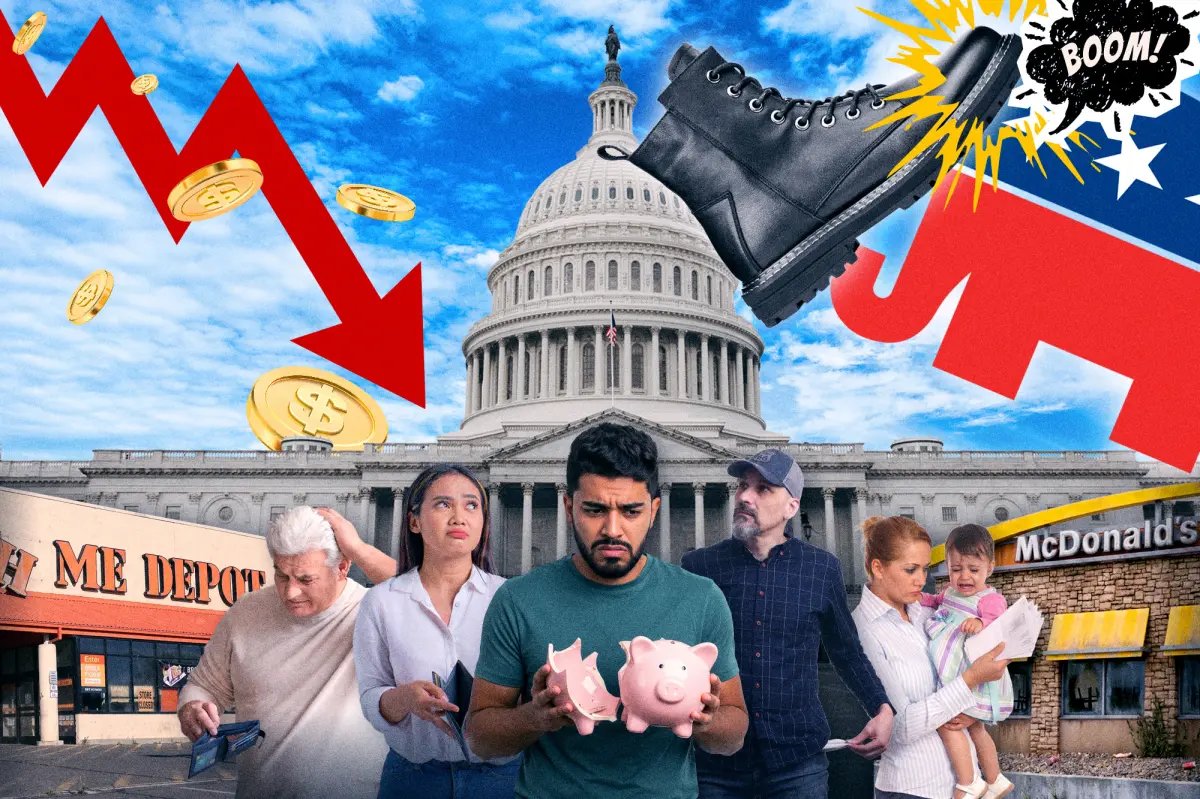

Wall Street’s biggest players are showing more concern about the GOP’s midterm outlook than many everyday investors — and weakness in names like Home Depot and McDonald’s helps explain why, On The Money has learned.
The prevailing view across prediction markets such as Kalshi and Polymarket, financial-TV chatter and retail-trader forums is that Democrats are positioned to retake the House, while control of the Senate remains much less certain. Even with respectable polling for some Democratic candidates, the party’s embrace of hard-left contenders in states like Texas and Michigan could still leave Republicans with an edge in the upper chamber.
But major Wall Street traders, whose large positions tend to be backed by deeper research, are seeing more political risk than the headline consensus suggests. Their focus is on the sharp pressure hitting consumer-facing stocks, a signal that spending trends in middle America may be weakening — and that President Trump’s working-class coalition could be feeling the strain.
To be sure, Democrats are also taking risks of their own as socialist-aligned candidates gain visibility at the party’s edges. DSA-style politics, boosted in New York City by figures such as Mayor Zohran Mamdani, may have more traction in deep-blue urban areas than in battlegrounds like Texas and Michigan, where candidates including Abdul El-Sayed could prove a tougher sell statewide.
On the surface, Republicans still have plenty of economic data to point to. The Nasdaq, Dow and S&P are trading at record levels. Employment and GDP figures suggest the economy remains resilient. Americans are working, wages appear to be rising, and inflation — even with the Iran conflict pushing oil and gasoline prices higher — has stayed relatively contained.
More From Charles Gasparino
That is the bull case. The problem for the GOP is that a closer look beneath the headline numbers tells a more complicated story.
Top-line statistics can obscure what households are actually experiencing. Inflation reached 9% at one point under Joe Biden, while under President Trump it has been running between 3.2% and 3.4%. But inflation measures the pace of price increases, not whether prices are falling. For many consumers, costs are still climbing from already painful levels.
Trump’s tariff agenda has added to those pressures and is one reason inflation remains above the Federal Reserve’s long-standing 2% target. Chairman Kevin Warsh has little room to cut short-term interest rates; doing so could convince the bond market that he is turning dovish and push up the crucial 10-year Treasury yield, the benchmark that helps set consumer borrowing costs.
The 10-year is already under pressure from inflation and competition for capital for the AI infrastructure buildout, which has provoked Treasury Secretary Scott Bessent to intervene, buying Treasurys to suppress yields (which move in the opposite direction of prices).
That is just the beginning. Larry McDonald from the Bear Traps Report points to two charts that speak directly to how the average American consumer feels about the economy, as opposed to speculators jumping on the AI bandwagon that is powering the major indices.
The first is a stock chart for Home Depot, a bellwether for the middle-class housing market. The second is for McDonald’s. Both have underperformed the S&P for more than a year, a strong indication that working-class consumers are cutting back because of rising prices and tepid wage growth.
“These charts are painting an ugly picture for Trump and the Republicans,” McDonald tells On The Money. “These are consumer-facing stocks, not diluted by big tech names that are pumping indices.”
Of course, I can find plenty of naysayers. Bob Sloan of S3 Partners, a data firm that tracks long and short interest in stocks, says the negative bets on McDonald’s, Home Depot and other US consumer discretionary stocks he tracks are pulling back from a peak of 10.6% in July to 10% this week (Disclosure: Bob is my partner on the Risk and Return Podcast).
McDonald’s, in fact, hit a 10-year high in short interest in July before it began pulling back, signaling a weakening of bearish sentiment, S3’s data shows IMHO, Trump voters have lots of reasons to turn out for the GOP given the lefty surge of the Democrats.
Still, it seems that some of the savviest players on Wall Street are getting more worried about the price of houses and burgers. The GOP and investors alike should take note.


