
Boston — A federal judge on Thursday scrutinized the Justice Department over the Trump administration’s push to roll out new mail voting rules only weeks before the November midterm elections, while voicing concern that the changes could leave some voters unable to cast ballots.
Attorneys for the federal government and for a coalition of Democratic-led states, backed by voting rights organizations, appeared before U.S. District Judge Indira Talwani as the court considered whether to keep a block in place on the U.S. Postal Service’s new rule ahead of the approaching elections.
The states and voting rights advocates challenging the mail ballot regulations say the policy violates the Constitution and are seeking a more lasting court order to stop it.
Talwani did not issue an immediate decision from the bench, but said she planned to release an order as quickly as possible.
“I’m here 70 days before the election and I have nothing from USPS telling me how this will happen,” Talwani said.
After Talwani asked for additional details, Steven Monteith, the Postal Service’s chief customer and marketing officer and executive vice president, said in a declaration filed Thursday afternoon that USPS is still “make refinements” to its portal and expects it to be ready for voluntary use “by sometime next week.”
Monteith also said the Postal Service is not “currently” requiring reviews of mail ballot envelopes to determine whether they meet the new rule, though states may “voluntarily” send envelopes to the agency for review.
The dispute stems from an executive order Mr. Trump signed in March directing his administration — including the Postal Service and the Department of Homeland Security — to pursue tighter restrictions on mail voting. One part of that order, requiring Homeland Security to prepare and provide election officials with state-by-state lists of residents who are U.S. citizens, has already gone into effect.
Mr. Trump’s executive order is part of several actions his administration has undertaken to expand federal control over elections, though many have been challenged in court. Shortly after the president signed the directive involving mail voting, a group of 23 states filed a lawsuit seeking to block it.
Talwani, who presided over that case and a different lawsuit brought by voting rights groups, barred the Trump administration in June from implementing the executive order, including the provisions involving the Postal Service.
But last month, the Supreme Court granted a Justice Department request to freeze that decision. The high court, divided along ideological lines, said that the states’ lawsuit was premature. But the conservative majority did not address the legal merits of the president’s policies for mail voting.
It’s likely that the latest case involving the Postal Service’s final rule lands back before the justices in the coming weeks.
At the beginning of Thursday’s hearing, lawyers for the Justice Department said that if Talwani does not issue her decision on a preliminary injunction right away, they will leapfrog the federal appeals court and ask the Supreme Court to intervene.
Missouri’s solicitor general, Louis J. Capozzi, suggested that Talwani should make compliance optional in every state. Missouri intervened in the case along with 11 other Republican-led states, and is defending the mail-ballot rules.
“So we’re going to do a test run on this election?” Talwani asked the lawyer. “We’re not playing an intellectual puzzle game. We’re talking about people’s right to vote.”
“You want me to say, ‘Well, let’s see how this works out?'” Talwani later added, referring to the proposal as a “laboratory” and “experiment.”
The judge also raised concerns about allowing some states to follow the Postal Service’s requirements given the prospect that some mail ballots could be rejected.
“How does USPS holding up the ballots help you?” she asked. “You want the voters in your state to be disenfranchised?”
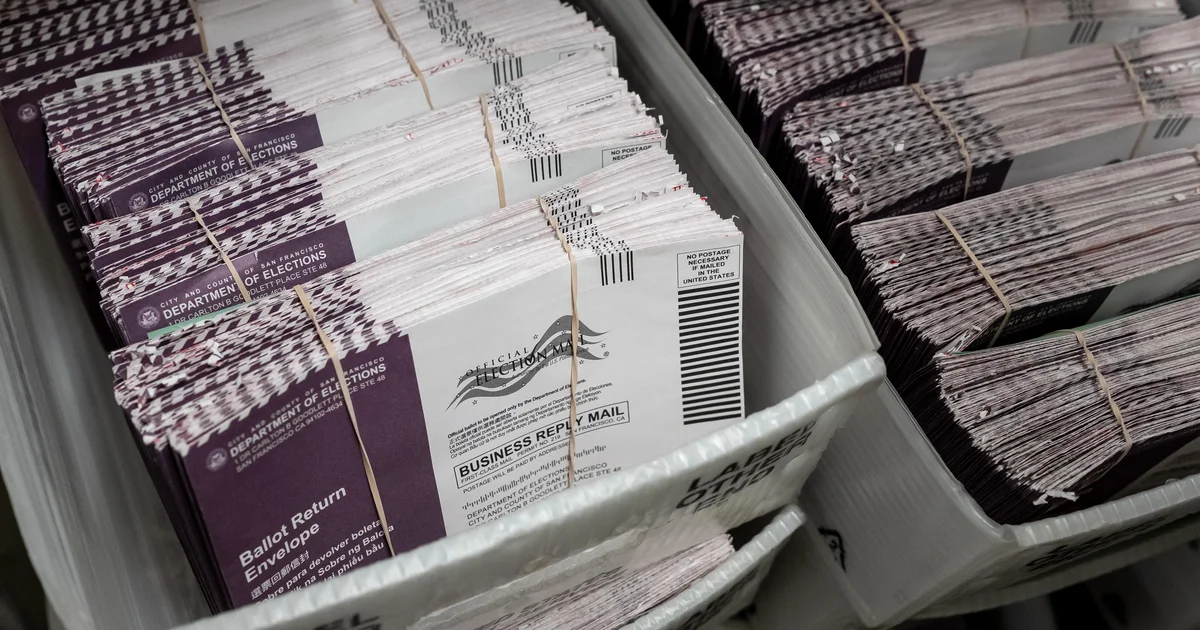
Under the final rule published by the Postal Service last month in response to the executive order, mail ballots must adhere to certain design requirements, including individualized unique bar codes, and states must submit to an online portal the names and addresses of voters set to receive mail ballots.
Voters are also enrolled on state-specific “Mail-In and Absentee Participation Lists.” The agency has said it “will not play any role in determining voter eligibility, maintaining voter rolls, or counting ballots.”
Mr. Trump, who has voted by mail this year in Florida’s elections, has long argued that the restrictions on mail voting are necessary to protect election integrity in future U.S. elections. The Trump administration has not put forth evidence of widespread voter fraud.
Shortly after the rule was published, a group of 24 Democratic-led states and the District of Columbia filed a lawsuit arguing that the measure is unlawful. The states argued that the regulations interfere with their ability to administer elections under their own laws.
Thursday’s arguments came after Talwani temporarily blocked the Postal Service from enforcing the requirements. Talwani’s order, set to last 14 days, was appealed by the Trump administration shortly after being issued. The U.S. Court of Appeals for the 1st Circuit has not yet acted on that appeal.
In her decision, issued Aug. 27, the judge said the regulation is “likely unconstitutional” and “practically impossible” to comply with for the November midterm elections, which are just over two months away.
The states, she wrote, “have neither time nor funds to design new mail ballots, seek approval of the new designs, order production of mail ballots, update their own election management systems, train election officials to use the USPS portal, and upload citizen data to the portal, all before the midterms.”
In North Carolina, election officials will begin mailing ballots Friday, and ballots will go out in several other states around mid-September, according to the Center for Election Innovation and Research.
The short time frame for implementation of the new regulations was underscored this week in a whistleblower disclosure submitted to Democratic Sen. Richard Blumenthal. The whistleblower, described by lawyers from Whistleblower Aid as a federal official, warned there could be “potentially catastrophic problems” with the Postal Service’s new system for handling mail ballots.
The official also said the new verification process could keep large numbers of mail ballots from being delivered to voters because of a “zero percent failure rate.” In the disclosure, the whistleblower alleged that the Postal Service violated Talwani’s earlier orders by moving ahead with implementing the president’s directives.
Voting rights groups provided the disclosure to Talwani on Tuesday.
Editor’s note: This story has been updated to correct the attribution of a quote from Missouri’s solicitor general, Louis J. Capozzi.