
Reactions like these suggest a basic misreading of how the American legal system is designed to work.
The result in the Clancy trial may have disappointed some observers, but it remains an example of the justice process functioning as intended.
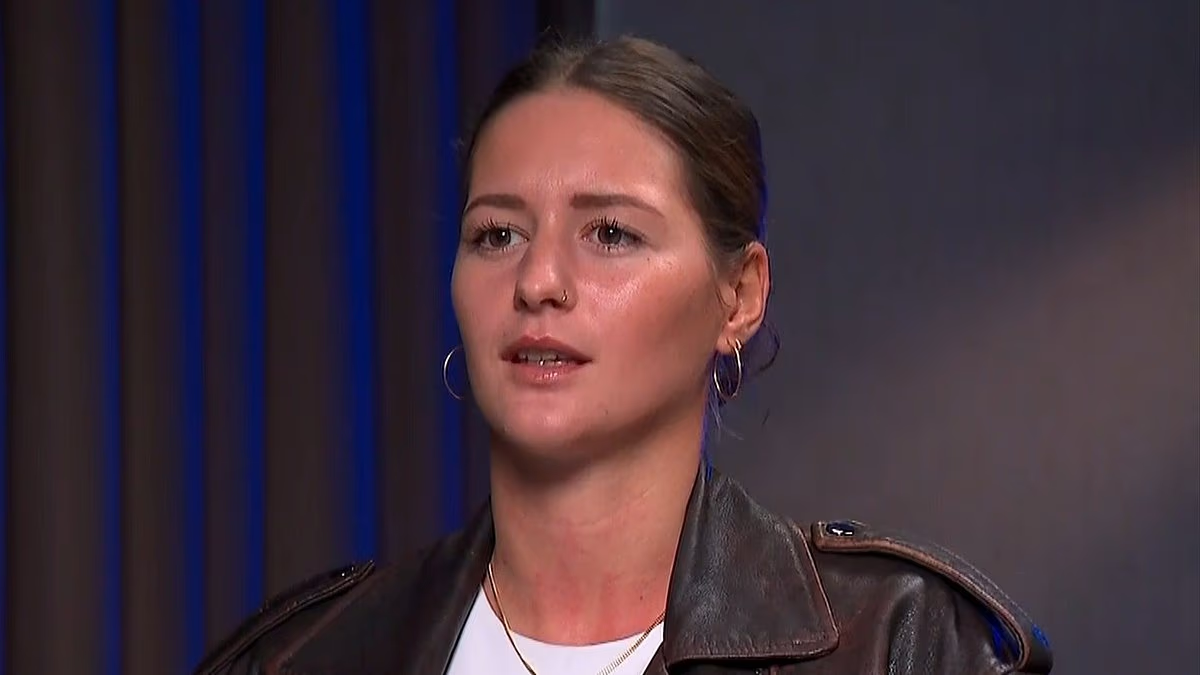
On Friday, Judge William Sullivan thanked and dismissed the Massachusetts jury made up of nine women and three men, formally declaring them “deadlocked” after they failed to reach a unanimous decision in the five-week trial of the 36-year-old mother accused of the premeditated murder of her three children.
Jurors told the court three separate times that they had reached an impasse. Each time, Judge Sullivan directed them to keep deliberating. But after roughly 35 hours of discussions across three days, he ultimately had no viable legal option other than to declare a mistrial.
That means the case ended with a hung jury. Clancy was neither convicted nor acquitted, and prosecutors may choose to try her again.
A mistrial should not be mistaken for a collapse of the jury system. Hung juries have been part of criminal justice for centuries and often emerge in cases where the public itself is sharply split over a defendant’s guilt or innocence — as appears to be true here.
In that sense, a divided jury can mirror the broader uncertainty felt across society, especially when the legal questions before jurors are anything but straightforward.

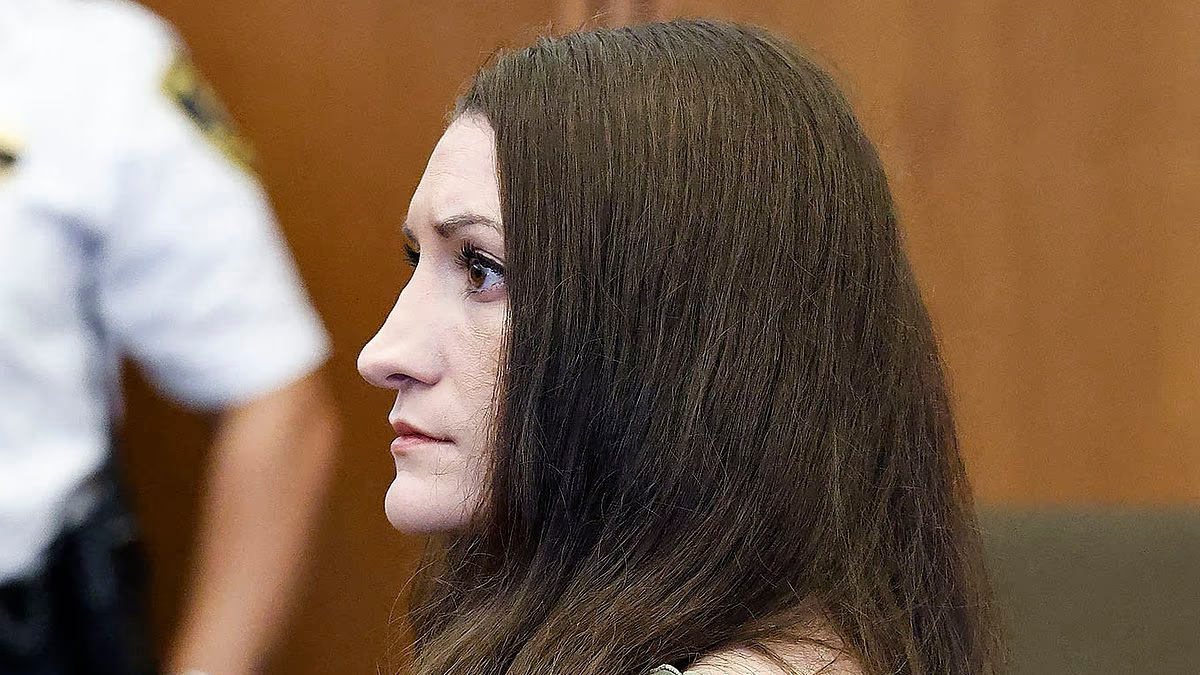
Judge William Sullivan thanked and discharged the Massachusetts jury of nine women and three men on Friday after declaring them “deadlocked” in Lindsay Clancy’s trial

For too many, the mistrial in the case looks to be a travesty of justice and makes her lawyer Kevin Reddington the villainous defender of a baby killer
Clancy’s lawyer argued that she was not guilty by reason of insanity, specifically postpartum psychosis, allegedly exacerbated by poor medical treatment and overmedication. Clancy’s medical providers have denied any wrongdoing.
The criteria for legal insanity are matters of degree about which even experts disagree. But the law is not a scalpel. It is a blunderbuss. That is why this outcome may best reflect justice, considering the complexity of this case.
Only dictatorships can guarantee the quick and clean application of justice. A free society must accept that it is not that simple.
The mistrial is not the end of this emotional and divisive roller coaster. It is a midpoint in an ongoing process that will involve appeals, retrial on some or all of the charges or even a plea deal.
It is certainly no outright victory for the defense.
Defense lawyer Kevin Reddington desperately sought a verdict rather than a hung jury. He appealed to Judge Sullivan to replace a single juror with an alternate after it presumably became clear that one person on the panel was refusing to go along with the 11 other jurors in favor of a not guilty verdict.
The judge denied that request. Reddington then requested the jurors be polled to determine whether they reached not guilty verdicts on any of the first-degree and second-degree murder and manslaughter counts.
Far from a bad actor, Reddington showed himself to be a resourceful attorney, one that any defendant would want to handle their case.
If the jurors had reached a consensus on any of the charges that may preclude retrial on those counts. Reddington will likely argue that the judge improperly declared a mistrial and that the 11 to one vote in favor of a not guilty verdict should constitute a final acquittal. Under the US Constitution, no person can be tried twice by the same government for the same crime.
The proceedings ended Friday without the judge allowing the jurors to be surveyed, but that does not preclude the defense from questioning the jurors or securing their sworn affidavits at some later date.
Meanwhile, the prosecution, knowing that had not adequately persuaded this jury, was advocating for a mistrial so that they could hopefully present a stronger case to a different jury.
They may, in fact, learn from this experience. They may decide to seek a sequestered jury (which was not the case in this closely-covered and highly-charged trial), a change of venue or reduced charges.

Far from a bad actor, Reddington showed himself to be a resourceful attorney – one that any defendant would want to handle their case

The jury was unable to reach a unanimous verdict after Clancy’s five-week trial
The overwhelmingly one-sided jury vote may have an impact on the district attorney’s decisions going forward. It may open the door to a compromise plea bargain, something the defense may accept.
Such a deal might entail Clancy pleading to lesser offense. She would have to admit her guilt as part of such a plea bargain but she could still claim that she was mentally ill. Both sides could claim victory and she could receive the mental health treatment that I believe she plainly requires.
Beyond this case, a hung jury may result in Massachusetts changing their laws governing insanity cases. That’s what happened after John Hinkley was acquitted by reason of insanity by a Washington DC jury for the attempted 1981 assassination of President Ronald Reagan and his press secretary.
In the District of Columbia and several other states, the burden of proof was changed, making it harder for a defendant to be acquitted on these grounds. But Massachusetts did not follow suit.
Commonwealth law still places a heavy burden on the state to prove beyond a reasonable doubt that the defendant was not mentally ill or that they could not appreciate the nature of their act or conform to the law. It’s difficult to prove a negative; to prove it beyond a reasonable doubt approaches the impossible, especially when the defendant is clearly mentally ill.
Massachusetts legislators may now be inclined to revisit this law. Any change could not apply to a retrial in this case, so if there is a second trial the prosecution would still have to satisfy its heavy burden.
Cases like this rarely end with absolute clarity, which may be the way it should be.