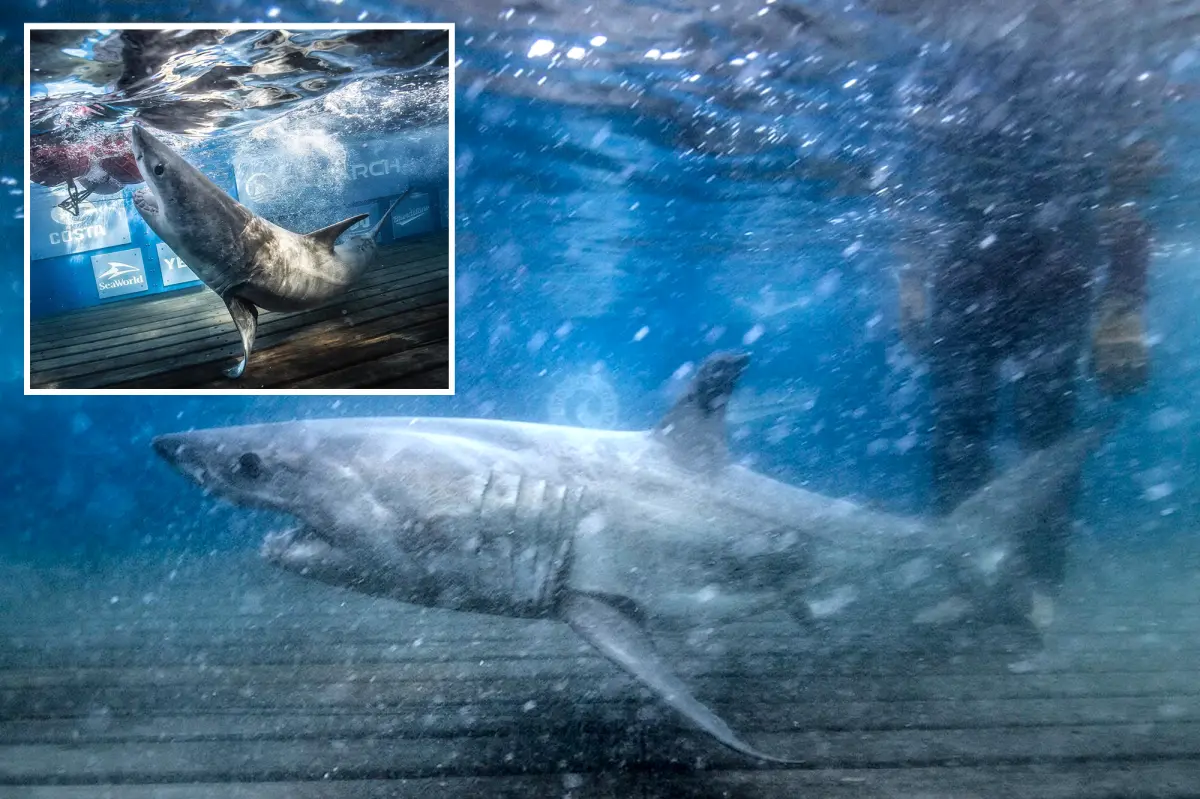

A groundbreaking genomic study of white sharks in the Western North Atlantic—believed to be the first of its kind—has uncovered new clues about how these apex predators move, reproduce and return to familiar waters.
The recent DNA research, led by OCEARCH, found that two white sharks tagged by the organization in 2021 and 2022 are not just connected by migration routes—they are brother and sister.
In all, OCEARCH said the genetic analysis identified three pairs of full siblings among great white sharks, along with seven pairs that are considered likely half-siblings.
One of the full sibling pairs is believed to have been born in the same litter, while the other two pairs appear to have been born five years and 19 years apart, respectively.
“The collaborative research, conducted using genetic samples collected by OCEARCH and collaborating scientists, marks the beginning of an entirely new chapter in understanding white shark biology and ecology,” OCEARCH said.
Researchers hope the findings will help explain why white sharks return to the same seasonal habitats year after year—and whether family ties may play a role in those patterns.
“This research changes the questions we can ask,” said Chris Fischer, founder and expedition leader of OCEARCH. “For most people, white sharks are the ultimate lone predator. But every expedition reminds us the ocean is more complex than we imagine. For years, OCEARCH has helped reveal where white sharks travel across the Atlantic. Now we’re beginning to understand the families behind those journeys. Every new discovery brings us closer to understanding how these remarkable animals live, reproduce, and survive—and that knowledge is essential to returning our world’s oceans to balance and abundance.”
The investigation gained momentum in 2025, when scientists noticed that a tagged shark named Jekyll was following migration patterns strikingly similar to another white shark known as Simon. That overlap raised the possibility that the two might be related.
The DNA results ultimately showed Simon and Jekyll were not relatives. Instead, researchers discovered that Jekyll shares both parents with another tagged white shark, Olympia, making the two full siblings born five years apart.
Olympia was tagged by OCEARCH in 2021 while she was still a juvenile off the coast of Cape Cod. Her tracker stopped transmitting public location data in 2022.
Jekyll was also a juvenile when he was tagged in 2022 near Jekyll Island, Georgia, the location that inspired his name. His tracker stopped publicly reporting data in 2024.
OCEARCH said the study also showed that every full sibling pair had been sampled in comparable seasonal habitats, with one sibling documented in the southeastern United States during winter or spring and the other recorded in New England or New York during summer or fall.
And while this information is important, researchers stressed it does not mean that white sharks recognize one another, intentionally travel together or inherit their migration routes.
“This study is really the beginning, not the end,” said Dr. David Portnoy, an OCEARCH collaborating scientist and principal investigator of the study conducted at Texas A&M University-Corpus Christi.
“We’ve identified close family relationships among Western North Atlantic white sharks, but we’ve only scratched the surface of what those relationships may tell us. By integrating genomics with years of satellite tracking data, we can now begin exploring whether related sharks share similar patterns of habitat use or migration. Those are exciting scientific questions, but they’ll require additional research before we understand exactly what patterns exist and why.”
The findings also raise the question of population size in the Western North Atlantic. With multiple sibling pairs identified from a small sample collection, it could suggest a small population of white sharks.
OCEARCH said if supported by further analysis, this finding could have significant implications for conservation policies aimed at rebuilding the Western North Atlantic white shark population.
“For OCEARCH, the findings represent another milestone in its mission to transform our understanding of white sharks and the oceans they help sustain. The organization has spent nearly two decades building the world’s largest open-access database of white shark movement and biological information,” OCEARCH said.
“This latest research expands that mission from documenting where sharks travel to exploring how family relationships may shape their lives across generations.”
Track great white sharks like Olympia and Jekyll with OCEARCH’s free global shark tracker app.