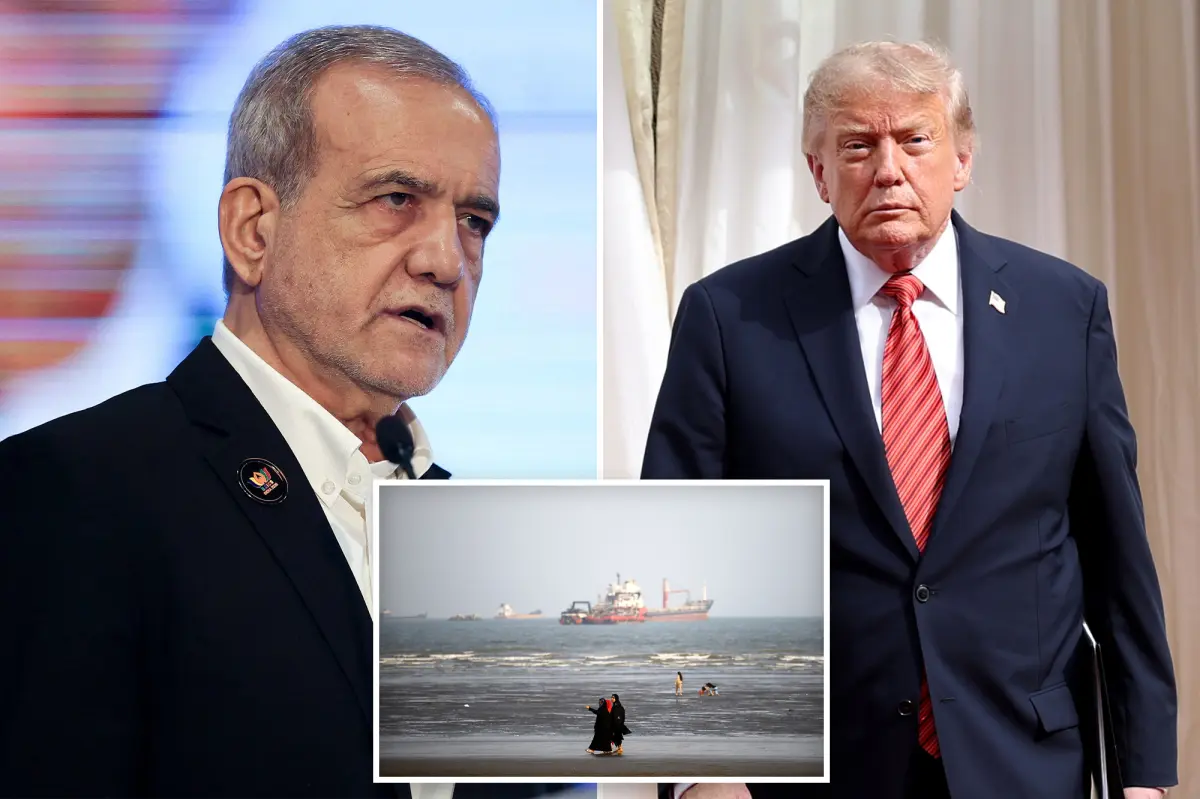

Iranian President Masoud Pezeshkian said Tehran would not back down in the face of pressure from the United States and Israel, delivering a forceful message as the conflict put two of the Middle East’s key shipping corridors at risk.
Speaking to religious leaders in New Delhi late Friday, Pezeshkian declared that Iran had successfully resisted both Israel and the US.
“Because we stand for truth and justice, we will not submit to bullying and arrogance,” he said.
The Iranian president also alleged that American attacks were harming civilians.
“If the Americans consider themselves warriors, they should confront our brave military forces,” Pezeshkian wrote on X.
He questioned why Washington would target civilian infrastructure, food supplies and the livelihoods of ordinary people.
“If they are truly human, why prevent people from obtaining water, food and medicine?” he asked.
Pezeshkian added that Iran’s population could not be forced into submission, declaring that the country would not surrender.
His comments came just before the BRICS Summit in India, several days after President Donald Trump defended the US military operation against Tehran.
“If I had to make the decision again, I would do exactly what I did,” Trump said Thursday, maintaining that Iran represented a danger to Israel, the wider Middle East and American cities.
Pezeshkian’s defiant statements coincided with a new diplomatic push by Iran, as the conflict continued to raise concerns about global energy supplies and international maritime commerce.
On Saturday, Iran and the United Arab Emirates supported a joint BRICS statement voicing “deep concern” over the escalating violence in the Middle East and calling for restraint, despite the deterioration of relations between Tehran and Abu Dhabi during the war.
Pezeshkian also met Abu Dhabi Crown Prince Sheikh Khaled bin Mohamed bin Zayed on the sidelines of the summit, as regional governments sought to prevent the fighting from spreading further.
Indian Prime Minister Narendra Modi, who met Pezeshkian on Friday, underscored the need to protect seafarers, maintain freedom of navigation and safeguard maritime commerce.
Modi also reiterated India’s call for resolving the conflict through “dialogue and diplomacy.”
The push for diplomacy comes as Iran prepares for talks in Oman on Monday over the Strait of Hormuz, where commercial traffic has been severely disrupted during the war.
But a senior Iranian official told Reuters on Saturday that the Oman meeting was not expected to produce a signed agreement on the Strait of Hormuz, one of the world’s most important oil-shipping chokepoints.
Tehran is seeking a greater role in managing passage through the strait, including the ability to collect fees from vessels.
Riyadh temporarily shut its East-West oil pipeline after a drone attack targeted the critical conduit, which allows Saudi crude to bypass the Strait of Hormuz and reach export facilities on the Red Sea.
Saudi officials said the drones were launched from Iraqi territory but stopped short of publicly blaming Iran. Trump said Saturday that he believed Iran was “probably” responsible for the attack.
Saudi Arabia said it would not retaliate immediately, giving Baghdad an opportunity to prevent further attacks originating from Iraqi territory.
Brent crude settled Friday at $104.61 a barrel, while US benchmark West Texas Intermediate finished at $100.05 — up roughly 18% and 21%, respectively, from Aug. 14.