
FBI official outlines Peoria explosive device investigation
FBI Special Agent in Charge Ryan Presley commends the coordinated response by the FBI, Peoria Police Department and ATF after authorities discovered a credible explosive device in Peoria. Presley said a suspect was quickly taken into custody and urged residents to remain alert and report suspicious activity to help protect the community and the nation.
The Army is telling residents of a southeastern Iowa town to leave their homes temporarily Friday while crews prepare to destroy five tons of a bomb-making chemical that has become an “explosive safety hazard” and was determined to be too dangerous to move.
Officials said the planned destruction of 68 drums of lead azide at the Iowa Army Ammunition Plant in Middletown will produce an airborne plume containing some lead particles that could later settle on the ground. Lead azide is used to initiate explosives in munitions.
“Although strict safety protocols will be in place, the controlled detonation will create temporary noise, ground vibrations and a dust plume containing some lead,” the Army said. “People in Middletown will hear a loud blast, feel vibrations from two rapid detonations and see a dust plume that is expected to dissipate within about an hour, depending on wind conditions.”
Middletown has a population of nearly 400, but thousands of people live within the projected plume area. Authorities have notified communities located as far as 100 miles away.

Degraded lead azide is scheduled to be detonated Friday, Nov. 20, 2026, at the Iowa Army Ammunition Plant in Middletown. (Lori McFate/U.S. Army)
Middletown residents were informed in March that the Army had to dispose of several dozen barrels of lead azide. The material was discovered after the ammunition plant halted operations during a review.
“The safety of our people and our neighbors is non-negotiable,” Lt. Col. Daniel Nosse, the plant’s commander, said at the time.
During an October public meeting in Middletown, Army officials provided additional information and said the detonation would take place sometime in November. The Environmental Protection Agency approved an emergency permit Nov. 13, clearing the way for Friday’s operation.
MUST READ: Gernot Reinstadler’s 1991 Wengen Ski Crash: What Happened?
“EPA issued the Emergency Permit based upon the determination that the explosion risk from the degraded condition of the lead azide presented an imminent and substantial threat to human health and the environment,” the agency said.
The EPA said the Army had supplied information showing that lead azide stored over a long period had undergone recrystallization. That process made the material vulnerable to friction and shock, creating a serious risk of spontaneous explosion and an unstable, dangerous condition.

The pack production process for 155 mm rounds is shown at the Iowa Army Ammunition Plant. (U.S. Army photo by Shawn Eldridge, U.S. Army Sustainment Command)
The Army said its explosives-safety specialists determined the material could not be safely handled or transported. As a result, officials concluded that in-place detonation was the only viable disposal method.
According to the Army, the barrels will be destroyed inside concrete, earth-covered magazines protected by Hesco barriers filled with sand and standing approximately two stories tall.
Middletown residents have been instructed to leave their homes between 8 a.m. and 2 p.m. local time Friday.
Authorities have also published maps depicting the potential path of lead dust drifting north toward nearby communities. Several schools located within the projected plume area have canceled classes.

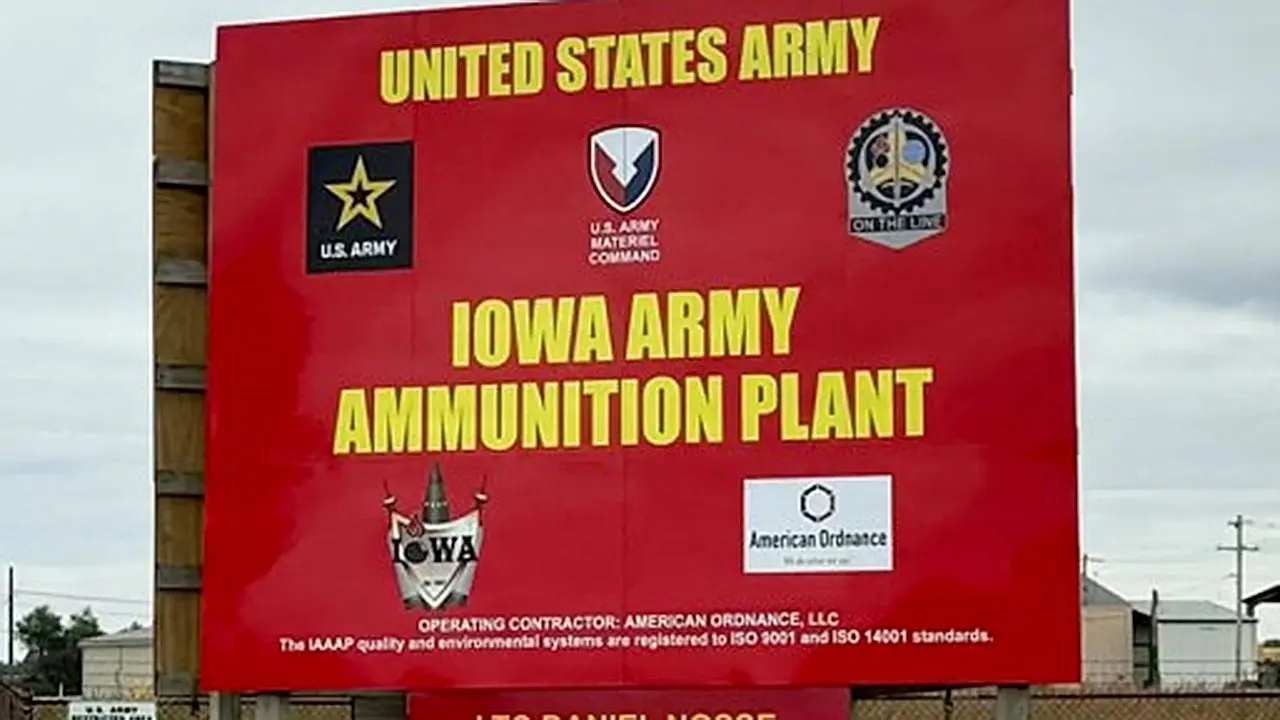
The Iowa Army Ammunition Plant is located in Middletown, Iowa. (U.S. Army via AP)
The Army said the soil covering the magazines will be saturated with water before and during the blast, while water misters spray the area. Officials said those precautions should limit the amount of lead released into the air and carried beyond the installation. Extensive modeling indicates airborne lead levels could rise but should remain well below the threshold at which the EPA would require protective measures, the Army said.


