
Andy Burnham is under growing pressure to set out how his government intends to increase defence spending, with demands coming from both Nato’s leadership and Labour’s trade union backers.
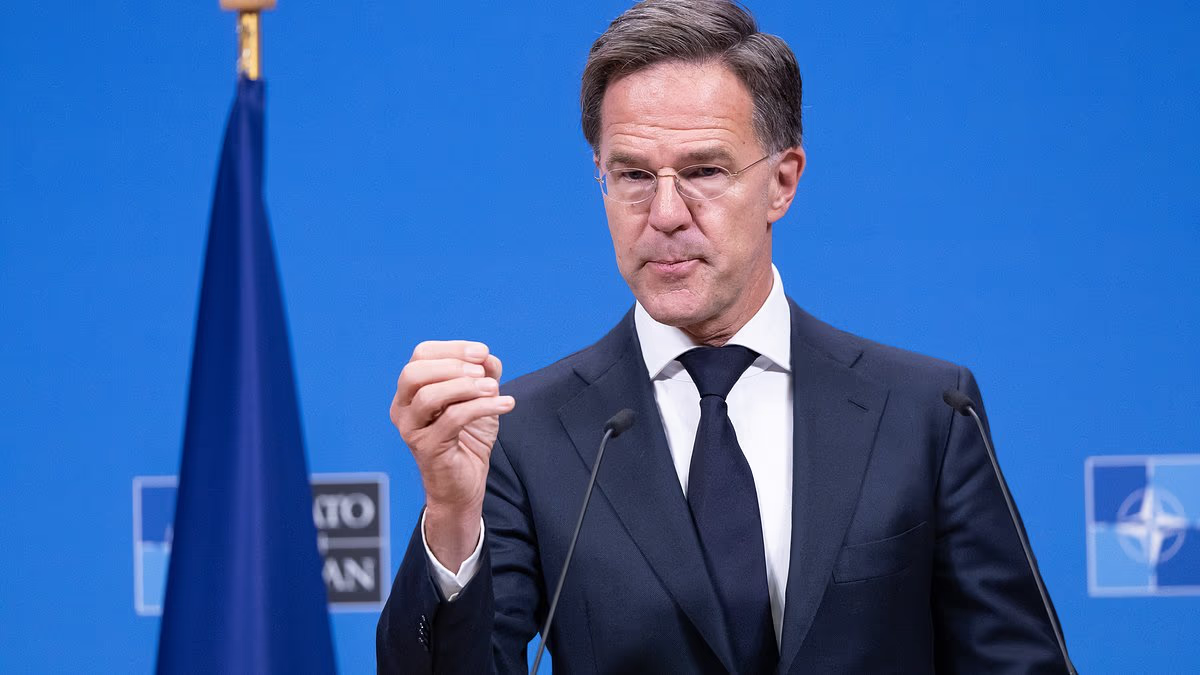
Mark Rutte, the former Dutch prime minister, is expected to use a speech in Oxford tonight to apply public pressure on the Prime Minister over plans to rebuild the UK’s depleted armed forces.
Speaking at the Ditchley Foundation’s annual lecture in Oxfordshire, the Nato secretary general will praise Britain as a country that is “serious about security”.
However, in a pointed reminder that further action is required, he is expected to say: “The UK is already investing more in defence. And I welcome the new Prime Minister’s assurance that his government will meet its Nato commitments.”
The Government must now find a way to raise defence spending to 5 per cent of GDP within the next decade, while contending with higher borrowing costs linked to the US-Iran war and mounting pressure on the public finances.
Defence spending is expected to reach roughly 2.7 per cent of GDP by 2027. But Mr Burnham has warned that the UK may fall short of an interim goal of 3 per cent by 2030.
The Prime Minister triggered an angry response last week when he rejected cuts to welfare spending as a way of financing defence increases. “National security cannot come at the expense of social security,” he said.
At the same time, Labour’s union paymasters are urging him to direct more money towards defence, arguing that investment could support jobs and revive industry.
Sharon Graham, the Unite general secretary, said Britain had been “running our hand across our mouth in defence for ages” and argued that military investment should be part of a “proper plan for the reindustrialisation of Britain”.

In a speech tonight, the former Dutch premier is expected to put public pressure on Mr Burnham over plans to increase spending on the UK’s depleted military

UK defence spending is forecast to rise to about 2.7 per cent of GDP by 2027, but Mr Burnham has faced questions over the further target of 3 per cent by 2030
She told Politico: “I’m in conversations with members and employers in defence, and these people are making decisions now about whether they stay in Britain.”
Yet Labour’s unions are far from united. The University and College Union used the TUC conference to support a motion calling for the money to be spent instead on tackling climate change and bringing utilities back into public ownership.
Backing its “wages not weapons” campaign, UCU general secretary Jo Grady criticised the US and Israel over what she described as their “war of aggression against the people of Iran”.
“Our lives don’t feel more secure because BAE Systems is getting another multi-billion-pound contract. A global arms race does not make us feel safer,” she told the conference.
‘There is a choice, because every pound spent on bombs doesn’t get homeless people off the streets, it doesn’t build a new school, it doesn’t feed a hungry child, it doesn’t help the desperate NHS, the crumbling transport infrastructure or the crucial need for a programme of insourcing and renationalisation.’
However defence secretary Wes Streeting criticised the move, saying: ‘I’ve seen first hand in Ukraine the consequences of war and it is vital we strengthen our deterrence to prevent another.
‘As we do so, we’re reindustrialising Britain – fulfilling the PM’s commitment to growth in every postcode – and we’re buying British, delivering new jobs, skills, apprenticeships and opportunities for young people from a wide range of backgrounds.’
He added: ‘I’m happy to sing the (socialist anthem) Red Flag, but this Labour government won’t wave the white flag.’
Nato allies have agreed to hike their defence spending to 5 per cent of economic output by 2035, amid burgeoning threats from Russia and China, and demands from Donald Trump’s America that European member states invest more in their own security.

Unite boss Sharon Graham said that the UK had been ‘running our hand across our mouth in defence for ages’ and said it should form part of a ‘plan for the reindustrialisation of Britain’.

However the University and College Union’s Jo Grady used the TUC conference to say that the cash should be used to fight climate chance and improve schools and housing instead
Chancellor John Healey quit as defence secretary in June over Sir Keir Starmer’s refusal to commit to the 3 per cent target, saying it was the minimum needed to keep Britain safe.
Mr Rutte will use his speech to say that the UK ‘is leading, along with Nato allies, the push back against Russia’s dangerous and reckless campaign against us’.
He will add: ‘Collectively we will continue to strengthen our ability to deter and defend all allies, against any threat. Nato will not be intimidated by Russia’s campaign of hostile actions. Russia wants to stop us helping Ukraine – but their actions will only lead us to do more for Ukraine. Russia’s actions are a sign of weakness, and a symptom of Putin’s failure in Ukraine.’
Elsewhere in his speech, Mr Rutte will address the changing nature of the military alliance.
Mr Rutte will say: ‘To stay transatlantic, Nato is becoming more European. A Nato with Europe, and Canada, spending more, producing more, and doing more for their security. This is the idea of Nato 3.0.
‘Building for the future. A stronger Europe, in a stronger Nato.’