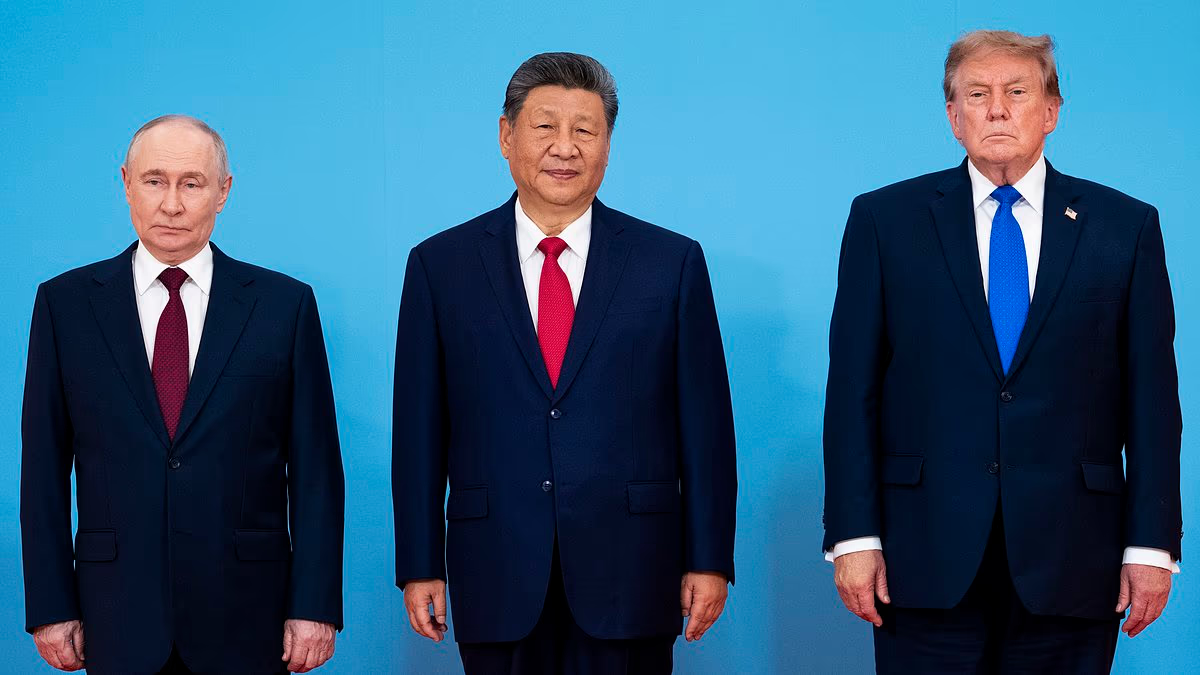

For all the ceremony, Thursday’s meeting of the so-called ‘Big Three’ — Presidents Xi Jinping, Donald Trump and Vladimir Putin — in Shenzhen, China’s technology hub, produced little of substance.
That may be a relief. Little that benefits the world’s democracies is likely to emerge when these three leaders find themselves working in harmony. Even so, the symbolism was historic — and deeply troubling.
Historians may one day identify the gathering as a defining image of the retreat of Pax Americana, the US-led global order that has shaped international affairs since the Cold War ended nearly four decades ago.
Rather than standing alone as the leader of the world’s unrivalled superpower, the American president appeared as one of three competing giants sharing the international stage.
Two of the other leaders are dictators, and their presence underlined the defining geopolitical trend of this century: the steady advance of authoritarian power while democracies struggle to keep pace.
For Putin in particular, the summit was an early Christmas present. Restoring Russia to the ranks of the world’s great powers has been the central ambition of his adult life since the Soviet Union collapsed. In Shenzhen, he was treated as an equal by two of the most powerful men on Earth.
Yet Putin’s Russia is nowhere near the same superpower league as China or the United States. Its troubled economy is smaller than Britain’s, its finances remain heavily dependent on fossil fuels, its armed forces have failed to defeat a much smaller opponent in Ukraine and its population is shrinking rapidly.
Russia retains an elevated position largely because its vast territory spans eleven time zones, giving it enormous strategic importance, and because it possesses the world’s largest nuclear arsenal. That was sufficient to secure Putin a place at the top table.

The ‘Big Three’ – Vladimir Putin, Xi Jinping and Donald Trump – gathered in Shenzhen, China earlier this week

Trump and Xi applaud as the US President arrives in China to attend the Asia-Pacific Economic Cooperation summit
It also helped that Putin had a powerful friend. Donald Trump reportedly supported the Russian leader’s inclusion in the Shenzhen gathering after Putin lobbied for an invitation. Xi had shown little enthusiasm, but Trump pressed the issue and the Chinese president eventually agreed.
Xi’s true feelings were perhaps clear from the contrasting welcomes. He personally greeted Trump on the tarmac at Shenzhen Bao’an International Airport and arranged a flypast by fighter jets. Putin, by contrast, was received by an official.
The official was extremely tall, drawing attention to Putin’s relatively modest height. Russian state television, which is controlled by the Kremlin, reportedly hesitated before showing images of the encounter.
Even so, the summit represented a propaganda victory for the Russian president. The Kremlin-friendly media had promoted Shenzhen as a modern-day Yalta, invoking the February 1945 meeting at which Winston Churchill, Franklin D Roosevelt and Joseph Stalin discussed the post-war order.
The comparison was plainly exaggerated. Yalta brought together the leaders of the three Allied powers that had done most to defeat Nazi Germany and Imperial Japan. Shenzhen was a very different affair.
Two of its three participants are entangled in wars that appear increasingly difficult to win, and there were no conquered territories or spoils waiting to be divided.
Nevertheless, the images delivered the message Putin wanted broadcast: Russia’s global standing had been restored, with the president occupying the role of his personal hero, Stalin.
Xi also emerged from the meeting with his position enhanced. The summit reinforced China’s growing influence, presenting its leader at the centre of an immense round table, with Trump on one side and Putin on the other — seemingly dependent on the man presiding over the proceedings.
Xi appeared calm, dependable and restrained, a sharp contrast with Russia’s aggression and America’s unpredictability. For China’s propaganda apparatus, the scene was almost irresistible.
The authoritarian leaders therefore had plenty to celebrate. But what did the world’s democracies gain?
NEXT UP: London Model Arrested by ICE Weeps Over ‘Unsanitary’ Conditions
The short answer is almost nothing. That was hardly surprising, given that their sole representative was Trump. Expecting him to champion democratic values would be like appointing a Hamas operative as the public voice of the Israel Defense Forces.
Trump helped turn Shenzhen into a showcase for authoritarian power, apparently without discomfort. He described Putin, whose war in Ukraine has sent hundreds of thousands of Russians to their deaths, as ‘my friend’. He also portrayed Xi as a close partner in the management of global affairs.
At no point did he appear to demand meaningful concessions from Putin that might open a route towards peace in Ukraine. Nor did he press Putin or Xi to stop supporting Iran in its confrontation with the United States in the Gulf.
Indeed, Trump brushed aside their assistance as merely ‘small’.
Europe was absent from the proceedings. Its so-called ‘coalition of the willing’ remained in Berlin, attempting to compensate for the gaps created as Trump has steadily withdrawn American backing for Ukraine.
The scale of Washington’s abandonment of Kyiv has not been fully appreciated. The last US military aid package was approved during the final days of the Biden administration.
US military and financial assistance to Ukraine was cut by 99 per cent last year. The Trump administration’s 2027 budget contains nothing for Kyiv, while stronger sanctions against Russia have been put on hold.
Ukraine is now reliant on Europe, including Britain, as well as Canada for weapons and financial support. But even aid approaching £2billion a month cannot close the hole left by America’s retreat.
A significant portion of that money is being used to purchase American weapons for Ukrainian forces. Kyiv is increasingly anxious about how long Trump will permit those sales to continue.
The US president is eager to reach an agreement with Putin on energy, minerals and property development before his term ends in less than two years. It will be marketed as a deal serving American interests, but, as with so many Trump arrangements, it would also benefit him, his extended family, his allies and their relatives.
Putin is equally eager to move forward. The main obstacles are the Ukrainians and their European supporters. Trump would gladly sacrifice Ukraine if doing so secured a wider agreement with Moscow, but he has yet to find a way to overcome European backing for Kyiv. As time runs short, his frustration is becoming increasingly visible.
Ukraine is not the only area threatened by the final phase of the Trump administration. Nato’s eastern flank is also exposed. Trump has entrusted negotiations with Putin to two inexperienced figures — his son-in-law Jared Kushner and New York property developer Steve Witkoff. Both have allowed Moscow to place the redesign of Eastern Europe’s post-Cold War security system on the negotiating table, which is Kremlin language for weakening or reversing Nato’s expansion.
Trump would have little difficulty accepting such an arrangement if it helped secure a larger agreement with Russia. Nor does he appear troubled by the prospect of the three powers dividing the world into spheres of influence designed around their own interests.
China would dominate much of the Pacific, Russia would control its near abroad in Eastern Europe, and the United States would prevail across the Western Hemisphere — an area Trump treats as his personal backyard and regards himself as its de facto emperor.
The most alarming aspect of this proposed 21st-century partition is that two of its three principal zones would be controlled by dictatorships. It is a striking measure of how far authoritarianism has advanced.
The autocrats also have a powerful supporter in Trump, who appears unable to find a dictator he does not admire. He praises authoritarian leaders while repeatedly disparaging the democratic allies who have stood beside America for decades.
Europe can no longer simply be urged to contribute more to the defence of democracy. It must now prepare to protect itself. That is a challenge of historic proportions.
Britain should be at the forefront, bringing together countries that share its democratic values. Yet the Burnham government’s deeply damaging refusal to rebuild the armed forces on the scale required has weakened its ability to lead.
It can locate money to subsidise university fees for the privileged children of Brussels Eurocrats, but apparently cannot find the resources needed to defend democracy. Small wonder the world’s dictators believe events are moving in their favour.
IN CASE YOU MISSED IT: Neighbours near Australian fitness personality Sam Wood’s $3,000-a-night Noosa villa speak out


