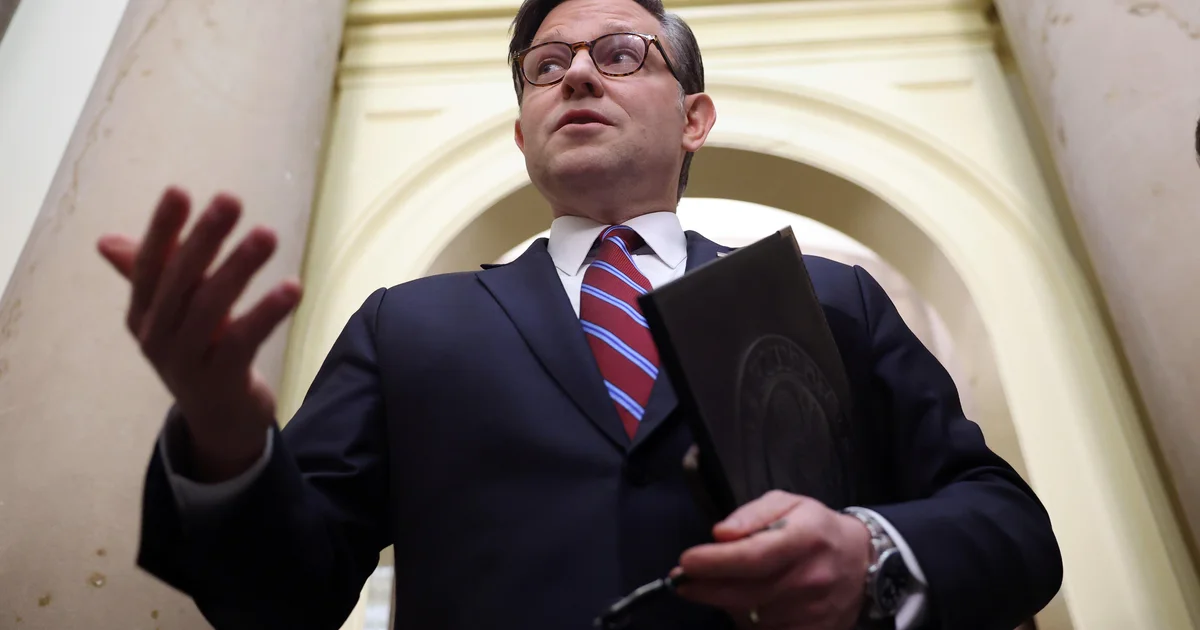

Washington — House Speaker Mike Johnson announced Wednesday that the House would not hold its scheduled votes Thursday, effectively ending the chamber’s work period and sending lawmakers home until after the November midterm elections.
Members are now set to remain away from Washington for more than six weeks, sidestepping a series of potentially divisive votes and further Republican infighting as the election approaches. Johnson had already scrapped House votes for the final two weeks of September.
“The House has done its work,” Johnson, a Louisiana Republican, told reporters at the Capitol. “It’s time for our members to go home to their districts and make their case to the American people.”
Before departing, lawmakers are expected to vote on legislation imposing additional sanctions on Russia, along with a measure designed to protect consumers from rising energy costs tied to data centers. Other unresolved matters, however, will remain stalled until Congress returns after the elections.
Rep. Ralph Norman, a South Carolina Republican, criticized the decision, calling the cancellation of Thursday’s votes “unacceptable.”
“The House has now canceled at least 63 scheduled voting days this Congress, including nine days this month alone, and now we’re leaving Washington until after the election,” he wrote on X. “The Founders did not envision taking this much time off and still getting paid. If Members of Congress want to go home and campaign instead of doing the job taxpayers sent us here to do, then their campaigns ought to be paying them, NOT the American taxpayer. We still have work to do.”
Rep. Thomas Massie of Kentucky, a Republican who lost his primary to a candidate backed by President Trump, introduced eight articles of impeachment against Defense Secretary Pete Hegseth on Tuesday over the war in Iran. Because the resolution is privileged, Johnson is required to address it within two legislative days. By canceling Thursday’s session, the speaker has effectively delayed the matter until early November, when Johnson said Republicans will seek to dismiss it.
Johnson rejected the suggestion that the shortened week was designed to prevent a vote on Hegseth’s impeachment.
“It’s ridiculous,” Johnson said, describing Massie’s effort as “a publicity stunt by someone who wants attention.” He added that the resolution “will immediately be tabled, of course.”
During an interview with CNN Tuesday night, Massie said he had deliberately kept Republican leaders unaware of his plans.
“I didn’t want to show my hand,” he said. “I didn’t show it to anybody. I was afraid that they would do something to subvert me getting on the floor for an hour and 20 minutes and reading these articles.”
Johnson also dismissed Democratic calls to cancel the recess so Congress could respond to rapid developments in artificial intelligence. Those demands came after AI researchers and industry leaders warned in recent weeks that the technology could pose potentially catastrophic risks. Democrats urged the speaker to keep lawmakers in session until legislation establishing safeguards could be approved.
“Congress should not leave town until something is done decisively to protect the safety and the well-being of the American people, in the face of growing concerns being raised by experts within the artificial intelligence industry itself,” House Minority Leader Hakeem Jeffries said Monday. “Republicans have completely abandoned their responsibility to legislate and engage in public policy efforts in a responsible fashion in the area of artificial intelligence.”
Lawmakers have introduced several proposals addressing AI safety, but Congress has yet to reach agreement on what action to take. Critics of tougher regulation argue that strict rules could weaken the United States as it competes with China in the technology sector.
Johnson has shown little urgency about advancing AI guardrails. In a series of posts Monday, President Trump likewise argued that protecting the technology requires only a “strong” president.
“If I called an emergency session today and I brought everybody in the House and said, ‘Let’s regulate AI,’ nobody in the room knows yet what that should look like,” Johnson said during his weekly news conference Tuesday.
The speaker said AI companies should have room to oversee their own conduct through voluntary standards.
“They don’t need the government to tell them to slow it down. If they want to slow it down, they should,” Johnson said.
Johnson has proposed bringing AI executives together with White House officials, saying he expected such a meeting to be arranged by early next week.
“The reflex of the legislative bodies is to cover things up with red tape and in hyperregulation,” Johnson said Monday.
Meanwhile, Congress has not renewed Section 702 of the Foreign Intelligence Surveillance Act, a major government surveillance authority that expired in June.
The president’s controversial choice of Bill Pulte, the head of the Federal Housing Finance Agency, to temporarily oversee the nation’s spy agencies complicated its renewal. Jay Clayton was sworn in as the director of national intelligence in August, but both chambers have been on recess for a majority of the time since then.
The Senate is scheduled, for now, to be in session through the end of September.
The upper chamber is working to pass a sweeping college sports bill, titled the Protect College Sports Act, that includes regulations around name, image and likeness rights and transfer eligibility. Senators are also nearing a bipartisan deal on a permitting reform overhaul.
“If the Senate works together and moves some of these important pieces of legislation, I will bring the House back on 48-hours’ notice,” Johnson said.