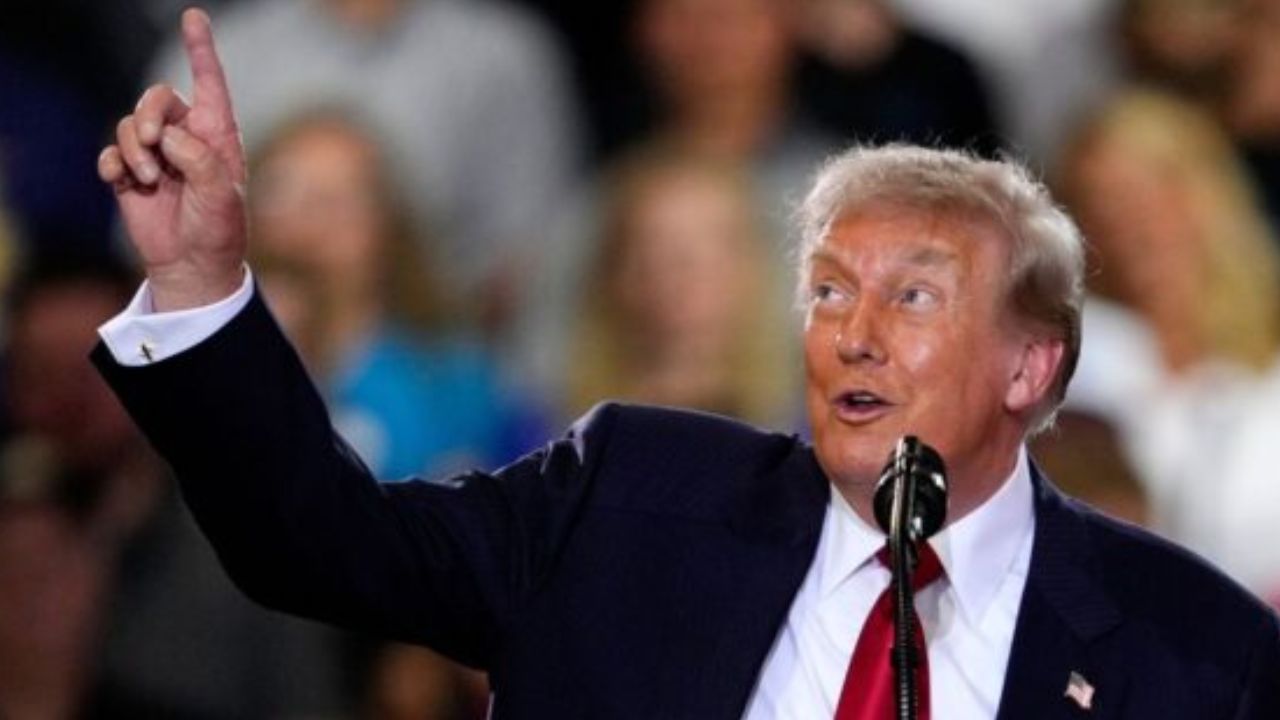

President Donald Trump speaks during an event at the General Motors Proving Ground on Monday, July 27, 2026, in Milford, Michigan. (AP Photo/Paul Sancya).
The Trump administration secured a significant victory in a Fourth Amendment dispute Thursday when a federal appeals court ruled that government agents may search a traveler’s cellphone at the border without a warrant or reasonable suspicion.
The case, which began during the Biden administration, involves Chinwendu Alisigwe, a green card holder convicted of financial crimes in 2023. In his appeal, as well as in an earlier suppression memo, Alisigwe argued that Department of Homeland Security and Customs and Border Protection agents violated his Fourth Amendment rights by scrolling through his cellphone and taking photographs of its contents.
The Department of Justice, in a position supported across administrations, argued that the border-search exception allowed the evidence to be used. The government also opposed expanding a landmark U.S. Supreme Court Fourth Amendment ruling that unanimously required police to obtain a warrant before searching a cellphone taken from someone who had been arrested.
The U.S. Court of Appeals for the 2nd Circuit sided with the Justice Department in an effectively unanimous decision that included one concurrence. The ruling reached the same ultimate result as the district court but expressly rejected part of the lower court’s reasoning.
“First, we conclude that the district court properly denied Alisigwe’s motion to suppress evidence obtained at the border,” the 43-page opinion states. “Contrary to the district court’s reasoning, however, reasonable suspicion was not required.”
The appeals court therefore went beyond affirming the lower court’s decision, establishing a broader interpretation of the border-search exception to the Fourth Amendment.
“Routine searches at the border are reasonable simply because those searches occur at the border,” the panel wrote. “Because the search of Alisigwe’s cellphone was a routine search, the government was entitled to conduct the search without suspicion.”
In reaching that conclusion, the appeals court treated a traveler’s cellphone much like other personal property, including luggage.
“Under our precedents, no suspicion is required before the government searches a traveler’s property at the border,” the opinion says. “Because a cellphone is property, our precedents establish that the government does not need to have reasonable suspicion before searching a traveler’s cellphone at the border.”
The court distinguished “non-routine” border searches, explaining that the term generally applies to particularly intrusive searches of a person—such as body-cavity or strip searches—rather than searches of belongings.
The panel also rejected the argument that the Supreme Court’s warrant requirement for cellphone searches incident to arrest should apply at the border. It said the Supreme Court was primarily concerned in that context with risks to officers and the possible destruction of evidence. Those concerns, the 2nd Circuit reasoned, do not apply in the same way when agents are simply reviewing digital data on a cellphone.
“[T]he rationale for the search-incident-to-arrest exception does not have ‘much force with respect to digital content on cell phones,'” the opinion states. “That holding does not implicate the border-search exception, which relies on a different rationale.”
The 2nd Circuit said its ruling was consistent with earlier decisions permitting warrantless searches at the border, even when the searches are conducted for purposes beyond locating contraband.
The court explained its reasoning this way:
The court’s precedents allow the government to conduct pretextual border searches without a warrant, meaning agents are not restricted to looking for contraband or evidence of offenses tied directly to the border. The government’s authority at the border extends more broadly to determining “who and what enters the country.” Under that authority, the court said, agents may search for evidence of criminal activity among people entering the United States.
The opinion does impose one potential limit on the government’s authority. The panel declined to decide whether its reasoning would apply to a more invasive digital examination conducted with specialized forensic tools.
“Because this case involves only a manual review of the contents of the cellphone, we need not decide whether the use of ‘sophisticated forensic search methods,’ such as ‘the off-site forensic analysis of the phone’s data,’ might qualify as a nonroutine search requiring reasonable suspicion,” the court wrote in a footnote.
The 2nd Circuit also clarified that its decision does not necessarily resolve every legal question surrounding cellphone searches at the border.
In his motions, Alisigwe pointed out that several federal district courts in Manhattan and Brooklyn had adopted a warrant requirement for border searches of cellphones.
“Those decisions are wrong,” Circuit Judge Steven Menashi, a Trump appointee, wrote.
The decision was joined in full by U.S. District Judge Hector Gonzalez, a Joe Biden appointee sitting by designation. The judgment was joined by Circuit Judge Eunice Lee, who was also appointed by Biden.
The post ‘The government was entitled’: Trump’s border agents can now search cellphones without a warrant, probable cause or reasonable suspicion, 2nd Circuit rules first appeared on Law & Crime.