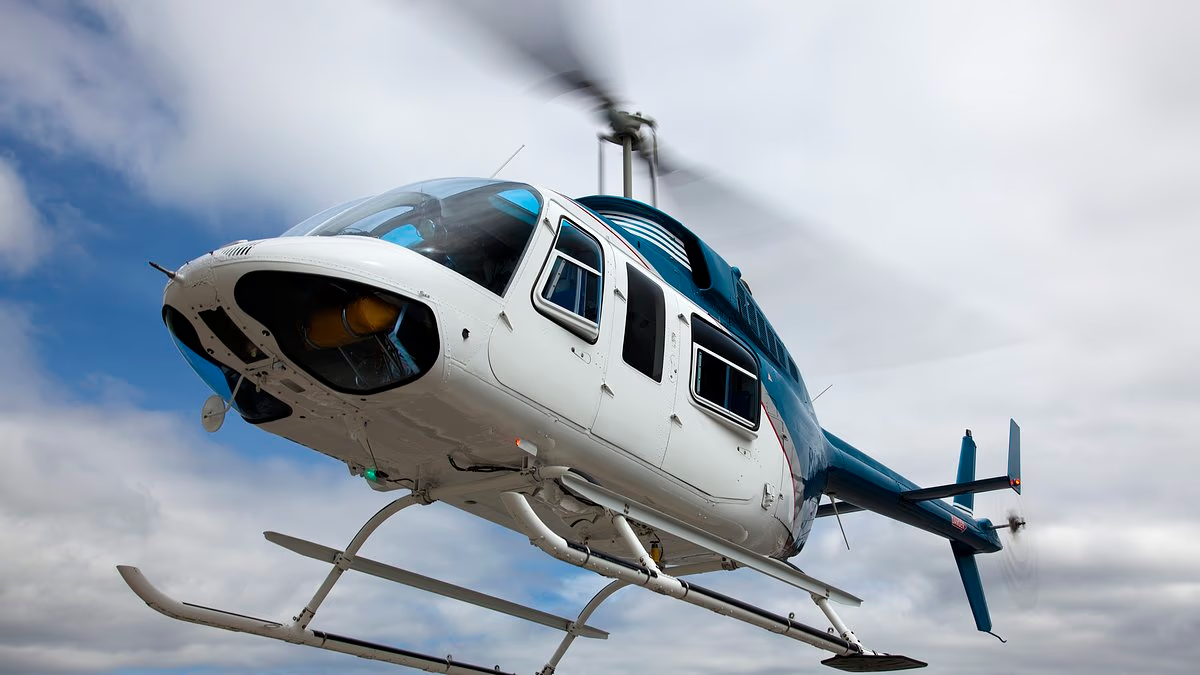

Residents of a Westchester County suburb say the steady stream of helicopters carrying affluent travelers toward the Hamptons has transformed their peaceful community into something resembling a warzone.
People living along the Sound Shore say the aircraft noise frequently breaks through the area’s normally quiet atmosphere, disrupting work meetings, family dinners and relaxing afternoons beside Long Island Sound.
Larchmont resident Jay Davis said the helicopters are now impossible to ignore. He hears them while working remotely, spending time in waterfront parks and watching television with his family.
“I have to turn on closed captions just to understand what’s happening on television. I don’t want to keep living this way,” Davis told The Wall Street Journal.
According to Wings Air Helicopters, private helicopter service can get wealthy Hamptons-bound passengers to their destination in less than an hour, helping them bypass congested roads and slower train journeys.
Frustration among residents has continued to build, with neighbors using Nextdoor to document and criticize what they describe as increasingly frequent and intrusive flights overhead.
One person likened the volume to that of a military Chinook, posting: “It’s giving me ’Nam flashbacks.”
A Vietnam veteran from Yonkers responded with a contrasting perspective: “As a Vietnam veteran myself, I enjoy the flyovers. Welcome home.”

Westchester County residents say loud helicopter traffic bound for the Hamptons is disturbing the calm of their suburban neighborhoods and fueling growing anger.

Known as the Sound Shore, the Westchester suburbs cover a 36-mile stretch along Long Island Sound, an area recognized for its historic homes and expansive estates.

Wings Air Helicopters says traveling by helicopter can cut the trip to the Hamptons to under an hour, compared with lengthy drives or train rides.
“One time, I thought a helicopter had landed in my driveway. It just isn’t as peaceful here as it used to be,” Nancy Monzidelis, another Larchmont resident, told the WSJ.
The complaints have prompted residents to reach out to the Federal Aviation Administration and their local members of Congress in search of answers.
Mateo Lallemand, a sophomore at Rye Country Day School, developed an app to investigate the flights by matching recorded helicopter sounds with information from the FAA registry and FlightRadar24.
Lallemand told the WSJ that he installed a microphone outside his home to record the aircraft noise, with the audio automatically sent to his app for analysis.
The data he gathered indicated that some helicopters heading toward the Hamptons were flying at roughly 1,000 feet above homes. That appeared to differ from the 4,000-foot cruising altitude advertised by companies including Flexjet.
Lallemand presented his findings to Representative George Latimer, who represents Westchester County, hoping the information would help prompt action on the neighborhood’s noise concerns.
The WSJ reported that Latimer has since spoken with FAA officials as the agency examines the issue.
“Residents have a legitimate concern, and it cannot be dismissed,” Latimer said in a statement to the outlet.
Westchester residents are not the only New Yorkers voicing anger over the growing problem of helicopter noise.
Outraged residents of Riverhead, Long Island attended a town board in July and complained about helicopters flying overhead from the North Fork to the Hamptons.

Rye is a coastal city in Westchester County, New York, United States, located near New York City

Rep. George Latimer (pictured) has engaged with FAA staff to study and investigate the issue.
According to the Gabreski Airport noise committee, the Westhampton airport recorded over 500 complaints from January through April of 2026.
Riverhead residents described the noises as ‘intolerable’ and claimed pilots were not following the FAA’s mandatory New York North Shore Helicopter Routes.
Since then, Eli Flint, the president of Flexjet’s helicopter division, has spoken out to WSJ about major safety concerns being the key reason why helicopters fly at low heights.
Earlier last year, a passenger jet carrying 60 passengers and an Army helicopter with crew members collided in Washington while heading to Ronald Reagan National Airport. The accident killed up to dozens of people.
As a result, air traffic controllers have directed all pilots to make more space for commercial airlines heading into airports.
‘That’s why we’re at 700 to 1,000 feet. We know it’s an issue,’ Flint told the outlet
Our News Outlet has reached out to Mateo Lallemand, Representative George Latimer, Eli Flint and the FAA for comments.