
Until his arrest in June, Nicholas Brandram seemed to be leading an exceptionally privileged life.
Charismatic and impeccably dressed, the decorated former Army captain was a familiar figure in the City. Colleagues joked that the descendant of Queen Victoria looked so at home in his tailored suits that he could have been the next James Bond.
That image was shattered when the 44-year-old millionaire banker became the leading suspect in the notorious “Putney Pusher” investigation.
Friends and acquaintances struggled to understand how a man widely described as an “officer and a gentleman” — someone whose life appeared to centre on duty, honour and sacrifice — could be linked to the male jogger captured in blurred CCTV footage on Putney Bridge nearly a decade ago. The footage appeared to show a woman, aged 33, being pushed from the pavement into the path of a bus.
Following Brandram’s suicide on Tuesday evening, renewed scrutiny has fallen on the police investigation into the baffling 2017 incident and on how the banker, whose grandmother was a Greek princess and Queen Victoria’s last surviving great-granddaughter, came to be placed at its centre.
His devastated family said he took his own life “after months of immense pressure”, during which he was also suspended from his position as a senior relationship manager at HSBC Private Bank.
“He lived with the shame, anxiety, humiliation and extraordinary pressure created by a wholly unnecessary investigation,” the family said in a searing statement issued on Thursday. Their words directly blamed the Metropolitan Police for the circumstances surrounding Brandram’s death.
Only hours later, the Independent Office for Police Conduct (IOPC) confirmed that it had received a “mandatory referral” from the force.

Nicholas Brandram at City of London Magistrates’ Court in October 2013, where he admitted driving without due care and attention and failing to stop after an accident, having knocked a female cyclist from her bike while riding his Harley-Davidson near Hyde Park Corner

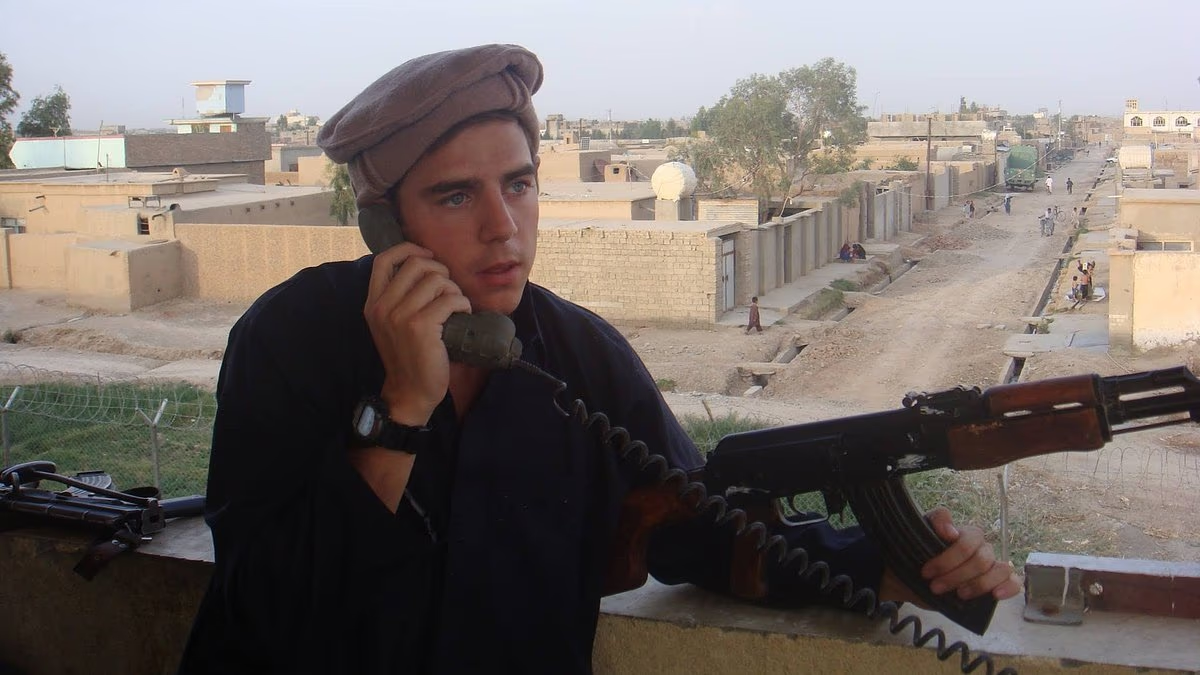
Nicholas Brandram served in Afghanistan. Former Army colleagues believe he suffered from PTSD, which affected his personal relationships
His sisters, Sophie Voelcker, 45, and Alexia Hicks, 40, said the family had placed its “faith in the justice system” but ultimately felt abandoned. They said Brandram was awaiting a DNA test that they believed would have exonerated him. Shortly before his death, they said, he told them: “This investigation was murdering me.”
The family has continued to insist that Brandram was not the “Putney Pusher”, arguing that there was “no credible evidence that he was the man shown in the footage”.
This week, friends, colleagues and former Army comrades told Our News Outlet that Brandram initially believed detectives would soon realise they had identified the wrong man. He did not expect the investigation to continue for so long.
Brandram had lived in Fulham with his first wife before their divorce in 2014. His family said he had moved to Notting Hill Gate by the time of the alleged pushing incident in 2017.
A source said Brandram regularly ran early in the morning before work. At the time, he was employed by Bank Leumi, whose offices were close to Bond Street in London’s West End.
He was arrested in June at his £1.4 million home in Chiswick, west London, which he had purchased in 2018. Brandram told a friend that he had “walked out of his door and was suddenly set upon and handcuffed and taken to the station”.
“Nick said that all the way there, he was in the dark about what he was being arrested for,” the friend said.
“When police told him at the station that it was on suspicion of being the Putney Pusher, he said: ‘I punched the air with relief because I knew it wasn’t me. I was so relieved.’ He said he knew he was in the clear and therefore had nothing to worry about.”
But as the months passed, his initial confidence reportedly turned into despair, particularly after he was suspended by HSBC.
He had separated from his second wife the previous year and was also said to fear that the prolonged investigation could damage his relationship with his three-year-old son.
He told one who met with him just a week before he died: ‘Everyone knows that I’ve been accused, but I didn’t do it.’
He cited as proof the fact that, unlike the figure in the CCTV, he had a withered calf dating back to his time in the Army and a prominent tattoo on his forearm – although admittedly on a section of his arm which would not have been visible in the image.
‘Over the last couple of weeks, the strain of being the most hated man in Britain was taking its toll, even if he appeared to be stoical,’ says the friend.
Even though he was never named in the Press ‘everyone knew who he was because it was all over social media,’ they said. ‘It was weighing on his mind constantly but he swore blind to the end that it wasn’t him.’
If most knew Brandram as an ebullient character with a ready smile, then there was also a darker, more introspective side to his character, a legacy of the psychological trauma he suffered after commanding troops in Afghanistan, Bosnia and Iraq.
Aged 22, he passed out from Royal Military Academy Sandhurst with flying colours in August 2005 – a year ahead of Princes William and Harry. But just 12 months on, in August 2006, his closest Sandhurst friend, Ralph Johnson, was killed in Afghanistan’s Helmand Province by a rocket-propelled grenade when the Taliban ambushed the armoured car in which he was travelling.
‘He was absolutely inconsolable at losing Ralph,’ a former Army comrade told Our News Outlet this week. ‘They considered themselves indestructible, as most young recruits do. Ralph’s sudden death was a horrible shock.’
As well as 24-year-old Johnson, Brandram also lost the man he considered a father figure while commanding an infantry platoon in Helmand, when his second in command, 42-year-old Colour Sergeant Alan ‘Cammy’ Cameron, was hit by an improvised explosive device in Lashkar Gah in April 2010.
Paying tribute to Cameron, who succumbed to his injuries in hospital nearly a year later, Brandram said: ‘The sadness with which I mourn his loss is only matched by the joy and appreciation I had in working with and knowing him.’
Brandram, who was educated privately at Stowe School and studied philosophy and psychology at Newcastle University, resigned his commission soon after the Scots Guards’ 2010 Afghanistan tour, swapping his life in uniform, as many former officers do, for a career in the City.
In 2012 he was awarded a Queen Elizabeth II Diamond Jubilee Medal in recognition of his military service.
After leaving the Army he worked at stockbroker Killik & Co. He moved to Israel’s Bank Leumi before moving to HSBC where he managed the assets of wealthy individuals. He was nominated as Private Banker of the Year 2026.
A former colleague describes him as ‘a very archetypal posh ex-Army bloke’.
‘He was very well-turned out, competitive, sporty, had a good sense of humour. I remember him being described as Captain Charm Offensive.’
In a ‘60-second interview’ with website CityWealth in March, Brandram described himself as ‘a co-parenting single father’ and said he turned to ‘gardening, opera and Frederick Forsyth novels’ when wanting to relax.

In August 2017 police released CCTV footage of the ‘Putney Pusher’ incident. Nicholas Brandram said it was clear he was not the ‘Putney Pusher’ because, unlike the figure in the CCTV, he had a withered calf dating back to his time in the Army

The 33-year-old female victim was crossing Putney Bridge when the jogger shoved her so hard she falls into the path of a double-decker bus. Thanks to the lightning reactions of the driver, the bus’s front wheels missed the woman’s head by just inches

Friends, colleagues and former Army comrades told Our News Outlet how father-of-one Brandram was initially confident that detectives would quickly realise they’d got the wrong man – not realising the investigation would drag on
Asked what he considered to be the most important attributes for a leader, he quoted the Sandhurst motto ‘Serve to Lead’ and said: ‘Compassion, adaptability, resilience and humility – the best leaders serve.’
Army colleagues believe he was suffering from PTSD, which had a knock-on effect on personal relationships.
His first marriage, in 2010, lasted four years. He married again in 2021 at the Guards’ Chapel in Wellington Barracks, just a stone’s throw from Buckingham Palace, but he and his second wife split last year.
Our News Outlet has been told that Brandram was in a new relationship with the daughter of a wealthy Greek businessman. She was said to have flown straight to the UK after being told of his death.
A friend said they had planned to go on holiday to Kenya in the summer with his son, but Brandram was unable to travel because of his bail conditions at the time.
A senior Army source who knew Brandram says: ‘He found it hard to settle down into permanent relationships. This is very typical of soldiers. It doesn’t matter how wealthy or privileged military types are – they still have to deal with the horror they’ve experienced for the rest of their lives.
‘They don’t talk about it either, instead keeping it all clamped up inside. Discussing what you’ve done or seen on the battlefield is considered highly dishonourable.’
In October 2013, just three years after he quit the Army, Brandram appeared at City of London Magistrates’ Court and pleaded guilty to driving without due care and attention and failing to stop following an accident, after knocking a female cyclist off her bike while riding his Harley-Davidson past Hyde Park Corner seven months earlier.
Representing himself in court, he said the roar of his 1948 motorcycle could be why he didn’t notice any impact. He didn’t stop, he said, because he was unaware of the collision.
After telling magistrates of his glittering military career and insisting he was an ‘upstanding member of society’ he was given five penalty points, a £200 fine and told to pay £105 compensation.
As a three-times great-grandson of Queen Victoria – via her eldest daughter – the story inevitably received media attention.
Nicholas George Brandram was part of an extraordinary blood line connecting him to most of Europe’s royal dynasties.
In 2020 a royal genealogist placed him at 525 in the ever-fluctuating list of those in line to the British throne. Born on April 23 – St George’s Day – 1982, his upbringing was unquestionably privileged. In 1988, aged just six, he appeared in photographs taken at the grand opening of the January sale at Harrods, driving a miniature battery-powered Rolls-Royce.
His grandmother Princess Katherine of Greece and Denmark – the youngest child of King Constantine I of Greece and Princess Sophia of Prussia, and first cousin of the late Duke of Edinburgh – met his grandfather Major Richard Brandram in 1946 on board the ocean liner Ascania, which was still in use as a British troop ship.
The princess was returning from exile in Egypt where she served as a war-time nurse. Major Brandram, the son of a Kent prep school headmaster, was on home leave from Baghdad where he was serving with the British Military Mission.
Engaged within three months of their arrival in Liverpool, their marriage in Athens in 1947 made newspaper headlines, as did their close ties to the then Princess Elizabeth and Prince Philip, who married later the same year.
Katherine dropped her princess title but King George VI granted her the rank of an earl’s daughter and she was known as Lady Katherine Brandram for the rest of her life. She and her husband had one son together, Brandram’s father Paul, who worked in marine insurance and died in 2020.
When he married Brandram’s mother, Jennifer, in 1975, the exiled King of Greece, Constantine II, served as best man.
The Duke and Duchess of Kent were also present. Their daughter, Lady Helen, then aged ten, was a bridesmaid.
‘Everybody joked about Nick being a Royal,’ says one of his Sandhurst contemporaries, ‘but he never boasted about it. He was a typical Guards officer – extremely well-connected, debonair and very low-key, and charming with it.’
Before his 2006 death in combat, his close friend Ralph Johnson used to imitate Brandram’s well-spoken accent and tease him by calling him ‘Your Excellency’.
Nearly a decade has passed since the so-called ‘Putney Pusher’ incident took place during rush hour on May 5, 2017 at around 7.40am.
The 33-year-old female victim, who has never been named, was crossing Putney Bridge towards Fulham when the jogger, wearing a light grey T-shirt and dark blue shorts, approached from the opposite direction. CCTV shows the bizarre moment the man shoves her so hard she falls into the path of a double-decker bus. Thanks to the lightning reactions of the driver, the bus’s front wheels missed the woman’s head by just inches.
While the vehicle stopped and passersby ran to the aid of the shaken woman, the jogger continued across Putney Bridge without so much as a backward glance. Incredibly, he ran back across the bridge 15 minutes later while the woman, who sustained minor injuries, was still being assisted. He ignored her when she tried to speak to him.
It wasn’t until three months later, in August 2017, that police released CCTV footage of the incident. It was viewed by millions globally amid endless speculation as to the identity of the jogger and what lay behind his seemingly unprovoked moment of madness.
The Met Police said it received a ‘huge response’ to its appeal for witnesses. A 41-year-old American investment banker who was arrested days later was told he would face no further action when it emerged he’d been out of the country at the time. He claimed he received death threats and had to hire bodyguards after his name became public.
A week later a second 41-year-old man was arrested but released on the same day. With no further leads to follow, the case was closed in June 2018.
By 2021, the by now notorious ‘Putney Pusher’ incident had become so engrained in the public psyche that it even became the subject of a play, ‘Once Upon A Bridge’ by Irish playwright Sonya Kelly.
Featuring just three characters, The Man, The Woman and The Bus Driver, it explored what might have led to their encounter that fateful day. In Kelly’s fictionalised retelling, ‘The Man’ is never caught but his wife recognises him from the CCTV footage and ends their marriage.
The Met Police re-opened their investigation earlier this year after receiving new information which led to Brandram’s arrest. Once in custody, he was also arrested on suspicion of possessing Class A and Class B drugs.

In 2012 Brandram was awarded a Queen Elizabeth II Diamond Jubilee Medal in recognition of his military service

If most knew Brandram as an ebullient character with a ready smile, then there was also a darker, more introspective side to his character, a legacy of the psychological trauma he suffered after commanding troops in Afghanistan, Bosnia and Iraq


His sisters Sophie Voelcker, 45, and Alexia Hicks, 40, said their family had ‘put faith in the justice system’ but felt let down
Earlier this month he was released under investigation – a status which, unlike bail, carries no conditions or fixed date for a return to a police station.
In the heart-rending statement they released this week, Brandram’s family claimed: ‘He was left for months carrying the stigma of an appalling allegation which the police themselves clearly recognised was unsupported by the evidence.’
The statement added: ‘The Met Police were quick to expose Nick to suspicion and painfully slow to remove it. They failed him. And Nick’s family will now live with the consequences of that failure for the rest of their lives.’
The Met Police, however, insists its investigation ‘remains ongoing’.
Chief Superintendent Dan Knowles, in charge of policing for south-west London, said: ‘We recognise the significant impact his death will have on those who knew and loved him. We also understand the strain that being subject to a police investigation can place on individuals and their families.
‘Following Mr Brandram’s release under investigation, it was made clear that inquiries would continue while officers progressed outstanding lines of inquiry and forensic examinations. This remains the position, and further investigative work is ongoing.
‘Investigations of this nature, particularly those involving complex evidential and forensic work, can take a number of months to complete as officers gather and assess all available evidence.’
Brandram’s sister Alexia said this week that her brother and his lawyer had offered to pay for a DNA test privately to speed up the investigation.
This raises further questions about exactly what evidence the police obtained from the scene of the crime.
Back in 2017, detectives described the man they were looking for as white, in his early to mid-30s, with brown eyes and short brown hair.
This week, among other details they said proved his innocence, his grieving family pointed out that Brandram had ‘distinctive blue eyes’.
Additional reporting: Peter Allen
For confidential support, call the Samaritans on 116 123. Visit samaritans.org for more information.