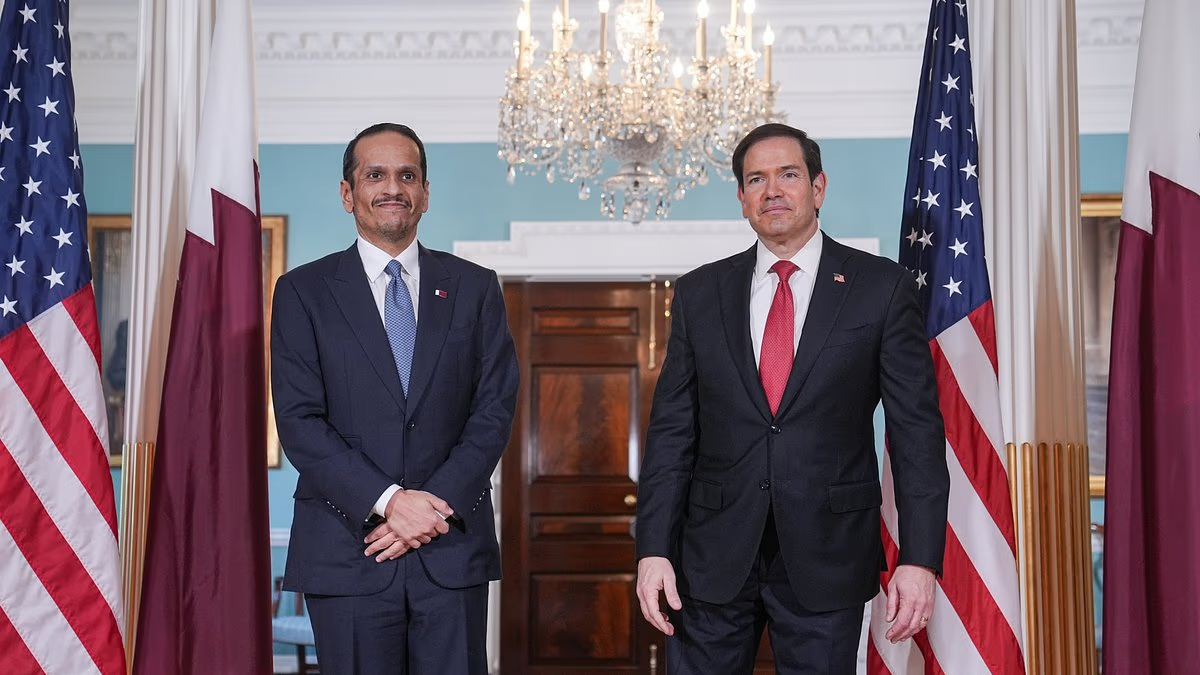

Secretary of State Marco Rubio offered no response Monday when questioned about whether Nvidia CEO Jensen Huang’s sudden reinstatement could present a national security threat to the United States.
As reporters sought his reaction to the announcement, which sent shock waves through the technology and political worlds, Rubio declined to comment.
He instead turned and quickly left the room.
The awkward exchange came only hours after Nvidia confirmed that Huang would resume his role as chief executive, just 11 days after acknowledging an affair with a woman accused of links to Chinese intelligence.
Earlier this year, Rubio oversaw the preparation of a report warning Trump administration officials that Huang was believed to have a close relationship with an alleged Chinese spy, according to reporting by The New York Times.
President Donald Trump welcomed Huang’s return Monday and claimed he had played a role in the decision. In an interview with CNBC, Trump said he had communicated both “indirectly and directly” with Nvidia’s board before the company reinstated its CEO.
“I believe my intervention was very important,” Trump told CNBC.
Trump later wrote on Truth Social that Attorney General Todd Blanche had told him investigators found no evidence Huang had “engaged in any unlawful conduct.” He did not provide further details.

Secretary of State Marco Rubio meets with Qatari Prime Minister and Foreign Minister Sheikh Mohammed bin Abdulrahman Al Thani at the State Department in Washington, DC

Rubio and bin Abdulrahman are seen exiting the Treaty Room after a reporter asked whether Nvidia’s CEO, Jensen Huang, posed a national security risk.

President Donald Trump speaks alongside Nvidia CEO Jensen Huang during a meeting with technology executives about artificial intelligence
The revelation that a sitting president had intervened on Huang’s behalf immediately triggered backlash on Capitol Hill, with lawmakers from both parties calling for investigations in the House and Senate.
Members of Congress also renewed demands for a detailed explanation of the decision.
Lawmakers confirmed Monday that Huang is scheduled to appear behind closed doors before three House committees next week, on December 2.
He is expected to testify publicly before the Senate Banking Committee the following day.
Questions surrounding Huang’s reinstatement continued to dominate the political debate, including among Republicans. Lawmakers pointed to an ongoing federal investigation involving allegations that Nvidia chips were smuggled into China in violation of US export-control rules.
Senator Pete Ricketts, a Nebraska Republican who serves on the Senate Banking Committee, said Huang’s “behavior does not support reinstatement.”
“Nvidia’s decision today doesn’t excuse Jensen Huang from testifying before Congress,” Ricketts said. “It also doesn’t absolve Nvidia of answering for national security concerns and unaccounted-for chips.”

Trump, Vice President JD Vance, and Marco Rubio speak to reporters at a press briefing

Nvidia CEO Jensen Huang sits for an interview with Bloomberg Television in London in October
“I look forward to Mr. Huang coming to the Senate in December,” Ricketts added.
Retired Congressman Don Bacon, a Nebraska Republican, said Nvidia should have “ignored the administration’s inexplicable desire to save Huang.”
“Congress needs to get to the bottom of who approved high-end computer chip sales to China,” Bacon wrote on social media. “We cannot say we want to win the AI race and then give China our best technology.”
Other Republicans also raised pointed questions about the company’s decision and the government’s involvement.
“Nvidia’s board says it relied on input from senior US officials to conclude that bringing Jensen Huang back posed no national security risk. I have some questions,” Republican Senator John Curtis of Utah wrote on social media.
“Who in our government weighed in?” Curtis asked. “What did they tell the board?” He also questioned the basis for the board’s conclusion that Huang’s return posed no security risk.
Outgoing Texas Republican Senator John Cornyn, who lost his reelection bid after Trump endorsed his primary challenger earlier this year, voiced similar concerns. Cornyn questioned how thoroughly US authorities had investigated Huang and Alice Huang, the woman accused of being linked to Chinese intelligence.
He also asked whether the FBI, under Trump, had given Huang a so-called “defensive briefing”—a warning that someone may be connected to a suspected foreign intelligence operative.
“If not, why not?” Cornyn asked. “If so, what did they tell him about the risk? Did he ignore it?”
The Trump administration does not appear to have issued Huang a defensive briefing concerning the woman officials believed to be a Chinese intelligence asset, The New York Times reported Monday. It remained unclear why such a briefing was not provided.
This is a developing news story. Check back soon for updates.


