
Archaeologists may be closer than ever to unraveling the 3,300-year-old mystery surrounding Egypt’s vanished heretic queen, Nefertiti.
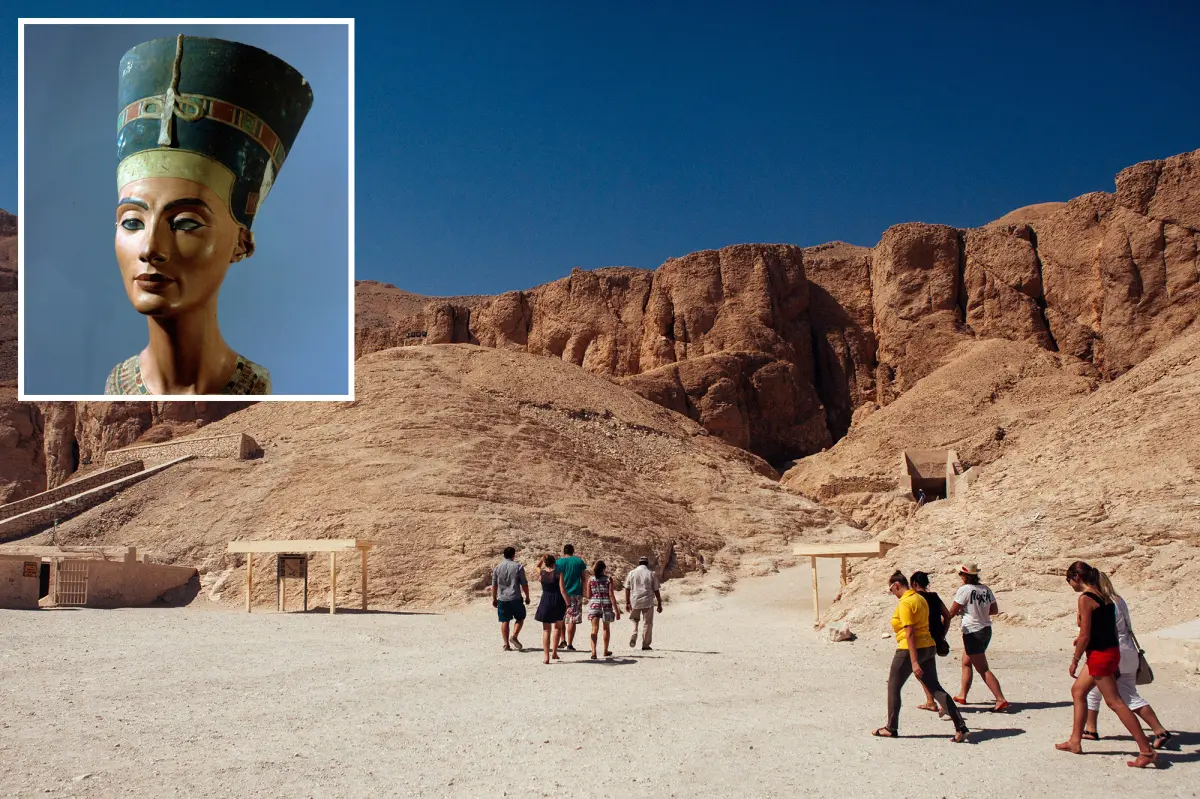
When her likeness emerged in 1912, the world was immediately captivated by Nefertiti’s face.
The pale limestone-and-stucco bust was remarkably beautiful, with finely sculpted features that have made it one of antiquity’s most recognizable images.
Few people could have failed to encounter her.
Her elegant profile has graced thousands of book covers and countless tourism brochures around the world.
Her image is also a fixture in souvenir stores and gift shops, while beauty and healthcare brands have used it to market their products.
Yet despite her fame, archaeologists still do not know where Nefertiti was buried.
In 2015, British Egyptologist Nicholas Reeves proposed that her tomb could be hiding in plain sight. He argued that the chamber may have been hastily adapted for the burial of her son, the boy king Tutankhamun.
Reeves based his theory on irregularities in Tutankhamun’s tomb, including unusual features in its layout, paintings and plasterwork.
However, more than a decade of investigation has yet to produce conclusive proof.
A study published Friday in the Occasional Papers of the Amarna Royal Tombs Project is now reviving hopes that the long-running mystery could be solved.
The research concludes that the available evidence points toward a series of undiscovered chambers concealed behind the plastered walls of Tutankhamun’s tomb.
“Should such an extension eventually be confirmed, it would represent not merely the most important discovery in the Valley of the Kings since the uncovering of Tutankhamun’s tomb in 1922,” said Mamdouh Eldamaty, a former Egyptian antiquities minister and archaeologist at Ain Shams University in Cairo.
“It could potentially rank among the most transformative archaeological discoveries of the modern era.”
The ghosts of KV 62
Tutankhamun’s tomb has long raised questions among researchers.
In fact, the site contains several features that appear out of place.
The tomb is unusually small, and both its orientation and floor plan differ from established royal burial traditions.
Its construction also gives the impression of having been completed in a hurry.
The golden shrine designed to surround the king’s coffin had to be reduced in size to fit inside the cramped burial chamber. Even the elaborate outer coffin required rough trimming of its feet so it could slide into the ornate stone sarcophagus.
Reeves, who contributed to the latest analysis, has drawn attention to newly identified lines and cracks in the chamber’s north wall. He also points to rushed modifications in the room’s paintings—clues that may indicate a hidden space beyond the plaster.
“KV 62 conforms to the architectural grammar of neither a private nor a kingly monument. The plan Tutankhamun’s tomb follows is that of an Eighteenth Dynasty queen,” he writes in the new report.
The tomb’s celebrated discoverer, Howard Carter, held similar suspicions.
So much so he secretly reinvestigated the tomb in 1932. But he just found a solid stone wall.
“Carter’s choice of test location was significant, reflecting his understanding that, however reduced in size, KV 62 was following an essentially kingly layout. It was not,” explains Prof Reeves.
“Had he recognised the tomb’s queenly orientation, he would have focused his attention on this wall’s opposite, right-hand end – a far more promising section of wall.”
Mismatched seams. Inexplicable chisel marks. Impractical dimensions.
And its wall paintings appear to have been modified to introduce – and overlay – the identity of a new male occupant in a context usually reserved for women.
But who was female, lived in the short but distinctive Amarna era, and enjoyed full royal status?
“The current north wall decoration preserves vital specifics of that room’s original role,” Prof Reeves concludes.
“In it, the officiant had been none other than Tutankhamun as a child, rendered in earlier, Amarna style, and the recipient a ruling woman with the facial characteristics of Nefertiti herself in her long-mooted capacity as Tutankhamun’s ruling predecessor, Smenkhkare.”
Set in stone
“Much has focused on the issue of whether any northern extension to KV 62 might contain the body of Nefertiti,” notes study co-author and geophysicist George Ballard.
“To dismiss that sub-hypothesis, however, is a very different matter from denying the primary contention – that Tutankhamun’s tomb has further chambers to reveal.”
He argues that the seven surveys conducted since the idea was floated in 2015 have not “definitively refuted” the prospect of hidden chambers.
Instead, he identifies what he calls consistently “intriguing features”.
“These may be passageways or chambers for which there appears to be some degree of correlation across the various data sources,” Mr Ballard explains.
The study’s project director agrees.
“The integration of these diverse methodologies and datasets has made it possible to construct a far more nuanced and reliable understanding of the tomb’s true structure,” Mr Eldamaty writes.
“Although the investigation has not yet reached a final conclusion, the cumulative architectural, decorative, and geophysical indicators strongly suggest the existence of at least one further storage chamber beyond the Burial Chamber’s west wall, and a royal funerary continuation beyond its north wall.”
But ground-penetrating sensors are a young science.
And they’ve thrown up plenty of false positives.
The scientific journal Remote Sensing earlier this year retracted a 2022 study claiming satellite radar had revealed hidden structures inside the Great Pyramid of Giza because of “serious methodological flaws and statistical errors.”
But project director Mr Eldamaty remains confident in his results.
“There remains genuine hope that the cliffs of the Valley of the Kings may still conceal, beyond the walls of KV 62, a hidden royal monument capable of illuminating one of the most obscure and controversial chapters of ancient Egyptian history.”
Woman of mysteries
We’ve been here before.
Egyptologist Dr Zahi Hawass announced in 2022 that he had found Nefertiti’s lost mummified remains among a cache of disturbed bodies relocated by Egyptian priests.
“I’m sure I’ll reveal Nefertiti’s mummy in a month or two,” he told the Spanish newspaper El Independiente.
He never did.
But his crush helped keep hopes alive of unravelling the heretic queen’s story.
Apart from her face, we know relatively little about Nefertiti’s (likely tragic) life.
She was married to Pharaoh Akhenaten. He threw ancient Egypt into turmoil by proclaiming one supreme god – the Aten – and moving the capital to a new site on the banks of the Nile at Amarna.
We know she lived roughly between 1370 and 1330BC.
She was lavished with grand titles, including “Great Royal Wife”, “Mistress of Joy” and “Lady of Grace”.
But was she her husband’s cousin? Or a foreign princess?
Was she the mother of “The Living Image of the Aten” (later Tutankhamun – a name change to reflect a return to the old chief deity)? An aunt? Or both?
Did, as some historians suspect, she succeed her husband briefly and rule as Pharaoh? Or perhaps as a regent while her son grew to age?
Akhenaten is shown in his later years as having a co-ruler beside him – bedecked with all the traditional (male) regal trappings.
We know he controversially elevated Nefertiti to equal status in his sun-god-centric regime. But was this king, sometimes depicted in intimate poses with Akhenaten, actually her? Or a forgotten son?
Archaeologists have found the name Neferneferuaten.
Was it Nefertiti’s, adapted like that of Tutankhamun’s, after her husband’s death?
Does it suggest she survived? At least for a while?
The Pharaonic name Smenkhkare also seems to fill the gap between Akhenaten and Tutankhamun. But most pharaohs adopted a new name when formally accepting the role.
“I really believe that Nefertiti ruled Egypt for three years after Akhenaten’s death under the name of Smenkhkare,” Dr Hawass told El Independiente.
Proving this isn’t easy.
The restored priests of Thebes (Luxor) were determined to erase her memory, along with her husband’s. They smashed her statues, chiselled out her name, and scratched her face off engravings.
Finding her tomb may be the best chance of filling in the gaps.
Dr Hawass was determined to find her body and tomb.
“I have searched for her burial all over the west of the Valley of the Kings and have not been able to find her,” he bemoaned wistfully in 2022.
“Archaeology is luck. What I do hope is that it will be my last year digging in the Valley of the Kings. I’ve already looked at five locations, and if I can’t find the tomb, I’m leaving.”
He didn’t find it.