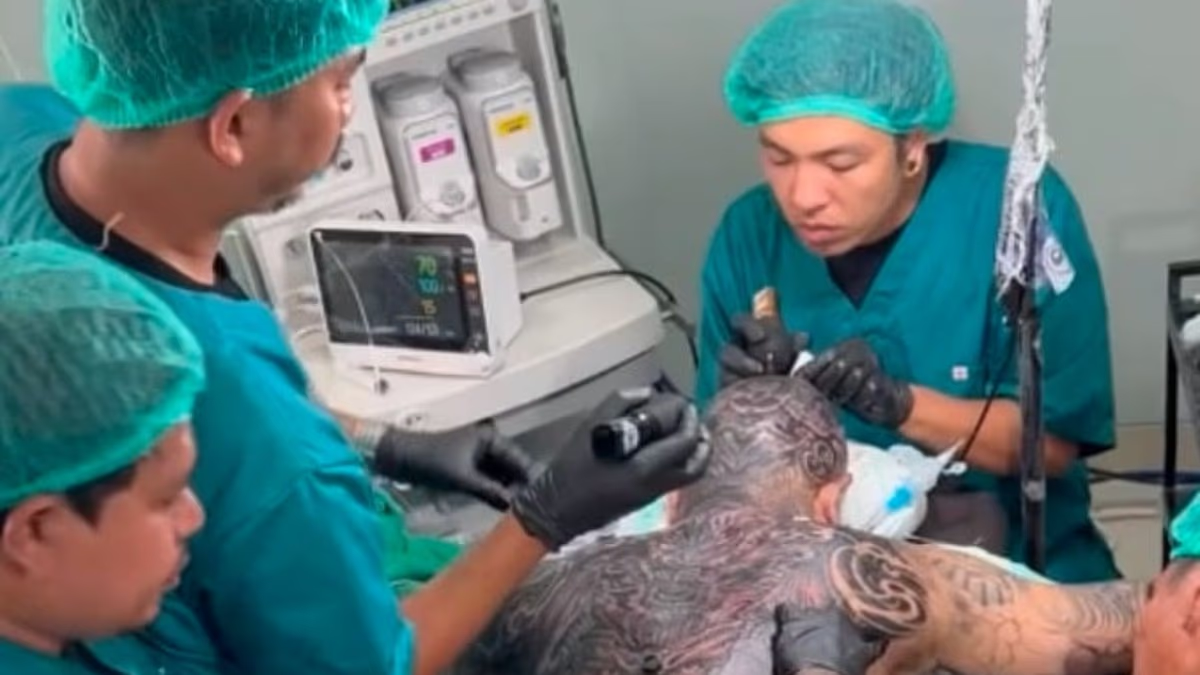

An Australian tattoo veteran has criticised a growing Bali trend in which tourists undergo general anaesthesia for full-body tattoos, comparing it to taking a helicopter to Mount Everest’s peak and then claiming to have climbed the mountain.
Kian Forreal, the owner and master artist at Authentink Studio in Sydney’s Surry Hills, told Our News Outlet that the practice introduces avoidable medical risks while removing what he considers the transformative experience at the heart of tattooing.
Clients are reportedly paying between $9,000 and $16,000 to receive tattoos inside licensed hospital operating theatres, with as many as nine artists working on one person simultaneously.
The procedures can run for 10 to 20 hours, compressing work that would ordinarily be completed over several months or even years into one or two sessions. Hospital and medical procedure costs are included in the package price.
Thousands of visitors have travelled to Bali this year for extensive or full-body tattoos performed under general anaesthetic, with videos and images of the operations attracting widespread attention online.
Bali has long been a popular destination for tourists seeking relatively inexpensive tattoo work, and international visitors make up at least 80 per cent of customers at some tattoo studios.
However, Australian tattoo artists and medical experts say the potential dangers of general anaesthesia outweigh the benefit of avoiding the pain associated with a large tattoo.
Forreal, who specialises in traditional Japanese Irezumi and has spent 33 years creating bodysuits and other large-scale pieces, also expressed doubts about the artistic quality of many tattoos produced through the process.

Australians are travelling to Bali for a controversial tattoo trend involving general anaesthesia and full-body designs

The procedure allows clients to avoid experiencing the pain of being tattooed

Kian Forreal, owner and master artist at Authentink Studio in Sydney’s Surry Hills, says the trend carries unnecessary risks and removes tattooing’s transformative element
“You don’t end up with a nice tattoo. Usually, you end up with a bunch of AI slop or Pinterest slop that’s been mashed together,” he said.
“When it’s done properly, you have something you’ve earned. Going to Bali and having a bodysuit done under general anaesthetic is like wearing a badge saying, ‘I climbed Everest,’ after taking a helicopter. Did you really? No.
“Over the 100 hours I spend with clients, working in four- to six-hour sessions, they become a different person.
“You can’t just phone it in. You squirm, sweat, bleed and complain, but you get through it. That changes you, and that is part of the transformative process.
“We all get to sit at that table because we’ve earned our place there. By choosing an anaesthetic bodysuit, you’re removing that entire experience.
“You see people getting lions, wolves, warriors and all those kinds of images. They get a giant dragon to demonstrate how tough they are, but they can’t sit through the work.
“When I create a large warrior across someone’s back, it becomes their power talisman — and they earned it.”
DON’T MISS: Knicks Players Call Taylor Swift ‘Fakest Fan’ and ‘Performative’
Sydney tattooist Ray Vom, who operates Markd Tattoo Studio in Redfern, also spoke out against the practice.

The procedure places a client under general anaesthetic while up to nine tattoo artists work at the same time

Australian tattooists and medical professionals have described the trend as dangerous and an unnecessary risk
“It’s an enormous risk. I don’t think that’s being emphasised enough, because some people don’t wake up,” Mr Vom told 9News.
Gold Coast tattoo artist Kristen Sorrenson, of Nine Muses, said she “wouldn’t take those odds” or put her life at risk for a tattoo.
Kyle Hoath, president of the Australian Medical Association WA, labelled the practice dangerous, unnecessary and unsafe.
He explained that general anaesthesia requires a trained medical professional to manage a patient’s breathing and vital functions while they are unconscious, and carries potentially fatal risks.
According to Dr Hoath, doctors typically avoid general anaesthesia when a procedure can be completed without it.
“Tattooing can be carried out safely in sterile environments, but there is no need for a general anaesthetic, which adds significant risk to the procedure simply for convenience,” Mr Hoath told 9News Perth.
“That isn’t convenient — it’s dangerous and unsafe, and it should be avoided.
“We don’t see this happening in Australia, and I can’t imagine that we ever will because it adds an unnecessary complication and risk to what should be a relatively straightforward tattoo procedure.”

The elaborate designs are often brightly coloured and can include images such as tigers

Despite the health warnings, tourists — particularly Australians — continue to visit Bali for quicker, cheaper and pain-free full-body tattoos.
Brisbane resident Anthony Waud travelled to Bali in September and spent nine hours under general anaesthetic while artists tattooed both the front and back of his body.
Mr Waud told Yahoo News that he paid $9,000 for the complete procedure and encountered no complications during his recovery.
The 46-year-old said medical staff asked about his use of drugs, alcohol and cigarettes before carrying out blood tests, cardiac checks and blood-pressure monitoring.
“I had no concerns. Everything was handled professionally. The medical care was good, and the staff were very helpful and caring,” he said.


