
As Andy Burnham rose at the Commons despatch box this week to defend his proposed “reset” with the European Union, one furious British business owner sent him a bill for £137,000.
That is the cost Lance Forman, whose family runs Britain’s oldest smoked-salmon producer, says the agreement could impose on his company.
H Forman & Son would need to redesign and reprint its packaging, scrap tens of thousands of pounds’ worth of stock and shoulder additional compliance expenses running into thousands more.
For Mr Forman, the bill is a direct consequence of the Government’s decision to make Britain a rule-taker across the wider agri-food industry.
It is little wonder that he and other business owners in similar positions watched aghast as the Prime Minister described the EU agreement to MPs on Wednesday as a “pragmatic” arrangement.
Burnham insisted the deal was “not a prelude to anything”, presenting it instead as a practical package intended to lower supermarket prices, reduce export bureaucracy and deliver a headline £17billion increase to the British economy.
That interpretation is difficult to accept. When dealing with Brussels, critics argue, every supposedly limited technical concession creates a new point of leverage, while each act of regulatory alignment pushes Britain further from national control and closer to unelected bureaucratic oversight.
Under the proposed arrangement, British businesses would have to comply with EU rules covering food safety, animal and plant health, and carbon emissions trading. It would also introduce a broad “Youth Experience Scheme”, enabling up to 100,000 young Europeans each year to live, work and study in the UK for as long as three years.

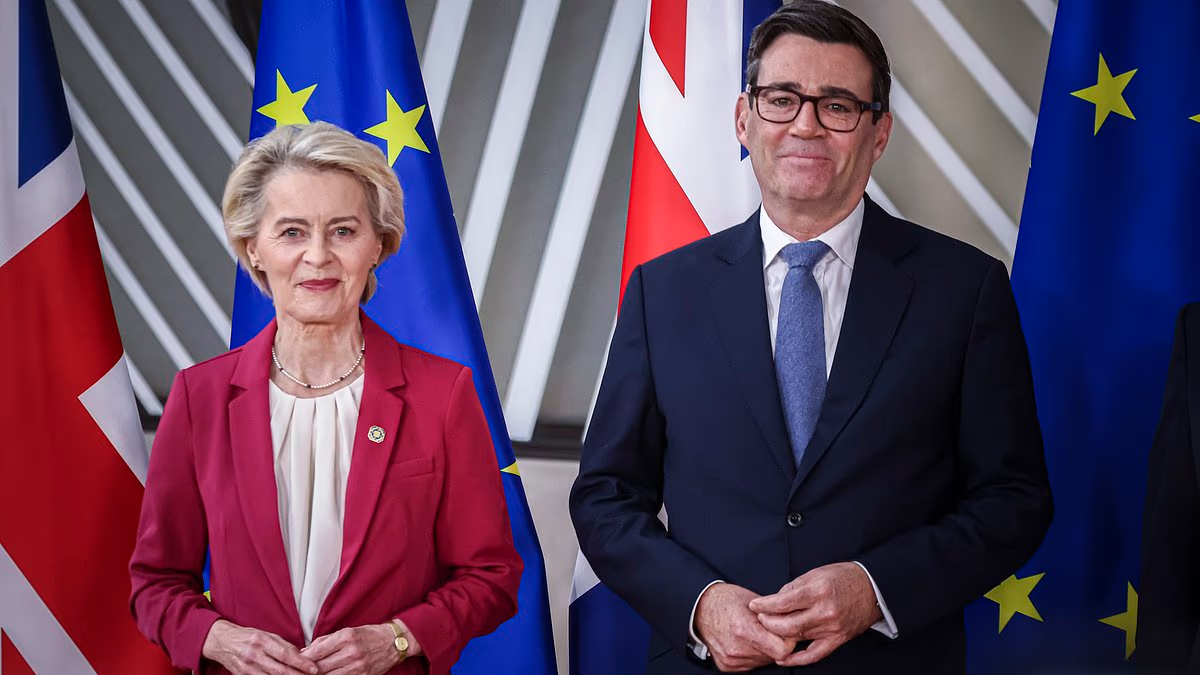
Andy Burnham with Ursula von der Leyen, president of the European Commission
Start with the much-advertised £17billion economic gain, equivalent to 0.5 per cent of GDP.
The figure appears far less impressive when the Treasury’s own forecasts are examined. According to the detail published yesterday, the full benefit would not arrive until 2040 — 14 years from now. That represents an annual growth boost of less than 0.04 per cent.
The proposed implementing legislation is also troubling. It would give ministers extensive “Henry VIII powers”, allowing domestic laws to be amended through secondary legislation whenever Brussels changes its regulations, limiting the opportunity for proper parliamentary debate.
And what would Britain receive in return?
A limited group of exporters — notably businesses selling red meat, dairy products and Scottish seed potatoes — may benefit from reduced checks when sending goods to the Continent.
However, most British farm produce is sold domestically. At the same time, trade with countries outside the EU depends on the UK retaining the freedom to negotiate its own agreements and introduce newer farming techniques involving precision breeding and crop protection.
In practice, a modest reduction in paperwork for certain food exports — a sector representing only 1.3 per cent of total UK exports — would come at the price of binding every business across food, drink and agriculture, including firms that never export, to current and future single-market rules. Lance Forman’s experience illustrates the cost.
The proposed carbon-market link may be even more damaging to Britain’s economic interests.

The PM attends the EU-UK Summit in Brussels on November 20
The UK already faces some of the highest industrial electricity prices among developed economies, a burden that has helped drive steel, chemical and ceramics production out of the country.
Connecting Britain’s Emissions Trading Scheme — which limits the greenhouse gases companies can release — to the EU system, while extending it to aviation and shipping, would leave energy-intensive industries tied to Brussels’ demanding timetable for decarbonisation.
Rather than using Brexit freedoms to make energy more affordable and British industry more competitive with businesses in the United States and Asia, Burnham’s plan would import the EU’s net-zero costs into the UK economy.
Then there is the so-called “Youth Experience Scheme”, effectively a limited version of free movement given a more marketable name. Downing Street describes it as a cultural exchange for people aged between 18 and 31.
But with Britain already under pressure from high housing costs, strained public services and a difficult jobs market for young people, adding up to 100,000 arrivals annually to existing migration levels could place further pressure on the country.
The dispute over university fees is even more revealing. Almost immediately after the Brussels agreement was announced, EU officials indicated that its success depended on Britain reducing tuition charges for European students to the same level paid by domestic students.
That would represent an estimated £500million subsidy, funded either by already struggling universities or, more likely, the taxpayer.
When Burnham suggested yesterday that EU students would continue paying higher fees, Brussels responded by giving him six months to change course.

British economist Liam Halligan writes: ‘Britain already suffers from some of the highest industrial electricity prices in the developed world’
It is a familiar negotiating strategy: once Britain accepts substantial obligations, the EU can withhold the promised advantages until further concessions are secured.
Perhaps the most alarming feature of the proposed reset treaties is the ten-year termination provision. If a future UK government attempted to abandon the arrangement, Britain could face a financial penalty amounting to tens of millions of pounds.
That raises serious democratic concerns. Having failed to secure a clear public mandate for reversing Brexit, Burnham is, critics say, increasing the financial and constitutional barriers that any future Parliament would face.
This is why Conservative leader Kemi Badenoch has called the agreement a “terrible deal” and pledged to repeal it. Nigel Farage has likewise said his Reform party would refuse to pay any termination charge if it entered government, arguing that Burnham cannot tie the hands of a future administration.
The Prime Minister told MPs that rejoining the EU without another referendum would be “unthinkable”.
Yet he has simultaneously invited Brussels to take part in a year-long “brainstorming process” focused on closer integration.
That, critics fear, amounts to democratic erosion through a series of seemingly minor alignments: regulatory independence is surrendered gradually, Britain becomes increasingly woven into the EU’s legal and financial systems, and full membership is eventually presented as the inevitable next step.
Britain’s underlying economic weaknesses — poor productivity, an oversized state, high taxation and expensive energy — were not created by Brexit. Nor will they be fixed by transferring responsibility for British laws to Brussels.
The gloomy predictions made after the referendum are also open to question. Since the 2016 vote, the UK economy has grown by roughly 13 per cent overall, compared with 12.5 per cent in France, 10.3 per cent in Italy and 6.3 per cent in Germany — all EU members, at the last count.
Burnham’s motivation, the argument goes, is political. Unable to establish a lead large enough to secure a Labour majority, he is attempting to attract pro-EU Liberal Democrat and Green voters and assemble a progressive “traffic light” coalition. That would risk more public spending, higher taxes and potentially severe financial consequences.
The growing campaign to rejoin the EU rests on the notion that the bloc offers economic prosperity and political stability. Its critics believe that picture bears little resemblance to reality, given the EU’s sluggish growth and increasingly interventionist approach.
A decade after the Brexit referendum, Britain needs decisive leadership, tighter control of public finances and a radical programme to remove regulation that holds back growth. What it does not need is a gradual retreat into the authority of an unaccountable bureaucracy based in Brussels.