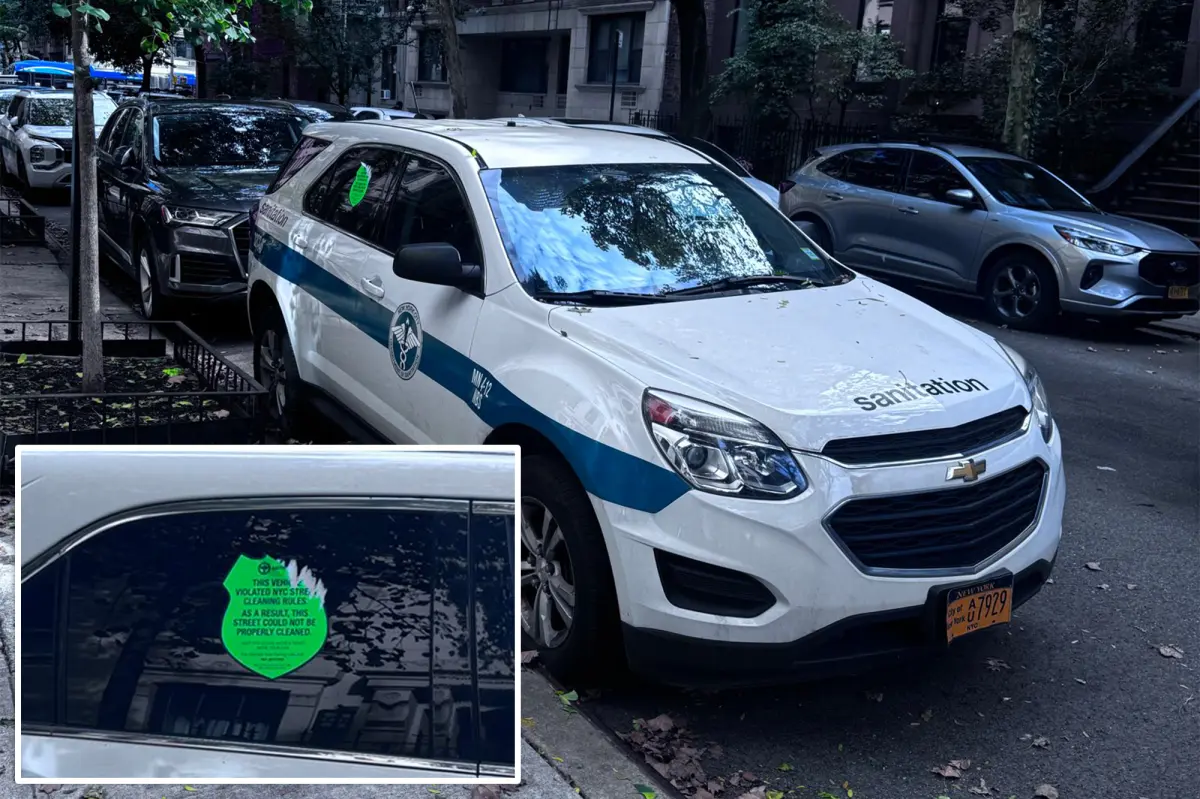

A frustrated New York City driver appears to have taken aim at the city’s alternate-side parking crackdown by placing a “shame sticker” on a Department of Sanitation vehicle.
The large neon-green notice, designed to call out motorists who repeatedly ignore parking regulations, was spotted on the window of a DSNY vehicle parked on a sidewalk beside a row of townhouses. Catherina Gioino, a news editor at Fortune, shared a photo of the scene on X Monday.
A DSNY spokesperson told The Post that the sticker was apparently placed there by a “disgruntled car owner” who had removed the notice from their own vehicle.
“This was not affixed by a DSNY employee. It appears to be a case of a disgruntled car owner peeling off their own sticker and putting it on a DSNY vehicle,” the spokesperson said.
The city introduced the controversial “shame stickers” in August after Manhattan Councilwoman Gale Brewer sponsored legislation overturning a decade-old ban on the practice. The change allowed street sweepers to publicly flag vehicles whose owners repeatedly violate alternate-side parking rules.

The bright placards have drawn criticism from New Yorkers and elected officials, who say sticking them to car windows amounts to vandalism and that removing the adhesive is an unnecessary hassle.
Instructions printed in small type at the bottom of each sticker advise vehicle owners to remove it with “warm water and a scraper.”
The DSNY spokesperson said the notices are intended to encourage drivers to move their vehicles as required by law, allowing street sweepers to keep curbs clean across New York City.
“Our hope remains that Albany will pass a bill that allows automated camera enforcement so that we do not have to use these stickers,” the spokesperson added.
Assembly Member Steven Raga and state Sen. Julia Salazar have each sponsored legislation that would use automated camera enforcement to target parking violations.
Automated camera enforcement is already used on MTA buses to issue violations to vehicles traveling or stopping in bus lanes, double-parked cars along bus routes and motorists blocking bus stops.