Florida Republican gubernatorial hopeful Byron Donalds has significantly scaled back President Donald Trump’s visibility on his campaign website, mirroring a broader shift among GOP candidates who have removed Trump-focused photos, slogans and prominent endorsements.
Not long ago, Republican campaign websites routinely placed Trump at the center, signaling loyalty to the president and his political movement.
With the 2026 midterm elections drawing closer, however, more GOP contenders are quietly adjusting their online messaging and minimizing Trump’s presence on their homepages.
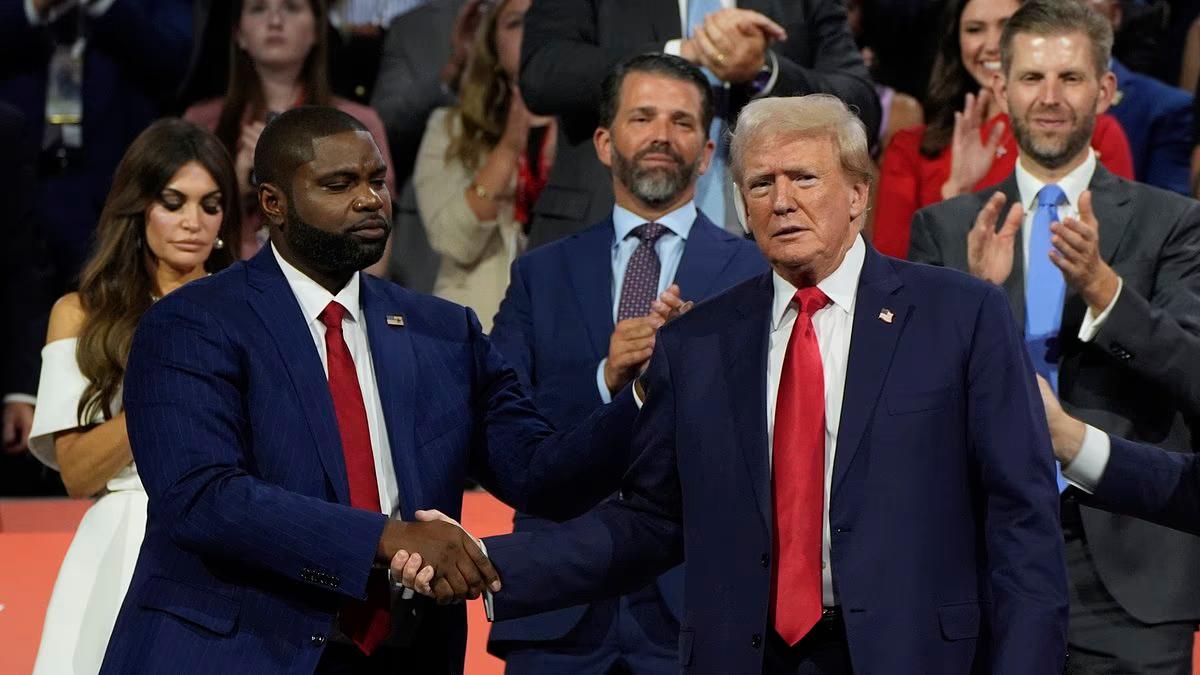
Donalds, who has Trump’s endorsement, recently revamped his campaign site. The homepage no longer features the large endorsement banner or the previously prominent photographs showing the two politicians together.
Trump’s backing has not been removed altogether and can still be found elsewhere on the website.
Even so, the president now occupies a far less prominent position in the campaign’s public presentation.
Gates McGavick, communications director for the Donalds campaign, rejected the characterization that Trump was being deliberately sidelined, dismissing the attention as “FAKE NEWS.”
McGavick said the redesigned website was created to spotlight Donalds’ priorities, including affordability, rising insurance expenses and government transparency. He also stressed that the campaign remains proud of Trump’s endorsement.

The Florida gubernatorial campaign website for Byron Donalds previously featured a photo of President Trump and a reference to him in its “issues” section

The updated “issues” section no longer includes a reference to President Trump or his America First agenda

Trump endorsed Donalds for Florida governor in February 2025, before Donalds formally entered the race. On Truth Social, Trump promised his “complete and total endorsement” if Donalds ran, ending with the rallying message: “RUN, BYRON, RUN!”
Donalds is not the only Republican candidate to have recalibrated his campaign website.
Candidates in several closely watched GOP contests have made comparable changes since winning their primary nominations.
In Kentucky, Ralph Alvarado removed highly visible Trump imagery and replaced the phrase “America First Fighter” with “Independent Leadership.”
Trump still appears in parts of Alvarado’s campaign materials, but the adjustment changes the message visitors encounter first when they visit the site.
Florida candidate Mike Beltran has also taken several prominent Trump references off his campaign website.
Earlier versions of the site highlighted Beltran’s allegiance to Trump and included imagery tied to the president’s political movement.
Following the primary, those elements were reduced as the campaign shifted more attention toward issues including the cost of living, taxes and healthcare.
Beltran continues to publicize Trump’s endorsement and his connection to the president in other parts of the site, underscoring the difference between softening Trump’s profile and breaking with him politically.
Comparable website changes have also been reported in Michigan, Iowa, Texas and California.
Mike Bouchard removed a prominent Trump endorsement banner from his Michigan campaign homepage, although the endorsement remains listed elsewhere.
Iowa Republican Joe Mitchell removed some of the more explicitly pro-Trump language from his website, while Texas candidate Carlos De La Cruz dropped ‘Trump Conservative’ from the prominent description of his campaign.
In California, Young Kim removed references to Trump and ‘America First’ from prominent portions of her website, while James Gallagher removed Trump’s endorsement and photograph from his campaign site.
The changes have drawn attention because many of these candidates continue to support Trump and his policies.
Their campaigns generally argue that the changes reflect the transition from a Republican primary, where Trump’s endorsement can be central to winning the nomination, to a general election in which candidates want to emphasize local issues and their own records.
Trump has not necessarily been rejected by these candidates, but in a number of competitive races his face, name and ‘America First’ branding are no longer occupying the same prime real estate they did during the primaries.