
Prime Minister Anthony Albanese has accepted the Global Citizen Award at a star-studded dinner in New York City, despite vocal frustration from Australians over his selection for the prestigious honour.
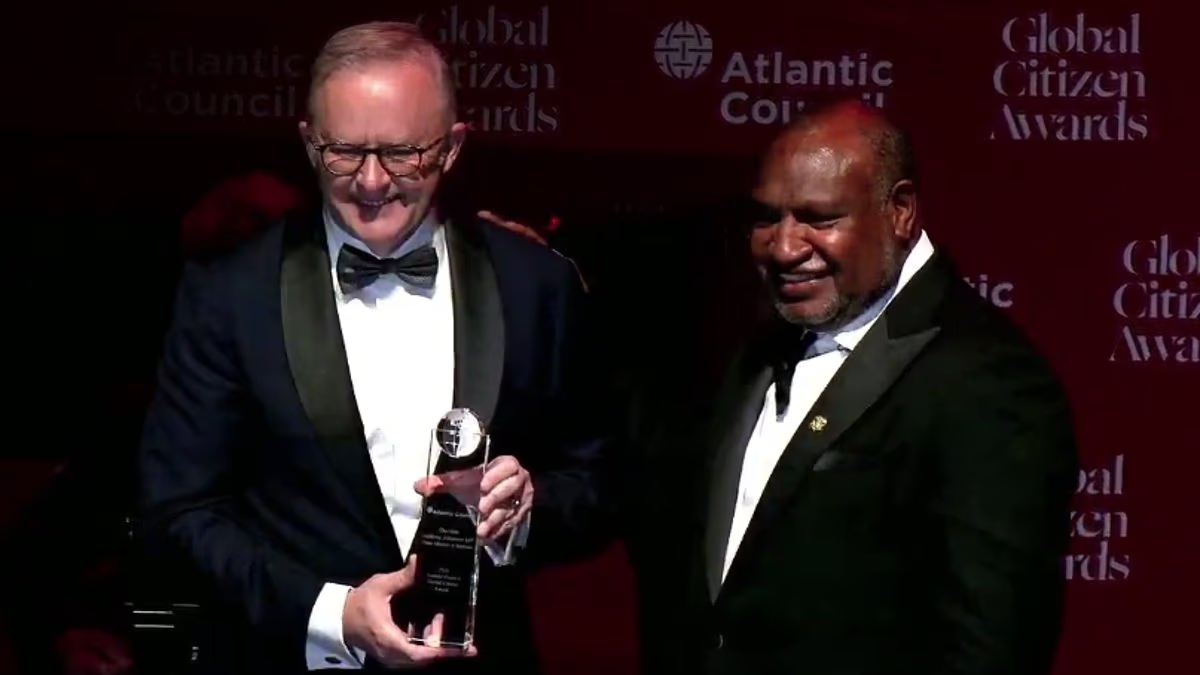
Presented by the Atlantic Council on Wednesday night, the award acknowledged Albanese’s efforts to strengthen Australia’s international alliances, advance the AUKUS security partnership and support stability and cooperation throughout the Indo-Pacific.
In his acceptance speech, Albanese warned that the assumptions supporting the post-Cold War world were rapidly breaking down. He said the international order created after World War II was struggling to respond to today’s challenges.
“Since the end of the Cold War, the prevailing assumptions of international affairs were clear: openness was security; efficiency mattered more than resilience; and international rules would be observed as a matter of course,” he said.
“Both those expectations are now being tested. The post-1945 world order is no longer fit for purpose. Universal institutions that remain necessary are now not always sufficient for the challenges we face.”
Albanese said rising geopolitical tensions and growing instability had highlighted the shortcomings of institutions designed for another era, making stronger partnerships and greater resilience increasingly important.
The ceremony took place only days after an awkward exchange at the beginning of Albanese’s New York visit.
On Sunday night, ahead of the event, The Nightly’s journalist-at-large Latika Bourke questioned Albanese about whether he deserved an international leadership award while facing domestic political pressure after a recent Newspoll.

Anthony Albanese (left) was presented with his Global Citizen Award by James Marape (right)
“Prime Minister, here in New York on Wednesday night, you will receive an award for being a global citizen,” Bourke said.
“Don’t you feel like a bit of a fraud accepting this award when at home you’ve screwed up the response to the worst massacre since Port Arthur, Labor is one point shy of where it was under Julia Gillard when you rolled her, and your net approval ratings are worse than Scott Morrison’s?”
Albanese paused before giving a brief response.
“No,” he replied, before the press conference moved on to another question.
Many Australians quickly backed Bourke, praising her for putting the pointed question to the Prime Minister.
“He is the worst and most dangerous PM in the history of Australia. He has no idea how hated he is,” one person wrote.
“A great and reasonable question Latika. The PM could have taken the opportunity to answer in a manner befitting his position, yet he arrogantly ignored it,” another added.
The other 2026 recipients included Finnish President Alexander Stubb, Wicked actress and singer Cynthia Erivo, and Formula 1 chief executive Stefano Domenicali.

Albanese (centre) sat with James Marape (right) and Kevin Rudd (left) at the dinner
Former prime minister Kevin Rudd was seen seated beside Albanese at the dinner, while actor Keanu Reeves introduced Domenicali before his award presentation.
Papua New Guinea Prime Minister James Marape praised Albanese’s leadership and highlighted Australia’s importance to the Pacific, describing the Prime Minister as both a trusted partner and a friend.
‘It is our privilege tonight to introduce not only the Prime Minister of Australia, but someone I am proud to call a friend,’ Marape said.
‘The Honourable Anthony Albanese, or Albo, as he is known to many. To those who are his friends, he is a fair dinkum Australian.’
Marape said Australia played a unique role in the region because of its economic strength and international influence, giving it a powerful voice across the Pacific and on the world stage.
‘For those of us from the island nations of the Pacific, Australia is a special nation,’ he said.
‘Its economic strength and international influence give it an important voice across our region and on the global stage.’
He said he and Albanese had worked closely together on issues including security, economic development and climate change.
‘My brother, the Prime Minister, understands the responsibility that comes with that,’ Marape said.