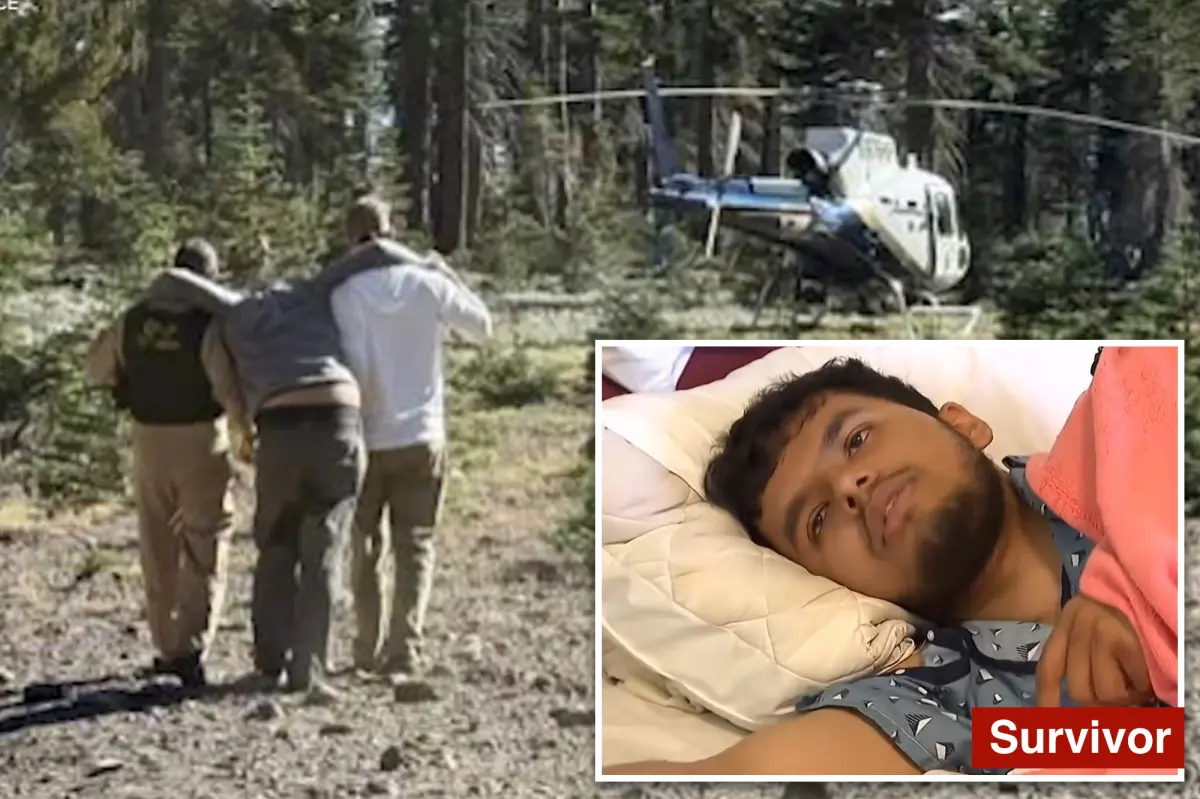

A first-time climber’s attempt to conquer Mount Shasta became a fight for survival after he slid nearly 500 feet down the mountain and was forced to crawl toward safety without a phone, food, water or light.
Zubayir Kazi, 24, reached the summit at about 7:30 p.m. on Sept. 10 after beginning his climb early that morning. Although he had surveyed part of the trail five days earlier, the conditions he encountered were far more severe than he had anticipated.
“It turned out to be much worse than I expected,” Kazi told NBC Bay Area.
The most dangerous part of the climb began during his descent. Shortly after reaching the summit, Kazi lost his equipment and suddenly began sliding down the mountain.
“Everything I had with me just goes out of my hand and I find myself flying down the mountain,” he told the outlet.
The fall left Kazi seriously injured and without the supplies he needed to call for help. He had no phone, no light, and nothing to eat or drink. With few options, he decided his best chance was to keep making his way downhill.
Kazi crawled down the mountain, driven by the fear that stopping could cost him his life.
“My mentality became very one dimensional. I don’t know what’s the optimal thing to do, but I just know that I have to go lower because if I stay here and fall asleep, I’m going to die,” Kazi said.
Meanwhile, in San Jose, Kazi’s family grew increasingly concerned after he stopped responding. His mother contacted his friend Abdullah, and as the hours passed, search-and-rescue crews launched a missing-person operation.
The breakthrough came when rescuers learned that Kazi had reached base camp. Another climber found him there and gave him food and water while he waited for emergency crews to arrive.
Once officers reached Kazi, the seriousness of his injuries became clear.
“When the officers came in, it was the first time I really realized how badly I was injured. They said ‘You have no skin behind your leg’,” Kazi said.
Kazi sustained extensive skin and nerve damage, as well as serious internal complications. Doctors told him he might have died within hours, and his recovery is expected to take several weeks.
The U.S. Forest Service says the route Kazi used is not recommended at this time of year, particularly for inexperienced climbers. Conditions on Mount Shasta can shift rapidly, and accidents can occur even when hikers believe they are prepared.
The ordeal has also changed Kazi’s perspective on mountain climbing.
“It is very important to fully and properly account for all of the requirements and safety considerations necessary to complete a hike like this and not miss a single one — and I’d say to definitely not go alone.”