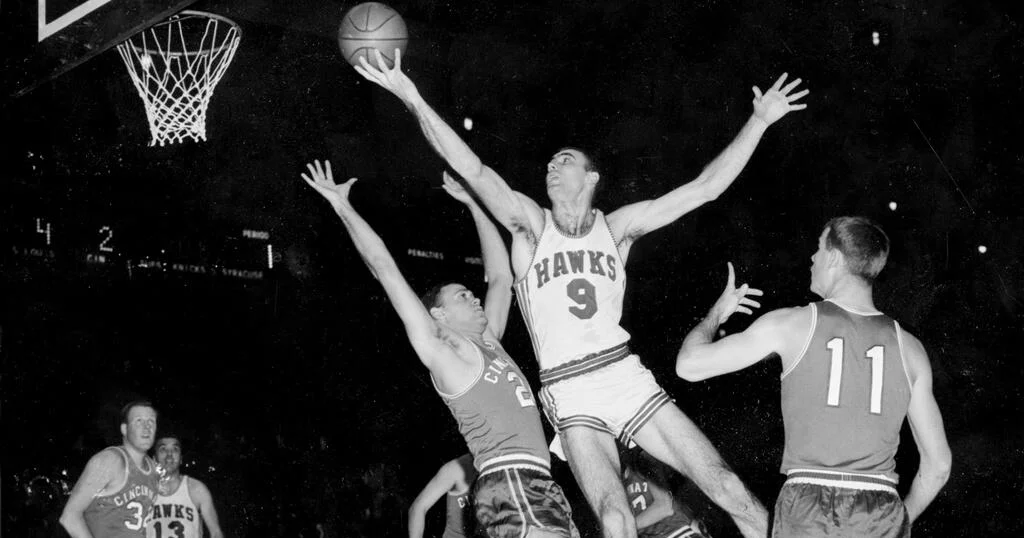

Bob Pettit, the dominant scorer and rebounder who led the St. Louis Hawks and became the NBA’s first Most Valuable Player in 1956, has died at age 93.
Louisiana State University, Pettit’s alma mater, confirmed Thursday that he died the previous day. No cause of death was released.
A standout All-American at LSU, Pettit went on to become an NBA All-Star in every one of his 11 seasons, all spent with the Hawks. He guided the franchise to its only championship in 1958, defeating the powerhouse Boston Celtics.
Pettit claimed a second regular-season MVP award in 1959 and was named All-Star Game MVP four times. Only Los Angeles Lakers icon Kobe Bryant has matched that total.
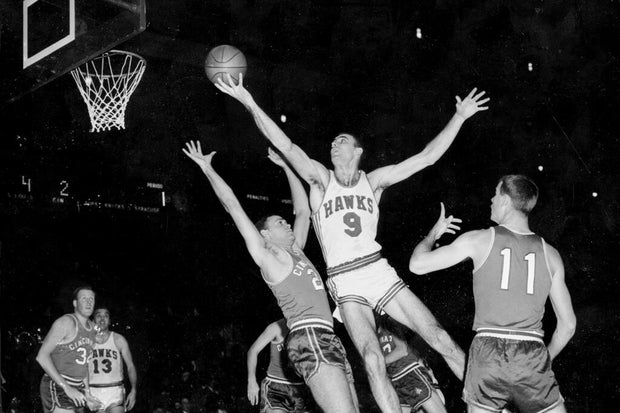
AP Photo/File
He established himself during an era that included legends such as Wilt Chamberlain, Bill Russell, Oscar Robertson and Elgin Baylor. Yet Pettit played before the NBA had widespread national television exposure, and his career in the smaller St. Louis market limited the size of his audience.
Listed at 6-foot-9 and 205 pounds, Pettit brought unusual strength and athleticism to the power-forward position, a term that was not yet commonly used. With his receding hairline and imposing frame, he was a formidable presence who seldom missed games. He also played center and helped pioneer a more versatile style for big men by attacking the basket facing forward rather than relying exclusively on post-up moves.
Pettit earned Rookie of the Year honors in 1955, the same season the Hawks played their final year in Milwaukee before relocating to St. Louis.
One year later, he won the league’s first MVP award after averaging 25.7 points to lead the NBA in scoring. He topped the scoring rankings again in 1959, putting up 29.2 points per game.
Pettit ended his career after the 1964-65 season with averages of 26.4 points and 16.2 rebounds per game. At retirement, his 20,880 points ranked first in NBA history, while his 12,849 rebounds placed him second.
The Basketball Hall of Fame inducted Pettit in 1970.
EXPLORE MORE: Unsealed Memo Claims Bryan Kohberger Didn’t Understand Guilty Plea
“Lean, graceful, and always well-conditioned, Bob Pettit’s physical build made him one of the first big men to play facing the basket,” the Naismith Memorial Basketball Hall of Fame says in its biography of Pettit. “But Pettit’s resolve set him apart from his peers; he simply would not be outworked.”
Robert Lee Pettit Jr. was born Dec. 12, 1932, in Baton Rouge, Louisiana. His father was a law enforcement officer who later served as sheriff of East Baton Rouge Parish. Pettit developed into a basketball player later than some of his peers and did not reach the Baton Rouge High School varsity until his junior year.
As a senior, he led Baton Rouge High to a state championship and attracted more than a dozen college scholarship offers. He stayed close to home at LSU, where he became a star as a sophomore—the earliest point at which players were then eligible for varsity competition.
Pettit led the Southeastern Conference in scoring throughout all three of his college seasons, averaging 25.5 points as a sophomore, 24.9 as a junior and 31.4 as a senior.
He remains one of just three LSU players to be enshrined in the Basketball Hall of Fame, alongside Pete Maravich and Shaquille O’Neal. LSU honors him with a bronze statue outside the Pete Maravich Assembly Center, where another statue commemorates O’Neal. Pettit’s No. 50 has been retired by LSU, while the Atlanta Hawks retired his No. 9.
Pettit’s championship résumé was shaped in part by the Celtics dynasty that dominated professional basketball for much of his career and ranks among the greatest sustained runs in American sports.
He came within two victories of winning three NBA titles. The Hawks reached the Finals four times during Pettit’s career, facing Boston in each series and losing twice in decisive Game 7s.
Boston won the first matchup in 1957 after a Game 7 that required two overtimes. The Hawks answered the following year, winning the championship and briefly interrupting Boston’s remarkable stretch of nine titles in 10 seasons. Atlanta later fell to the Celtics in the 1960 Finals, again in seven games, and in the 1961 series, which Boston won in five.
After retiring from basketball, Pettit returned to Baton Rouge and built a career in banking and financial consulting. In his later years, he remained a familiar presence at LSU and New Orleans Pelicans games.