

Natural springs and centuries-old pools across the occupied West Bank have long offered relief from punishing summer temperatures. For Palestinian communities, they are also essential sources of income and water, supporting tourism and irrigating farmland.
Yet access to those springs and the stone reservoirs they feed is becoming increasingly difficult for the territory’s 2.8 million Palestinians. Israeli settlers, emboldened by a hard-line government seeking reelection, have intensified efforts to take control of springs and other sites considered part of the region’s heritage.
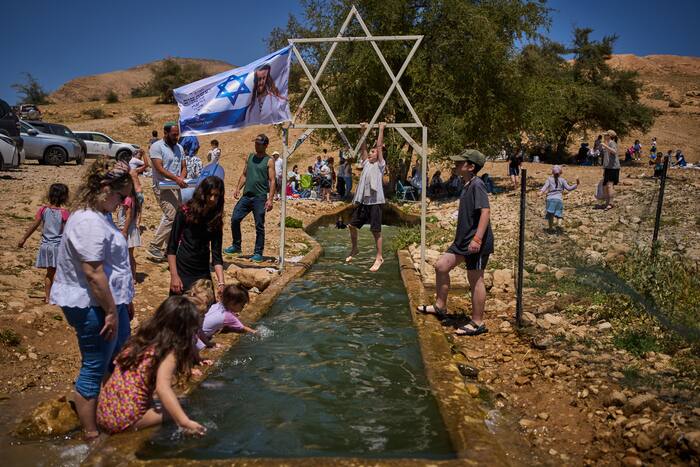
This summer, water flowing from a spring serving the Palestinian village of Fasayil was diverted without authorization into a nearby ancient pool. The people who redirected it used the water to fill the site and promoted it as a new tourist destination named for Herod, the Roman-appointed king of Judea.
Under agreements reached in the 1990s, the pool lies in Area C, the portion of the West Bank under complete Israeli military control. Research by Dror Etkes, director of the settlement-monitoring organization Kerem Navot, found that the land was privately owned.
Saad Nemer, a Palestinian farmer from Fasayil, said the loss of water had ruined his fields. His family, he added, possesses documents showing ownership of the land. COGAT, the Israeli military agency responsible for civil affairs in the West Bank, confirmed that the diversion occurred “without authorization” and said it would investigate.
Other West Bank swimming spots have likewise become flashpoints. Last week, an Israeli father of six was shot and killed by a Palestinian at a spring in the northern West Bank, where he had been bathing with his eldest son before the Yom Kippur holiday.
Israel funds Jewish heritage projects in the West Bank
Israel has occupied the West Bank since capturing it, along with east Jerusalem and the Gaza Strip, from Jordan and Egypt during the 1967 war. Since then, it has established a network of settlements housing more than half a million Israelis on territory Palestinians seek for an independent state.
Most of the international community regards those settlements as illegal. Earlier this month, as settler violence and other actions displaced Palestinians, the British government accused Israel of turning “a blind eye” to what it called “ethnic cleansing of Palestinians in areas of the West Bank — perpetrated by settler terrorists.”
Prime Minister Benjamin Netanyahu condemned the violence, but attributed it to a “handful of rioters” in the occupied West Bank who, he said, unfairly discredit the “law-abiding settler public.”
The effort to seize and rename heritage sites forms part of a broader campaign, according to the Israeli rights organization B’Tselem. In a report issued this month, the group said such designations are used to “elevate the historical, cultural, and religious ties of the State of Israel and the Jewish people to the West Bank.”
Calling the pool near Fasayil after Herod was an attempt to “brand” it as a site belonging to Jewish history, said Alon Arad, executive director of Emek Shaveh. The Israeli organization campaigns against the politicization of archaeology in Israel and the Palestinian territories.
The site has never been examined by archaeologists, leaving its date of construction uncertain. Excavations by the archaeology unit of Israel’s Civil Administration, the military body that manages daily affairs in the West Bank, have found other remains in the area dating to Herod’s reign in the first century B.C.E.
Heritage Minister Amichai Eliyahu told The Associated Press that the pool would be emptied at the start of October, after the Jewish holidays, allowing the administration’s archaeologists to carry out a comprehensive survey.
Eliyahu praised the people who diverted the water and said the government had set aside about $1 million to restore the site. He said that sum was part of at least $166 million allocated for excavations and infrastructure at more than 100 locations he described as linked to Jewish heritage in the West Bank.
“We’ll turn this place into the Garden of Eden,” Eliyahu said during a visit to the pool near the Petzael settlement.
He also declared that there was “no such thing as a Palestinian nation” before jumping into the water.
Fields dry up as water is seized
The fight over water in this fertile area reflects the wider struggle for control of the West Bank, particularly the Jordan Valley. Palestinians see the valley as the agricultural heartland of a future state, while Israel considers it vital to securing its eastern border.
Palestinians have experienced water shortages and restrictions since Israel assumed control of the West Bank in 1967. Interim peace agreements signed in the 1990s acknowledged Palestinian water rights but maintained an arrangement under which roughly 80% of water drawn from the main aquifer was allocated for Israeli use.
Now, soaring attacks by settlers are exacerbating the problem. Settlers have damaged, destroyed or seized approximately 160 water and sanitation structures, including pipelines and cisterns, in Palestinian communities in 2026, according to a July report from the United Nations Office for the Coordination of Humanitarian Affairs.
The attackers are increasingly targeting shared water infrastructure and have disrupted supply to all or large parts of several Palestinian communities, the report said.
In Al Auja, in the Jordan Valley, the seizure by settlers of the local natural springs has forced some Palestinian farmers to abandon their fields.
Murad al-Juba, 53, once grew an abundance of fruit and vegetables, including cantaloupes, eggplant, bananas and tomatoes. But after settlers encroached, harassing residents and diverting the spring water, he said he has been unable to plant.
“All these farms depend on the spring, but today, the spring is gone, because the settlers took it,” Juba said.
More recently, “settlers have completely taken over” the spring’s waterfall and turned “the area into a quasi-military zone,” said mayor Hani al-Njoum, adding it has been devastating for local tourism and agriculture.
“This land was bountiful,” Juba said. “Today, it is a desert.”
___
Bwaitel reported from Al Auja, West Bank.