
CAMEROON – The U.N. refugee chief called on the world’s divided nations Friday to work toward ending the conflicts and crises that have forced more than 117 million people from their homes. He warned that displaced people should be able to return rather than spend generations living in foreign countries.
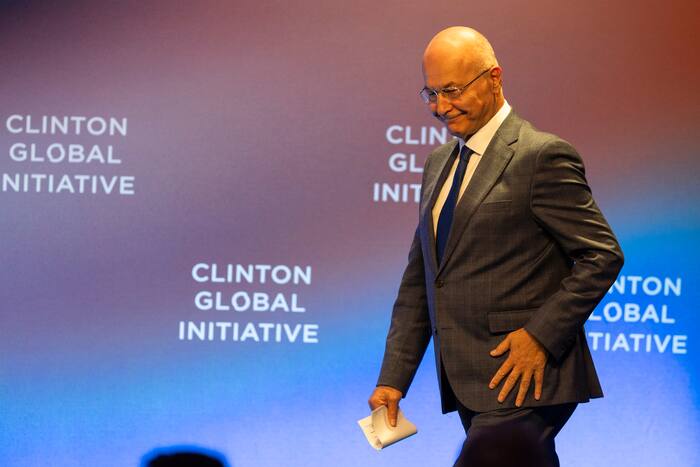
Barham Salih made the appeal in his first address to the 15-member U.N. Security Council since being elected high commissioner for refugees last December. He said the council has “a unique responsibility to help make peace possible.”
“For the millions of people forced from their homes – and the millions more who should never have to flee – I urge you to use that responsibility,” said Salih, a former refugee who served as Iraq’s president from 2018 to 2022. He spoke on the sidelines of the annual U.N. gathering of world leaders.
Salih emphasized that humanitarian workers, including those with the U.N. refugee agency known as UNHCR, confront the daily consequences of war but cannot deliver peace themselves. Under the U.N. Charter, that responsibility belongs to the Security Council, which is tasked with maintaining international peace and security.
He then highlighted several conflicts driving people from their homes around the world.
The war in Sudan has created the world’s largest displacement crisis, affecting 12 million people inside and outside the country, Salih said. “As long as this war continues, people will continue to flee,” he warned.
In Congo, he said, “generations have now lived through cycles of conflict and violence,” with the situation further complicated by an escalating Ebola crisis. The war in Ukraine, meanwhile, has displaced millions within the country and driven millions more across its borders.
In camps near Tindouf, Algeria, generations of refugees from disputed Western Sahara, which Morocco claims, have grown up “facing uncertainty and limited prospects while awaiting a political solution,” Salih said.
Amid the latest escalation in the Middle East, UNHCR has deployed resources and personnel to assist more than 130,000 Yemenis who fled recent fighting but remain inside the country. More than 3,700 others have sought refuge in Djibouti, Salih said.
Salih acknowledged that his goal, announced earlier this year, of cutting in half by 2035 the number of refugees in protracted displacement who depend on humanitarian assistance is “ambitious.” But he said it must be, because “keeping people alive year after year while they remain unable to rebuild their lives cannot be our end goal.”
Success, he argued, cannot simply mean improving the ability to keep people trapped in war alive for one more year. Nor can it mean opening another camp to address a crisis that has already lasted 50 years, or allowing children to inherit displacement from their parents.
“Success must ultimately mean creating the conditions in which people no longer need us,” Salih said. UNHCR’s goal, he added, must be “to prevent displacement where we can, resolve it where it has occurred, and create the conditions in which people can rebuild their lives in safety and dignity.”
___
Edith M. Lederer has covered international affairs for The Associated Press for more than half a century.


