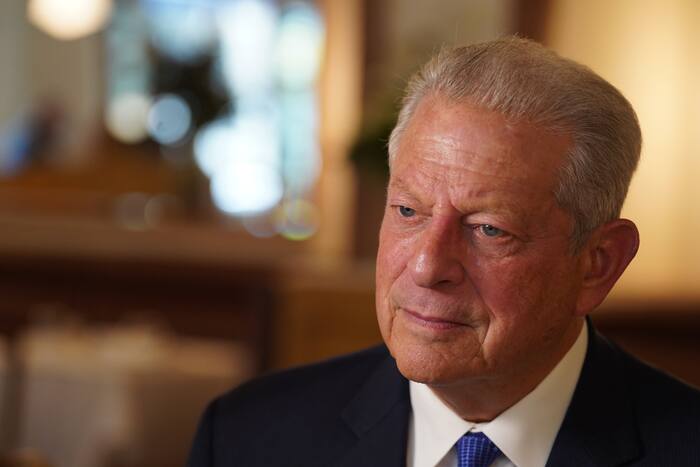


NEW YORK – Al Gore has spent decades warning about the climate crisis. Now, the longtime environmental advocate believes humanity may be nearing a breakthrough — though he fears the opportunity could still be lost.
“While we’re in grave danger, I think there is a possibility that 2026 will be looked back upon in the history books as the beginning of a positive tipping point,” Gore told The Associated Press in an interview during New York Climate Week. He said the world may soon reach peak consumption of coal, oil and gas, the fuels responsible for global warming, as solar power and other renewables increasingly outcompete fossil fuels.
Gore draws hope from earlier social movements. He likened the push for a cleaner planet to the U.S. civil rights campaign, Nelson Mandela’s fight against apartheid and the movement for women’s equality — “the other great morally based challenges that humanity has confronted in the past.”
“And in all of those prior movements,” he said, “there were times when the advocates felt despair but they kept going because courage is not the absence of fear, it’s the determination to go forward in spite of it.”
Still, the natural world gives Gore plenty of reason for concern. Global temperatures are rising faster, intensifying heat waves and fueling disasters such as the glacier collapse and flooding in Nepal that killed 1,300 people.
“I’m temperamentally optimistic, but the dangers are extremely grave, getting more so all the time,” said Gore, who has often been labeled a doomsayer by political opponents who are not climate scientists. “We’re seeing these extreme events come fast and furious. They’re worse as well as more frequent. … It’s like a nature hike through the book of Revelation.”
A race between old and new power
Gore described the energy transition as a contest between escalating climate risks and the rapid spread of cleaner, cheaper technologies that are creating jobs and attracting users around the world.
“This is a close race between the unfathomable risk we are taking, the unacceptable damages we are enduring on one hand, and the incredibly exciting advance of all the clean, cheap, job-producing alternatives that people not under the sway of the fossil fuel industry are adopting in droves,” Gore said.
He cited several indicators of the shift: Africa is installing 100,000 solar panels a day, renewables accounted for 91% of new U.S. electricity generation and electric vehicles are expected to make up 30% of all new cars sold globally this year. In Pakistan, he added, three solar panels have become a common part of a marriage dowry.
So which side will prevail? “The answer is in our hands,” Gore said. “The last chapter of this story won’t come for a while, but I think we really are at a turning point.”
A decade ago, Gore said, fossil fuels accounted for 55% of global investment, compared with 45% for renewables. Today, he puts the split at 65% for renewables. In his view, major transitions occur when new technology becomes less expensive than what it replaces — much as mobile phones eventually displaced landlines.
Experts say Gore is right to be optimistic
Three climate scientists broadly agreed with Gore’s assessment: the risks are growing, but there are also grounds for hope.
“I agree with Al Gore that we have incredible progress on exponential rise in adoption and decline in price for renewable electric green solutions,” said Johan Rockstrom, director of Germany’s Potsdam Institute for Climate Impacts Research. “But the dilemma, so far, is that they largely meet growing energy demand. We are not yet bending the curve on oil, gas and coal.”
Bill Hare, chief executive of Australia’s Climate Analytics, said he shares Gore’s optimism about what can be achieved through the rapid expansion of clean technology. At the same time, Hare warned that progress may not be fast enough and is being obstructed by the fossil fuel industry.
Michael Mann of the University of Pennsylvania also said the transition is moving too slowly, but argued that Gore’s hopeful message matters. “Doomism, despair and disengagement is the greatest threat at this point. We must not fall victim to it,” Mann said.
Gore, now 78, remains determined. He believes he will live to see a meaningful decline in the trajectory of carbon pollution. And if the turnaround takes longer, he said, the work will still be worthwhile, invoking a passage from the Jewish Talmud:
“You are not required to finish the work, but you are required to undertake it.”
___
The Associated Press’ climate and environmental coverage receives financial support from multiple private foundations. AP is solely responsible for all content. Find AP’s standards for working with philanthropies, a list of supporters and funded coverage areas at AP.org.


