Republicans are directing fresh campaign cash toward Senate battlegrounds as troubling polls emerge from states that have traditionally favored the party. The warning signs are now appearing across both chambers of Congress.
The National Republican Senatorial Committee is betting $46 million on a defensive effort, including $9 million in Iowa, $11 million in Ohio, $2 million in Alaska and $8 million in North Carolina, as it works to prevent a possible Democratic surge.
“You’ve got Republicans scrambling everywhere,” Sen. Jim Justice (R-W.Va.) told The Post. “My lord, all we really had to do was stay in touch with people four or five months ago. We’ve done a lot of great things, but we’re tone-deaf in a lot of ways.”
The Senate Leadership Fund, which is aligned with Senate Majority Leader John Thune (R-S.D.), has committed $100 million to support Texas Republican attorney general Ken Paxton, according to a source who said the spending could continue through Election Day. “It’s a red-wall kind of thing,” the source said. “We only spend money where we believe it can make a difference.”
Republicans’ growing exposure is evident in red-state polling, as well as in recent policy moves by vulnerable lawmakers who typically remain closely aligned with President Trump. Trump’s own approval ratings are currently underwater.
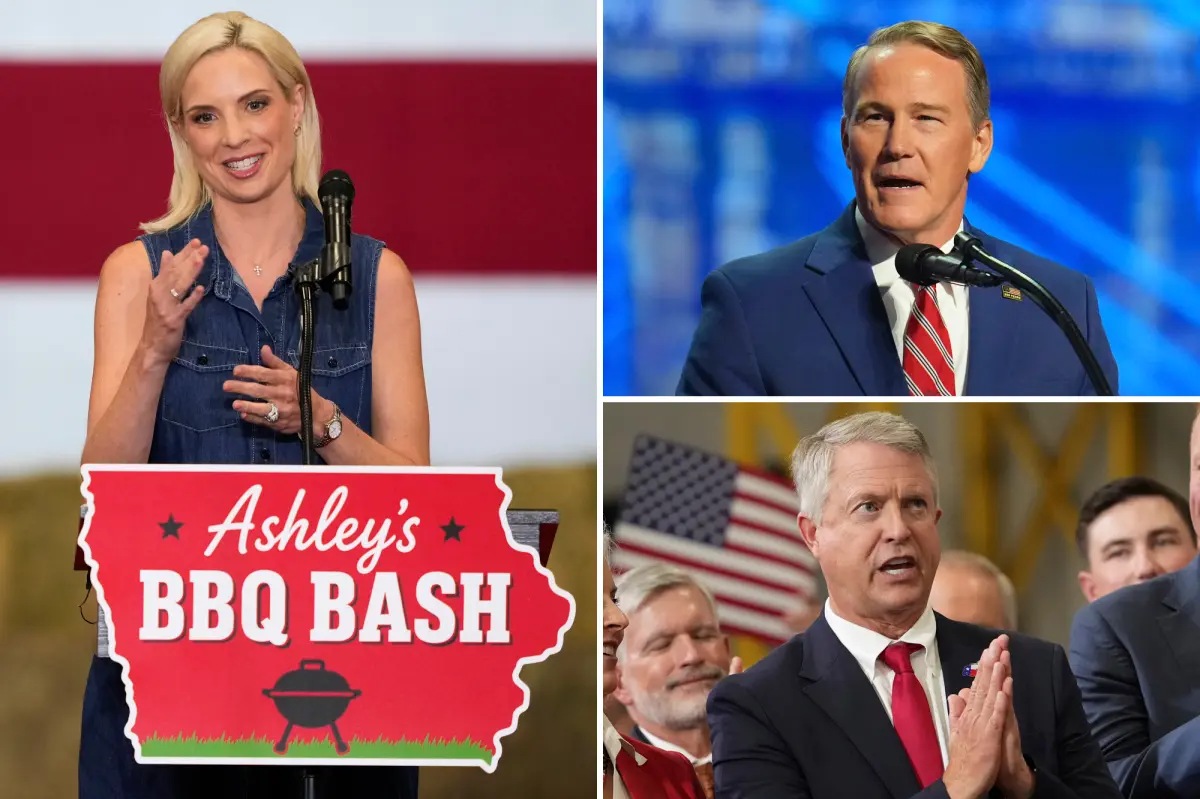
Recent Iowa surveys show Democrat Josh Turek running even with Rep. Ashley Hinson (R-Iowa), once viewed by Republicans as a top-tier contender in a state Trump won with 56% of the vote. Republicans currently hold a 53-47 Senate majority, meaning Democrats would need to gain four seats to make Sen. Chuck Schumer (D-N.Y.) majority leader.
In Ohio, former Sen. Sherrod Brown, a Democrat, has opened a four-point lead over appointed Republican Sen. Jon Husted. Trump carried the state by 13 percentage points over former Vice President Kamala Harris in 2024.
Hinson and former Rep. Mike Rogers, the Republican Senate candidate in Michigan, both issued statements this week criticizing the war in Iran as they sought to create some distance from the administration’s position. Husted said the conflict “needs to come to an end as quickly as possible,” though he did not support a War Powers resolution Thursday that called for ending the military action.
YOU MAY ALSO READ: Apple Engineer, 35, Dies After Boat Capsizes in San Francisco Bay
At a meeting with Republican lawmakers Wednesday, NRSC Chairman Tim Scott delivered a blunt message: candidates in red states should campaign as if they are trailing. One Republican source said Scott emphasized that the Senate contest features a record number of tossup races.
Election analyst Larry Sabato has shifted Iowa into the “toss-up” category and moved Kansas to “leans Republican.”
High fuel costs and tariffs have made Ohio and Iowa “look especially dire for Republicans,” said Erin Covey of the Cook Political Report. The publication also moved 15 House races toward Democrats on Friday, including the race for Rep. Tom Kean’s (R-N.J.) seat, which Covey now rates as “lean Democrat.” Kean recently had a prolonged absence while dealing with depression.
“What’s worse for them compared with 2018 is the economy,” Covey said, referring to the election cycle in which Democrats picked up 40 House seats and took control of the chamber. She noted, however, that fewer House districts may be genuinely competitive this year.
Sen. Roger Marshall (R-Kan.) said Thursday that Immigration and Customs Enforcement should coordinate with local authorities during operations in Kansas. His comments came as federal agents conducted a series of immigration raids in the state’s southwest, marking a measure of distance from one of the White House’s signature issues. Marshall is holding onto a narrow polling lead in a state where Republicans have not lost a Senate race in a century.
The economy has become President Trump’s “anvil,” wrote Cook Political Report editor Amy Walter. That burden could make it more difficult for him to campaign effectively in competitive states, where his presence might otherwise energize Democratic voters. His upcoming rallies are scheduled for deeply conservative Oklahoma and Alabama, rather than states considered Senate or House battlegrounds.
An Economist/YouGov tracking poll found Trump with underwater approval ratings in every state except Idaho, Wyoming and West Virginia.
A Republican source remained hopeful, pointing out that major spending and television advertising have not yet fully arrived. The source also cited the fluid political environment and divisions among Democrats over socialism as reasons for optimism.
“A lot of our races are being nationalized,” the source acknowledged. But Iowa, New Hampshire and Maine, the source added, remain “very siloed,” with local dynamics that could give Republican candidates some protection.