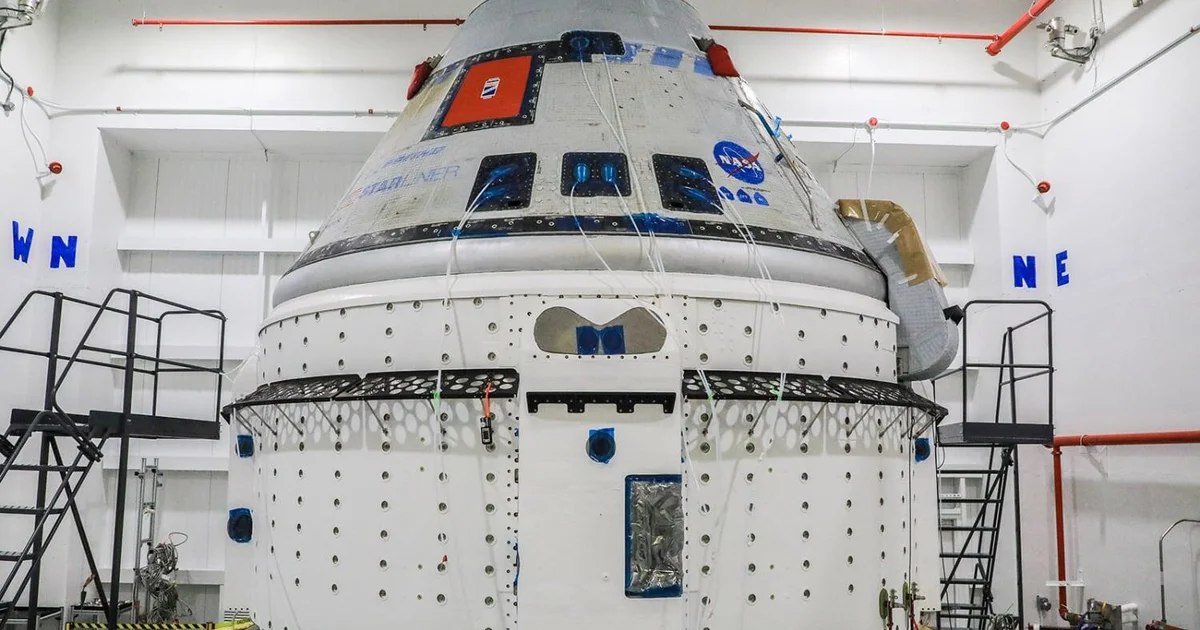
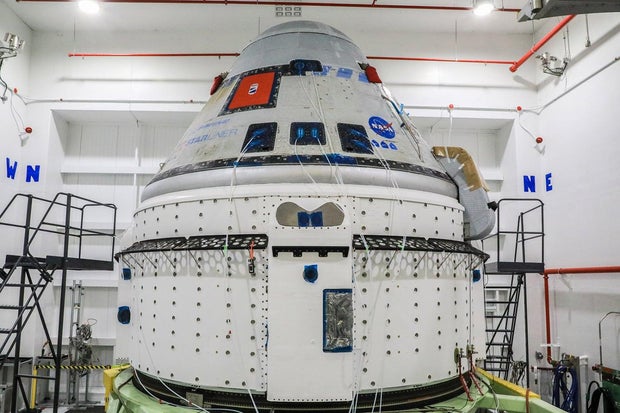
NASA and Boeing are targeting December or January for the launch of an uncrewed Starliner capsule, a test mission designed to evaluate upgrades ordered after a 2024 flight was hit by several propulsion-system failures and left two astronauts stranded on the space station for more than nine months.
If the uncrewed mission is successful, NASA and Boeing plan to launch a crewed Starliner in mid-2028, officials said Monday. That spacecraft would feature redesigned propulsion valves, stronger subsystems and other changes intended to prevent the failures seen in 2024. Veteran astronaut Warren “Woody” Hoburg is slated to command the flight.
SpaceX’s Crew Dragon is currently the only operational U.S. spacecraft capable of ferrying astronauts to and from orbit. NASA is eager to restore Boeing as a second provider, helping maintain a reliable American transportation option for astronauts and researchers traveling to the International Space Station before its planned retirement in 2030.
Boeing
NASA managers are also looking beyond the space station era. They want an American crew spacecraft ready to support missions to commercial space stations later in the 2030s, after SpaceX eventually retires its Falcon 9 rockets and Crew Dragon vehicles.
“It’s always been the Commercial Crew Program’s goal to have two crew transportation providers to ensure commercial access to low Earth orbit,” said Dana Weigel, NASA’s manager of low-Earth orbit operations.
“As SpaceX has publicly stated, the Dragon and the Falcon won’t be around forever. Certifying Boeing’s Starliner is important for both supporting ISS and also for follow-on future commercial destinations,” Weigel said.
Boeing said in a post on X: “Together with @NASA, we’re making Starliner hardware enhancements and adding resources for human spaceflight certification. These changes support the spacecraft as a long-term provider of crewed missions to low Earth orbit.”
Astronauts Barry “Butch” Wilmore and Sunita Williams, who have since retired from NASA, launched aboard Starliner on June 5, 2024. Their mission to the International Space Station was expected to last just 10 days. It marked Starliner’s first crewed flight, following two uncrewed test missions that both encountered problems.
NASA
During the spacecraft’s approach to the station, Wilmore and Williams faced multiple helium leaks and thruster failures in the propulsion system. Starliner successfully docked, but their trip back to Earth was delayed repeatedly as NASA and Boeing investigated the problems and searched for solutions.
An independent review board later described the propulsion failures as a “close call” that placed the astronauts in danger.
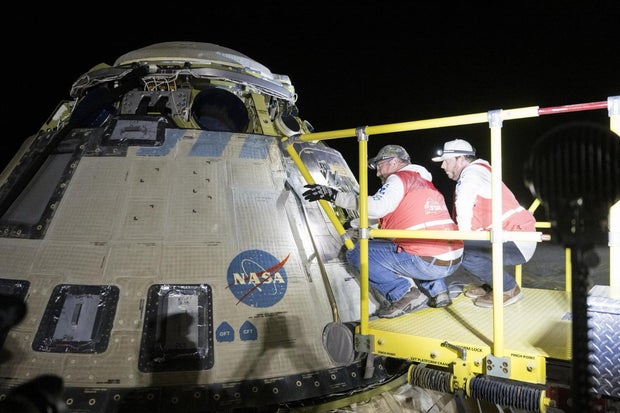
Ultimately, Starliner returned to Earth without its crew three months after launch. Wilmore and Williams remained aboard the space station for another six months before securing a ride home on a Crew Dragon on March 18, 2025. Their planned 10-day mission lasted 286 days in total.
The independent review board identified three primary Starliner problems, in addition to numerous less serious deficiencies that also required correction.
YOU MIGHT ALSO LIKE: Trump ‘Grand Conspiracy’ Case Falters as Lawyers Exit En Masse
Five thrusters in the capsule’s service module failed during its approach to the space station, temporarily depriving the spacecraft of full maneuvering capability. Investigators attributed the failures to Teflon “poppets” extruding inside propellant valves and restricting the flow of fuel.
Another thruster failed in Starliner’s crew module during the spacecraft’s uncrewed descent to Earth, eliminating redundancy in a critical system, the review board reported. The third major problem involved helium leaks in the plumbing used to pressurize the propulsion system.
The board also found that Starliner lacked the necessary redundancy in the system that fires the rocket needed to push the spacecraft out of orbit.
NASA
Boeing said it is addressing each of those concerns, along with operational changes aimed at reducing unexpected heating that contributed to the thruster failures.
The company is replacing the valves on all 12 crew-module maneuvering thrusters and adding protections against erosion. It is also redesigning the poppets in the service-module thrusters. Other upgrades include a faster flight-data recorder to capture more precise thruster performance measurements, improved batteries and upgraded parachutes.
NASA and Boeing plan to launch the uncrewed Starliner 1 mission in December or January. The spacecraft will rendezvous with and dock at the space station while flight controllers put its thrusters and pressurization systems through an extensive series of tests.
“Our goal is to fly Starliner One as soon as the vehicle and the team is ready,” Weigel said. “We really need to see how those thermal modifications perform on the spacecraft, and we intend to put the propulsion system through its paces.”
“We’ll do a series of on-orbit demonstrations and tests, stress the thrusters, and we’ll take that set of data coming out of the mission combined with redesign, and that’s what will inform the final crewed vehicle certification,” she continued. “We will fly the Starliner One mission with stricter performance parameters in place when we’re flying closer to [the] space station.”
“Long term, we are committed to Starliner certification and ensuring commercial crew access to low Earth orbit,” Weigel added.
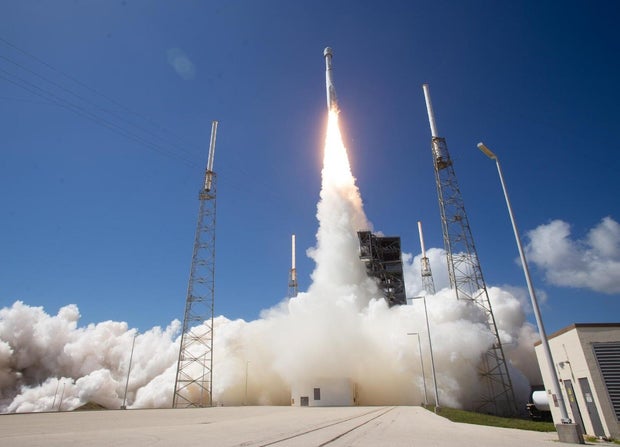
The Starliner has relied on United Launch Alliance’s Atlas 5 rockets for the ride to space, but only a half dozen of the venerable boosters remain in ULA’s inventory. As a result, NASA plans to help get ULA’s new Vulcan rocket certified to carry astronauts aboard Starliner capsules.
For its part, ULA said in a post on X that “we are already working towards the Starliner-1 mission and look forward to our continued work with @BoeingSpace and @NASA to integrate and certify our #VulcanRocket for human spaceflight.”
“We are committed to being a long-term launch provider of human spaceflight capability to low Earth orbit,” ULA added.