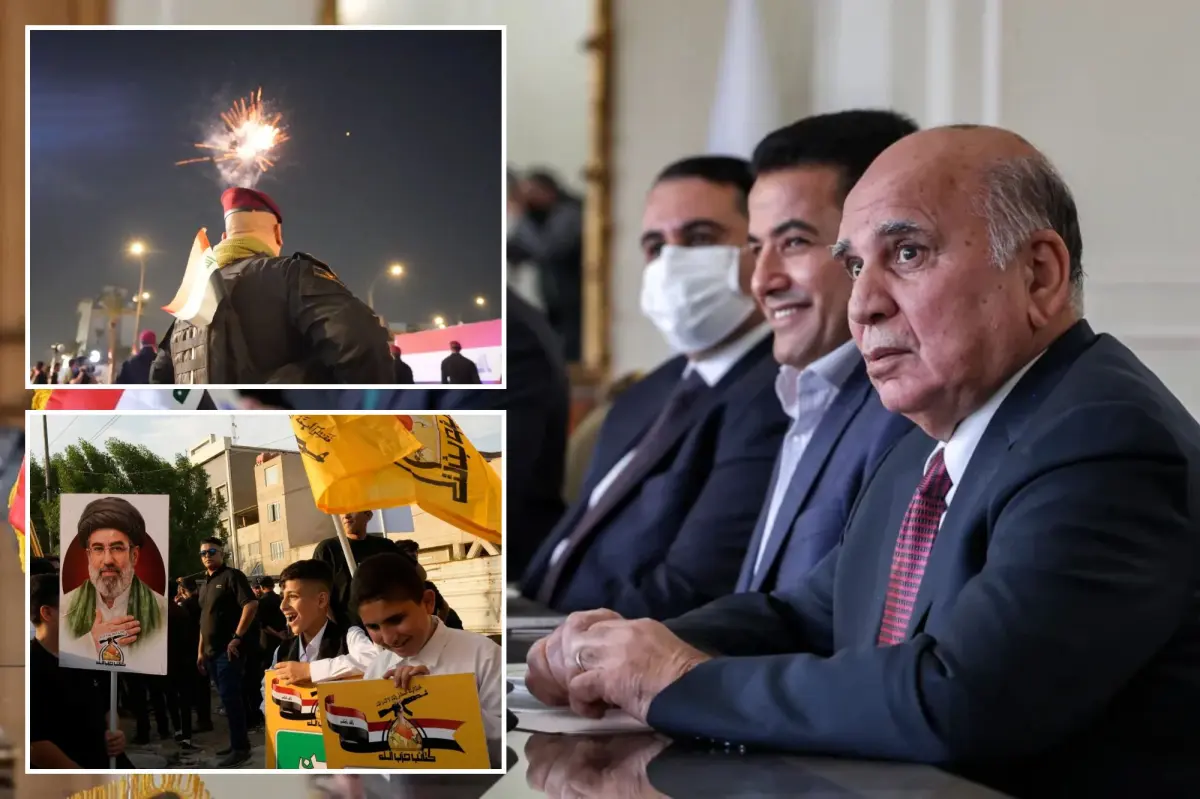
WASHINGTON — Iraq’s foreign minister said Thursday that his country has become a casualty of the conflict between the United States and Iran, signaling that Baghdad is hesitant to comply with US demands to impose sanctions on Iranian airlines. His comments came a day after President Trump announced that American troops would leave Iraq.
“Iraq became a victim of this war,” Foreign Minister Fuad Hussein told a small group of journalists at the Iraqi Embassy. He said the fighting had damaged both the nation’s economy and its people, adding that Iraq had been targeted repeatedly by different countries involved in the conflict.
Hussein was in Washington for meetings with senior officials at the Treasury and State departments. He said Iraq did not want to be drawn into the confrontation, but would be prepared to assist diplomatic efforts if both sides requested its help.
Treasury Secretary Scott Bessent is overseeing “Operation Economic Outcast,” a US campaign designed to isolate Tehran commercially and strengthen Washington’s negotiating position. Hussein, however, pushed back against efforts to cut off Iranian airlines, which he described as an important source of economic activity.
Hussein said most Iranians traveling to Iraq do so to visit religious shrines. He estimated that roughly 5 million Shiite pilgrims travel from Iran to Iraq each year, while approximately 3 million Iraqi pilgrims visit Iran.
“This is one of the most sensitive issues for us because it concerns the holy sites,” he said, warning that restrictions on air travel could create serious difficulties because of their direct connection to religious life and pilgrimage.
Hussein, a veteran Iraqi politician who is both Kurdish and Shiite, said Baghdad is working to preserve relationships with Washington and Tehran. At the same time, he argued that both countries bear responsibility for pulling Iraq into the conflict, which has continued for more than seven months.
“Iraq has been attacked by countries involved in the conflict,” he said. “For a period, the Americans attacked Iraq, but the Iranians attacked Iraq as well.”
He stressed that Iraq is not a participant in the war and favors resolving the dispute through negotiations and direct dialogue. Baghdad, he added, is not trying to interfere in US domestic or foreign-policy decisions.
Hussein acknowledged that Washington and Tehran share some interests while remaining divided on other major issues.
“Our mission is to expand the areas where they agree,” he said. “We want both sides to talk, meet and negotiate.”
MUST READ: Is Lindsay Clancy Freed? All About the Duxbury Mother Accused of Killing Her 3 Children
On Wednesday, Trump hailed the withdrawal of US forces from Iraq after more than 20 years and praised the country’s new political leadership.
“This day is a victory for the United States. It’s a victory for Iraq and a decisive victory over ISIS,” Trump said. He described Prime Minister Ali al-Zaidi as a “fantastic guy,” a friend and a leader he had supported and endorsed from the outset.
Hussein, who has served as foreign minister since 2020, cautioned that the Islamic State remains a security concern. He said Syria could still be home to hundreds, or possibly thousands, of ISIS fighters.
If those militants managed to cross into Iraq, he warned, they could once again pose a serious threat to the country’s security.
US forces were deployed to Iraq from 2003 through 2011 after Saddam Hussein was removed from power, and returned in 2014 as part of the campaign against the Islamic State.
The Iraqi foreign minister offered a more optimistic view of Baghdad’s efforts to disarm Iran-backed militias. He also said the country’s oil exports were approaching levels seen before the war despite continued regional instability.
According to Hussein, between 2.5 million and 2.6 million barrels of Iraqi oil are currently passing through the Strait of Hormuz, with assistance from the United States. “We are thankful to them,” he said.
An additional 200,000 barrels per day are being transported through a pipeline to Turkey, which restarted operations in March after the war began. Plans call for that route to eventually carry as much as 700,000 barrels daily.
Iraq is also discussing new pipeline links with Syria and Jordan, Hussein said. The proposed projects would offer alternatives to the Strait of Hormuz, whose shipping routes have been disrupted by the conflict.
Last year, Iraq exported roughly 3.45 million barrels per day of crude oil.
Hussein also revealed that he had just spoken with the Iraqi prime minister and learned that a fifth Iran-backed militia group had agreed to disarm by next summer, leaving two holdouts.